
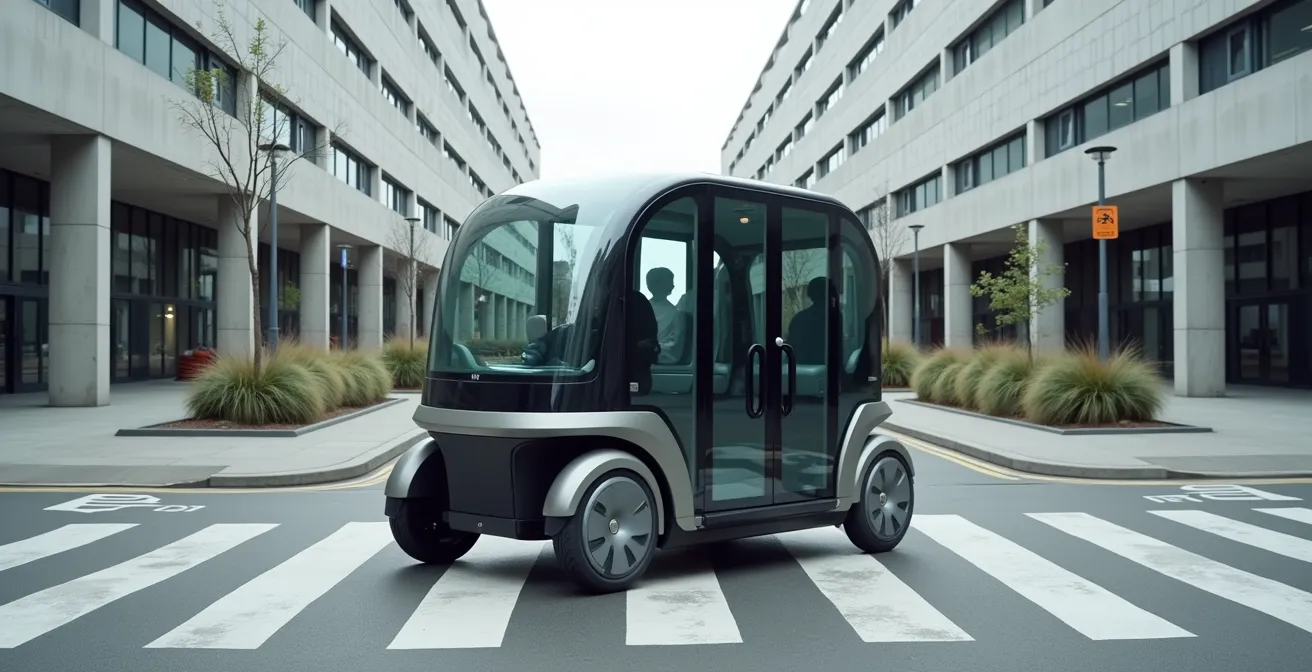
The real test of the Milton Keynes pods isn’t their onboard technology, but the strength of the complete “safety ecosystem” built around them.
- UK law makes insurers, not manufacturers, the first point of contact for any accident, simplifying claims for victims.
- The pods’ safety relies heavily on Milton Keynes’ unique grid layout and smart road infrastructure, which cannot be easily replicated elsewhere.
Recommendation: Judge the pods not just on their performance, but on the transparency of the operator and the clarity of the city’s long-term transport strategy.
The sight of a small, futuristic pod gliding silently along the pavements of Central Milton Keynes is no longer science fiction. For residents and visitors, it’s a tangible glimpse into the future of urban transport. But with this innovation comes a critical question that cuts through the technological excitement: are these self-driving vehicles genuinely safe for the pedestrians they share space with? While many discussions focus on the pods’ sensors and software, this is a narrow view.
The true measure of pedestrian safety isn’t found inside the vehicle alone. It lies within a complex, often invisible, ecosystem of law, infrastructure, and public trust that surrounds it. To understand the risk, we must look beyond the pod and investigate the entire system. Are the laws robust enough to protect victims? Is our city’s infrastructure truly “smart” enough to support them? And critically, have the architects of this future done enough to earn our trust?
This report moves beyond the technical specifications to dissect this safety ecosystem. We will investigate the crucial question of liability, examine the state of our infrastructure, and explore the psychology of trusting a machine with our safety. Only by understanding this complete picture can we, the residents of Milton Keynes, make an informed judgement on the autonomous revolution happening on our doorsteps.
To provide a complete and structured answer, this investigation will explore the key components of the autonomous vehicle safety ecosystem. The following sections break down everything from the legal framework to the long-term vision for our city.
Summary: Are Self-Driving Pods in Milton Keynes Safe for Pedestrians?
- If a Self-Driving Car Hits You, Who Pays: The Manufacturer or the “Driver”?
- Level 3 vs Level 5:How to Host a Corporate Event in a Grade I Listed Venue Without Breaching Preservation Rules?
- Smart Roads: Why Autonomous Cars Need 5G and Better Line Markings?
- Truck Platooning: Will Autonomous Lorries Replace Drivers on the M1?
- The Psychology of Trust: Would You Put Your Child in a Self-Driving Taxi?
- The Helmet Dilemma: How to Protect Your Head When Using Spontaneous Hire Bikes?
- Diesel Surcharges: Why Your Parking Permit Costs More Than Your Petrol Car?
- Lime vs Forest: Which Dockless E-Bike Subscription Offers Best Value in London?
If a Self-Driving Car Hits You, Who Pays: The Manufacturer or the “Driver”?
The single most important question for any pedestrian is what happens in a worst-case scenario. If an accident occurs, who is held responsible? The fear of a complex and costly legal battle with a multinational tech giant is a significant barrier to public acceptance. However, the UK has proactively created a legal “liability shield” to protect victims and simplify this process. The answer is surprisingly straightforward: you will deal with an insurer, not a manufacturer.
This is enshrined in law. A key parliamentary briefing paper clarifies that under the Automated and Electric Vehicles Act 2018, all claims for accidents involving autonomous vehicles in the UK are channelled through the vehicle’s insurer. The goal is to provide a single, clear point of contact for compensation, preventing victims from being caught in a dispute between the carmaker, the software developer, and the owner.
This principle is designed to keep the process within a familiar framework for the public. As the House of Commons Library explains, the legislation is designed to ensure the process feels like a standard motor insurance claim, not a complicated product liability case.
The intention behind the legislation is to emphasise that if there is an insurance ‘event’ (accident) the compensation route for the individual remains within the motor insurance settlement framework, rather than through a product liability framework against a manufacturer.
– House of Commons Library, Parliamentary Research Briefing on AEVA 2018
In Milton Keynes, this legal theory is put into practice. The pod trial operates under a specific public liability insurance policy. The operator, Aurrigo, holds the direct responsibility for any incidents involving pedestrians, providing a clear line of accountability for local residents.
Level 3 vs Level 5:How to Host a Corporate Event in a Grade I Listed Venue Without Breaching Preservation Rules?
While the title of this section appears to blend urban mobility with heritage management, the core technological question is about the different levels of vehicle autonomy. The SAE International scale defines five levels, from Level 1 (basic driver assist) to Level 5 (full automation anywhere, anytime). The public conversation often jumps to the idea of Level 5 vehicles, but the reality for Milton Keynes and the UK is more focused and pragmatic.
The UK’s strategy and investment is heavily concentrated on Level 4 autonomy. This means the vehicle can operate without a driver but only within a specific, well-defined operational design domain (ODD)—like a university campus, a city centre, or a dedicated motorway lane. This is precisely the model being used for the MK pods. They are not designed to go anywhere; they are designed to operate flawlessly within a pre-mapped, controlled environment. This distinction is crucial for pedestrian safety, as it limits the variables the vehicle must contend with. The UK government projects that this focused approach will create a significant industry, with Level 4 autonomous vehicles potentially generating 38,000 jobs and a £42 billion market by 2035.
Visually, the difference between a controlled Level 4 zone and the chaos of a typical UK street is stark. The success of the former depends on its separation from the latter.
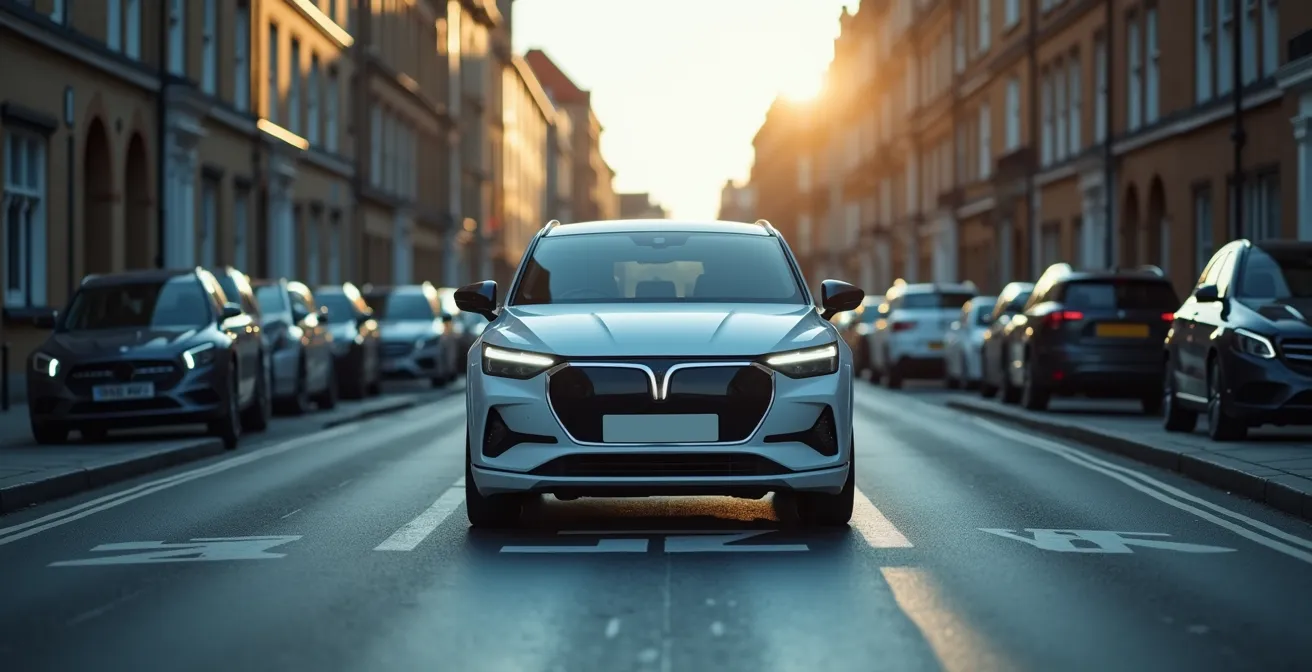
This image metaphorically represents the UK’s strategy: creating pockets of high-tech, predictable order within a broader, more complex transport network. The safety of the MK pods, therefore, is not just about the vehicle’s “level,” but about the integrity and management of its designated zone. For pedestrians, this means the pod’s behaviour should be highly predictable and reliable as long as it stays within its known operating area.
Smart Roads: Why Autonomous Cars Need 5G and Better Line Markings?
A self-driving pod is only as smart as the environment it operates in. While the vehicles are packed with sensors like LIDAR and radar, their safety and efficiency are dramatically enhanced by a concept one might call “Infrastructure-as-a-Sensor.” The road itself, with its markings, connectivity, and data feeds, becomes an active part of the safety ecosystem. Milton Keynes’ inherent design as a “new town” gives it a huge advantage in this area.
The pods are programmed with a pre-mapped environment, but this digital twin must perfectly match the physical world. Faded line markings, unexpected roadworks, or poor GPS signals in urban canyons can create uncertainty. This is where Milton Keynes’ modern infrastructure becomes a critical safety feature. As noted by IEEE Spectrum, the city is actively working with researchers to model future infrastructure needs and is already upgrading its Urban Traffic Management Center to handle large numbers of autonomous vehicles. This centralised control system can communicate hazards or route changes to the entire fleet instantly.
The difference between Milton Keynes’ purpose-built environment and that of a more traditional UK town is a crucial factor in the viability of autonomous technology. This is not just about road layout but the entire digital and physical infrastructure stack.
| Infrastructure Element | Milton Keynes | Traditional UK Towns |
|---|---|---|
| Road Layout | Grid system, wide paths | Narrow, historic streets |
| Line Markings | Modern, well-maintained | Often faded after winter |
| 5G Coverage | Urban centre covered | Patchy coverage |
| GPS Accuracy | High in open grid | Poor in narrow streets |
This table illustrates why Milton Keynes is a prime testbed. Its wide, clearly marked paths and strong 5G coverage create a highly reliable environment for the pods’ sensors and navigation systems. For a pedestrian, this means the pod is operating with a much higher degree of certainty about its surroundings, reducing the chance of erratic or unexpected behaviour.
Truck Platooning: Will Autonomous Lorries Replace Drivers on the M1?
While pedestrian pods in a city centre seem a world away from lorry convoys on a motorway, they are two sides of the same autonomous coin, and the lessons from one inform the other. The M1 motorway, a vital artery running past Milton Keynes, has been a testing ground for HGV platooning, and its challenges highlight the core principle of “systemic readiness.” The technology might be ready, but is the environment?
The economic incentive for freight automation is immense. Globally, the International Road Transport Union reported 3 million truck driver jobs were unfilled in 2023, a shortage that automation promises to solve. However, the UK’s M1 platooning trials demonstrated that motorway driving in Britain presents unique challenges not found in wide-open American highways. The high frequency of junctions, complex interchanges, and the unpredictable behaviour of other drivers cutting into convoys proved difficult for the system to manage.
The trials concluded quietly, with the consensus shifting towards a more practical, hub-to-hub model. This is a form of Level 4 autonomy: for instance, an automated lorry driving a specific, controlled route from the Port of Felixstowe to a distribution centre in the Midlands. This mirrors the MK pod strategy: success comes from limiting the operational domain to a predictable environment.
For the Milton Keynes resident, this is reassuring. It shows that the UK’s approach to automation, whether for lorries or pods, is not a reckless deployment of new technology. It is a cautious, evidence-based process that prioritises finding safe, manageable applications over chasing a futuristic vision of full autonomy everywhere. The challenges on the M1 reinforce the need for the controlled, “smart road” environment found in the city centre.
The Psychology of Trust: Would You Put Your Child in a Self-Driving Taxi?
Ultimately, the success of the Milton Keynes pods will not be decided by engineers or politicians, but by the public. If people don’t trust the technology, they won’t use it, and they will resist its expansion. Building this “trust threshold” is a psychological challenge as much as a technical one. It requires transparency, positive exposure, and a clear demonstration of safety in the real world.
Direct experience can be a powerful tool for building trust. In a parliamentary debate, Sarah Coombes MP recounted her own journey in an autonomous vehicle, which successfully navigated a chaotic urban environment, inspiring confidence.
Lots of people might feel reticent to get in a self-driving car because they do not feel safe, but I found my own experience yesterday in a Wayve autonomous vehicle reassuring. During the journey, we had cyclists jumping red lights, pedestrians walking out on to the road and other drivers cutting across our right of way. The car dealt with it all.
– Sarah Coombes MP, UK Parliament Westminster Hall Debate
Beyond individual experiences, systemic trust is built through consultation. The Law Commission’s work on public acceptance was extensive, involving 404 written responses and 350 stakeholder meetings to ensure the new legal frameworks reflect public concerns. Another key aspect is the vehicle’s ability to communicate its intentions to pedestrians. This human-machine interface can be as simple as a light pattern or a sound, but it is crucial for making the vehicle’s actions predictable and less intimidating.

This abstract communication, showing the pod is aware and responding to its environment, is a subtle but powerful trust-builder. It turns the pod from an unfeeling machine into a predictable road user.
Your Action Plan: How to Assess Autonomous Vehicle Safety Yourself
- Points of contact: Observe the vehicle’s external signals. Does it have lights, sounds, or displays to clearly indicate its intent to stop, turn, or yield to you?
- Collecte: Look up the operator (e.g., Aurrigo in MK). What is their published safety record? Is information about the trial’s performance publicly and easily available?
- Cohérence: Watch its behaviour from a safe distance. Does it act predictably around other pedestrians and cyclists, and does its driving seem consistent with the Highway Code?
- Mémorabilité/émotion: How does its presence make you feel? Does its movement seem hesitant and jerky, or confident and smooth? This emotional response is a valid data point for your personal trust level.
- Plan d’intégration: Check the council’s website. Is there a clear contact for questions or concerns? Is the trial presented as part of a wider, published transport strategy for the city?
The Helmet Dilemma: How to Protect Your Head When Using Spontaneous Hire Bikes?
While we contemplate the future risks of autonomous pods, it’s essential to ground the discussion in the present-day reality of our streets. The introduction of any new mobility form, from e-scooters to hire bikes, raises safety questions. By examining the existing dangers pedestrians face, we can better appreciate the safety-first design philosophy behind the Milton Keynes pods.
The debate over helmets for hire bikes highlights a familiar tension between convenience and safety. However, the most significant risk in the urban environment is often not from these new devices, but from traditional traffic. The latest UK government road safety statistics show that in 2024, 409 pedestrians were killed and 5,823 were seriously injured on Britain’s roads. These sobering figures provide a crucial context for the push towards autonomous technology, which proponents argue could drastically reduce human-error accidents.
Unlike some other mobility innovations that appeared in cities with little warning, the Milton Keynes pods have been developed through a process of extensive public consultation. Planners have actively engaged with the community, particularly with groups representing those who might be most vulnerable. The pods are designed from the ground up with pedestrian interaction in mind.
For example, extensive consultations were held with disability groups to address concerns for people with visual or hearing impairments. As a result, the pods are designed to slow down and stop if their path is blocked, and they emit a low humming noise to alert nearby pedestrians of their presence—a feature not present on a bicycle. This proactive, safety-conscious design process stands in contrast to the more reactive safety debates surrounding other forms of micro-mobility.
Diesel Surcharges: Why Your Parking Permit Costs More Than Your Petrol Car?
At first glance, parking permit costs and diesel surcharges seem unrelated to self-driving pods. However, they are a key part of the same story: the radical rethinking of the private car’s role in the city centre. Policies that discourage car ownership and use, like emissions-based parking fees, create a vacuum that new forms of transport—like the MK pods—are designed to fill.
The long-term vision for Milton Keynes, enabled by autonomous technology, is a city centre that prioritises people over parking spaces. The current landscape, with its vast surface car parks, is seen by planners as a significant opportunity for redevelopment. An analysis of the city centre revealed that over 20,000 parking spaces could be repurposed for business, leisure, and green spaces, transforming the urban experience.
This ambition is not just a dream; it’s a strategic goal. The head of Transport Innovation at Milton Keynes Council, Brian Matthews, explicitly connects this vision to the role of autonomous vehicles.
That could someday allow planners to ban cars from operating in the Central Business District and other parts of the city center. And the land area that is currently taken up by more than 20,000 parking spaces in the city center could be repurposed for business, leisure and retail development. ‘We might want cars to drop off people at the edge of the city, and then take a pod or walk or cycle,’ Matthews says.
– Brian Matthews, Head of Transport Innovation, Milton Keynes Council
In this context, the self-driving pods are not just a novelty; they are a crucial piece of “last-mile” infrastructure. They provide the convenient, on-demand transport required to make a car-free city centre viable. Therefore, for a pedestrian, the pods represent more than just a new vehicle to watch out for; they are the key to a future with cleaner air, less traffic, and more public space.
Key Takeaways
- Legal clarity is paramount: The AEVA 2018 Act ensures victims have a clear compensation route via insurers, not manufacturers.
- Infrastructure is non-negotiable: The success in Milton Keynes is intrinsically tied to its unique grid system and ongoing smart city upgrades.
- Public trust is earned: Transparency, real-world demonstrations, and stakeholder consultation are as crucial as the technology itself.
Lime vs Forest: Which Dockless E-Bike Subscription Offers Best Value in London?
Comparing different e-bike providers in London may seem a long way from the pavements of Milton Keynes, but it highlights the dominant trend shaping our urban future: Mobility as a Service (MaaS). The idea of owning a single vehicle for all journeys is being replaced by a flexible model where people access a variety of transport options—e-bikes, e-scooters, car shares, and autonomous pods—through a unified service. The question is no longer “which car to buy?” but “which service is best for this specific journey?”
Milton Keynes is not just trialling pods; it is building a comprehensive, integrated MaaS ecosystem. The pod project is a core component of a wider “Street Connected and Autonomous Vehicles project,” which aims to weave these new services into the fabric of the city’s transport network. This is not a standalone experiment but a strategic step towards a more connected future.
A new trial of larger, fully accessible autonomous shuttles is the next evolution. These eight-passenger vehicles will operate in the city centre with multiple pick-up and drop-off points, functioning like a true public transport service. The initial mapping for these shuttle routes is already underway, with passenger services expected to launch soon. This demonstrates a clear, iterative plan for scaling up autonomous services in a way that is integrated and serves the public good.
For pedestrians, this integrated approach is the ultimate safety guarantee. It ensures the pods are not a disruptive afterthought but a planned part of a managed system. They will operate on defined routes, as part of a public service, and within the same regulatory and data ecosystem as other transport modes. This systemic approach, where every piece of the puzzle is designed to work together, is what ultimately ensures that the autonomous future is a safe one for everyone.
The journey towards an autonomous future is an incremental one. By understanding the complete ecosystem—from legal protections to infrastructure and public trust—Milton Keynes residents can move from being wary observers to informed participants in this transport revolution. To take the next step, explore the official transport strategy on the Milton Keynes City Council website.