
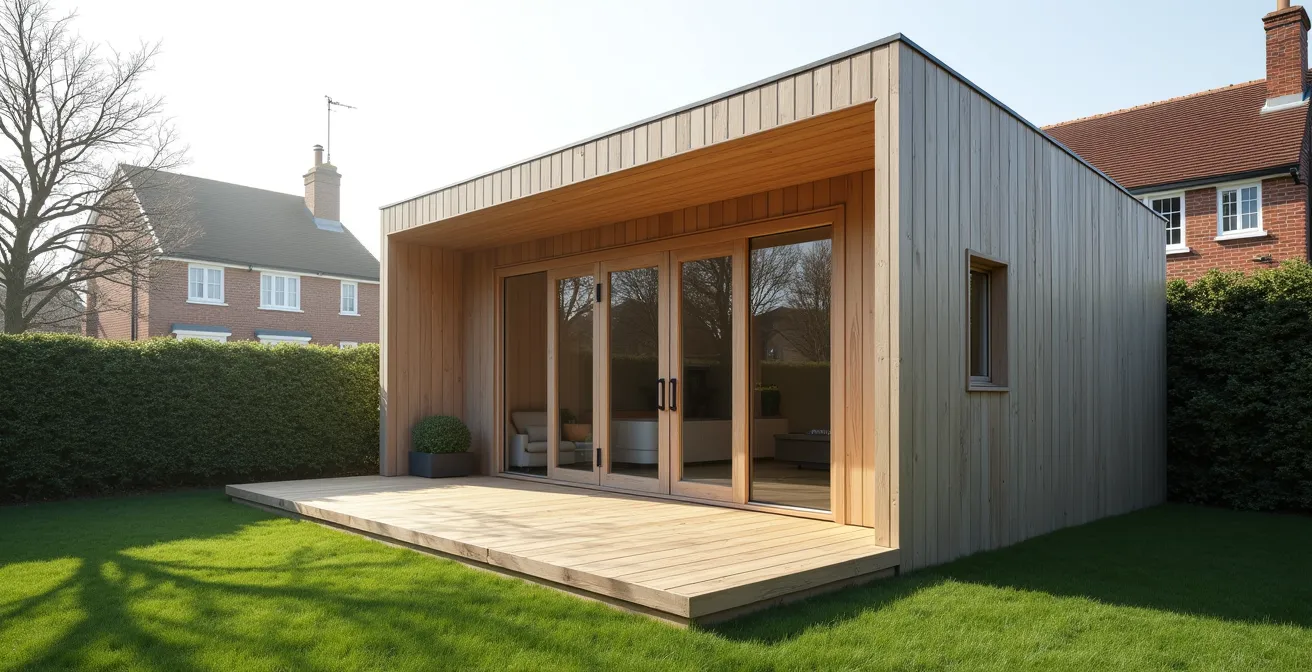
Building a garden office with a toilet is less about planning permission and more about avoiding a surprise Council Tax bill.
- The key is “incidental use”; adding a toilet can suggest the building is self-contained ancillary accommodation, not incidental to the main house.
- This can trigger the Valuation Office Agency (VOA) to assign it a separate Council Tax band, potentially costing over £1,500 annually.
Recommendation: Prioritise proving ‘incidental use’ over simple size compliance to protect your property’s value and avoid long-term financial penalties.
The dream of a short commute across the lawn to a fully functional, self-contained garden office is compelling for any freelancer. The idea of having a toilet and washing facilities within that space feels like a non-negotiable part of creating a truly independent workspace. However, this small addition is the precise detail that can escalate a simple project into a complex regulatory minefield. Many guides focus on basic size and height restrictions, suggesting that if your building is small enough, you are in the clear. This is a dangerously simplistic view.
The reality is governed by a ‘Regulatory Triad’: Planning Permission, Building Regulations, and your insurer’s policy. These three systems operate independently, and satisfying one does not guarantee compliance with the others. More critically, a fourth, often overlooked player enters the game when a toilet is installed: the Valuation Office Agency (VOA). Their interpretation of your garden room as “self-contained accommodation” can lead to the ‘VOA Trap’—a separate Council Tax liability that creates a significant, ongoing financial burden.
This article moves beyond the platitudes of “it depends on the size.” We will dissect the crucial difference between ‘incidental use’, which is generally allowed under Permitted Development rights, and ‘ancillary use’, which requires full planning permission. We will explore how each choice—from the type of electrical cable you run to the cladding you choose—has consequences that ripple through this regulatory landscape. The goal is to provide you with the strategic clarity needed to build a valuable asset, not a future financial liability.
This guide breaks down the essential considerations for your project, from the foundational infrastructure to the long-term financial implications. By understanding how each element is scrutinised by different authorities, you can navigate the process with confidence.
Summary: A Guide to Building a Compliant Garden Office with a Toilet
- Armoured Cables and Cat6: Powering Your Garden Office Correctly
- SIPs vs Timber Frame: Which Construction Keeps a Garden Room Warm?
- The 2.5 Metre Rule: How Close to Your Boundary Can You Build?
- Insurance for Outbuildings: Is Your Equipment Covered?
- Cedar vs Larch: Choosing Cladding That Lasts
- Managing Power Supply for a Self-Contained Office
- The Council Tax Trap: Avoiding a Separate Bill for Your Garden Office
- Garden Office vs. Loft Conversion: Which Adds More Value?
Armoured Cables and Cat6: Powering Your Garden Office Correctly
Before considering the structure itself, the first logistical challenge is providing safe and reliable power. A garden office with a toilet, heating, and computer equipment cannot simply run off an extension lead from the house. A permanent, professional installation is a legal requirement under Part P of the Building Regulations in England and Wales, which governs electrical safety in dwellings.
This involves running a Steel Wire Armoured (SWA) cable from your main consumer unit (fuse box) to a new, separate consumer unit inside the garden office. This ensures the office has its own dedicated circuits, protected by an RCD (Residual Current Device), preventing any electrical faults from affecting the main house. The cable must be buried at a regulation depth (typically at least 400mm) to prevent accidental damage. For a modern freelancer, running a Cat6 data cable alongside the power cable is essential for a stable, hard-wired internet connection, but care must be taken to maintain separation to avoid interference.
While planning permission isn’t needed for the electrical work itself, compliance with Building Regulations is mandatory. Failure to obtain a Part P certificate from a qualified electrician will cause significant issues when you come to sell your property. It’s also worth noting the distinction made in building regulations; buildings under 15 square metres are exempt from building regulations unless they contain sleeping accommodation. However, the presence of a mains water connection for a toilet often brings the project back under the scrutiny of Building Control, regardless of size.
SIPs vs Timber Frame: Which Construction Keeps a Garden Room Warm?
A garden office must be a comfortable workspace year-round, making insulation a primary concern, especially in the UK. The choice of construction method has the single biggest impact on thermal performance. The two dominant methods are traditional timber framing and modern Structural Insulated Panels (SIPs). While both can achieve high levels of insulation, their approaches and performance differ significantly.
A timber frame construction creates a wooden skeleton which is then filled with insulation batts (like mineral wool or rigid foam boards) between the studs. While effective, the wooden studs themselves can act as “cold bridges,” points where heat can escape more easily. Achieving high thermal efficiency requires careful detailing and often thicker walls. In contrast, SIPs are prefabricated panels made of a rigid foam insulation core sandwiched between two layers of Oriented Strand Board (OSB). This creates a continuous, highly insulated, and airtight shell with minimal cold bridging.
This schematic shows the layered composition of a typical SIP, highlighting the continuous foam core that provides its superior thermal performance.

The superior thermal efficiency of SIPs not only reduces heating costs but also helps protect the plumbing for your toilet from freezing in winter. While timber framing may have a lower initial cost, the long-term energy savings and consistent comfort offered by a SIPs construction often provide a better return on investment for a building intended for all-day, year-round use.
This table provides a clear comparison of the key differences:
| Feature | SIPs Construction | Timber Frame |
|---|---|---|
| U-Value Achievement | 0.15-0.20 W/m²K typical | 0.25-0.35 W/m²K typical |
| Cold Bridging Risk | Minimal (continuous insulation) | Higher (at frame joints) |
| Build Speed | 2-3 days assembly | 5-7 days assembly |
| Cost per m² (2024) | £1,800-£2,500 | £1,200-£1,800 |
| Frozen Pipe Protection | Excellent thermal mass | Requires additional insulation |
The 2.5 Metre Rule: How Close to Your Boundary Can You Build?
One of the most critical rules governing garden buildings under Permitted Development rights is the height restriction, particularly when building close to a boundary. The rule is straightforward: if any part of your garden office is within 2 metres of a boundary, its overall height cannot exceed 2.5 metres from the highest adjacent natural ground level. This rule applies to all boundaries, whether they border a neighbour’s garden, a public footpath, or a road.
This single regulation heavily influences the design of your garden office. To maximise internal headroom while staying compliant, many suppliers use a flat or single-pitched (pent) roof design rather than a traditional dual-pitched (apex) roof, which would likely exceed the 2.5m limit. It’s also vital to understand that the measurement is taken from the natural ground level, not from any artificial base like decking or a raised concrete slab you might install. If your garden slopes, this measurement must be taken from the highest point of ground the building touches.
Case Study: The Compliant London Garden Office
A London homeowner successfully built a garden office with a toilet within 2 metres of their boundary by adhering strictly to the 2.5m height limit. By choosing a modern pent roof design, they achieved a generous 2.2m of internal height. To gain absolute certainty, they applied for a Lawful Development Certificate (LDC) from their local council. For a fee of around £100-£200, this provided official confirmation that the build was compliant, removing any legal ambiguity for future property sales.
While adding a toilet does not change the 2.5m height rule itself, it does trigger the need for Building Regulations approval for sanitation and drainage, a separate process from planning. It is also good practice to inform your neighbours of your plans as a courtesy, even if you are building within your Permitted Development rights.
Insurance for Outbuildings: Is Your Equipment Covered?
A common and costly oversight is assuming that your standard home insurance policy automatically covers a high-value garden office and its contents. While most policies include some cover for outbuildings, it is often minimal and completely inadequate for a purpose-built office containing thousands of pounds worth of computer equipment, furniture, and professional gear.
Standard policies may only cover contents in outbuildings up to a limit of £1,000 or £2,500, and often exclude high-risk items like laptops and electronics unless they are specifically listed. Furthermore, the ‘security’ of the outbuilding is a key factor. An insurer will expect the building to have high-quality, key-operated locks on all doors and windows, matching the security of the main house. A simple shed lock will not suffice.
The most critical factor, however, is compliance. If your garden office was built in breach of planning permission or Building Regulations, it could invalidate your entire claim. An insurer can argue that the non-compliant nature of the structure contributed to the loss, whether through fire from faulty electrics or by making it an uninsurable risk from the outset. This is where the paper trail of compliance, such as a Part P electrical certificate or a Lawful Development Certificate, becomes invaluable.
This warning from industry experts underscores the risk:
Building a garden office with a toilet without the necessary planning permission can give UK insurers grounds to void a future claim for theft, fire, or flood.
– Insurance industry guidance, Garden Office Planning and Insurance Requirements
You must contact your insurer before construction begins. You will likely need to either add a specific extension to your existing policy or take out a separate, specialist policy to ensure your building and its valuable contents are adequately protected. The small cost of a formal planning application, which currently costs £258 in England, is minor compared to the risk of an uninsured loss.
Cedar vs Larch: Choosing Cladding That Lasts
The exterior cladding of your garden office defines its aesthetic, but the choice of timber is also a practical decision affecting longevity, maintenance, and even planning compliance. The two most popular premium choices in the UK are Western Red Cedar and British Larch. Both are durable softwoods that can be left untreated to weather naturally to a beautiful silver-grey, but they have distinct characteristics.
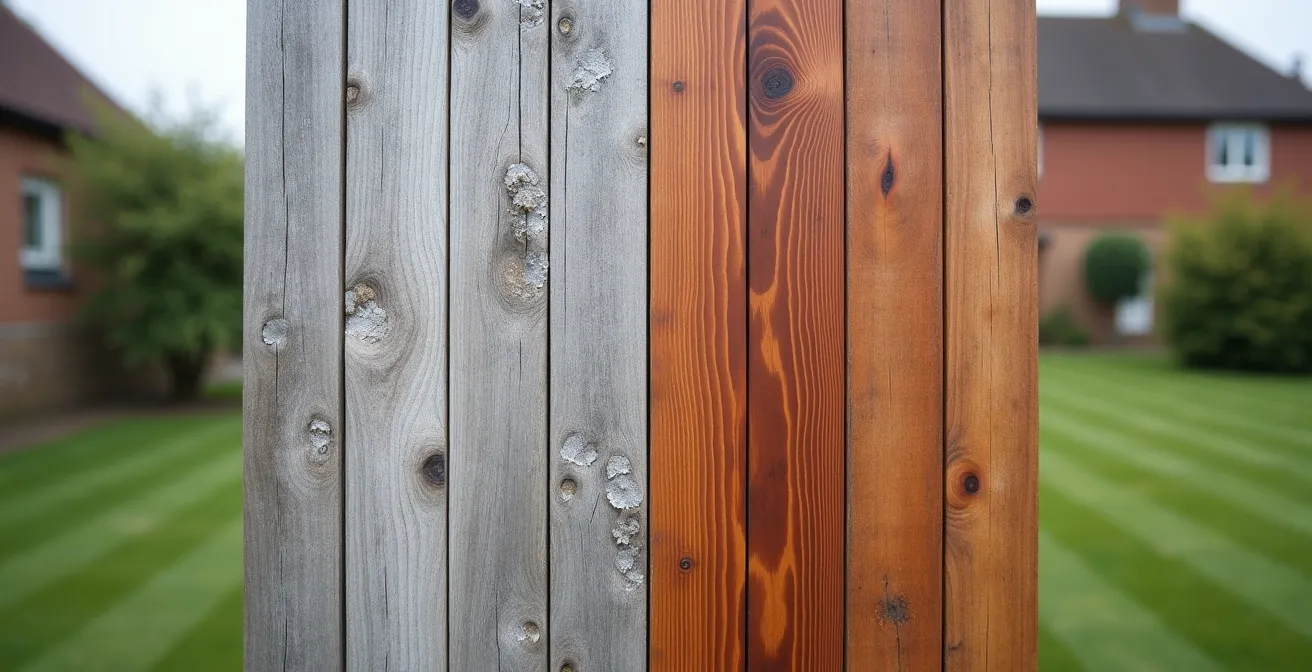
Western Red Cedar, typically imported from Canada, is renowned for its stability and natural resistance to rot and insects, thanks to its high content of natural preservative oils. It has a rich, warm colour palette ranging from reddish-brown to pink and weathers to a consistent, deep silver-brown. It is lightweight and easy to work with, but comes at a premium price. British Larch (and its Siberian counterpart) is a denser, tougher, and more cost-effective alternative. It has a more golden-yellow initial colour with more prominent grain patterns and knots. It weathers to a paler, more variable silver-grey and is more prone to natural ‘checking’ (small splits) as it dries.
This comparison shows the distinct weathered appearance of Larch (left) and Cedar (right), illustrating the different patinas they develop over time.
In some cases, the choice of cladding is not just a matter of preference. If your property is in a Conservation Area or an Area of Outstanding Natural Beauty (AONB), your Permitted Development rights are more restricted. The local planning authority may have a Design Guide that dictates the type of materials you can use, often favouring locally sourced or native species like Larch to maintain the area’s character. In these situations, applying for planning permission is almost always necessary, and your choice of cladding will be a key factor in gaining approval.
Case Study: Conservation Area Cladding Mandate
A homeowner in a Kent conservation area was required by the local planning authority to use British Larch for their garden office instead of their preferred Western Red Cedar. The authority’s guidelines explicitly favoured native timber to blend with the local vernacular. Despite the higher maintenance needs of larch compared to cedar, this choice was a non-negotiable condition for securing planning permission, demonstrating how external factors can override personal preference.
Managing Power Supply for a Self-Contained Office
A garden office with a toilet is no longer a simple shed; it’s a small building with significant power demands. A standard 13-amp feed is insufficient and dangerous. You must plan for the combined load of your computer, monitors, lighting, heating, and, crucially, the macerator pump for the toilet. A macerator pump, which is essential for handling waste when you can’t connect to a gravity-fed drain, has a high startup current that can easily trip a standard circuit.
Specialists note that a 5-7 amp startup current draw is typical for a toilet macerator pump. When you add a 2000W electric heater (approx. 8.7 amps) and computer equipment (approx. 2 amps), the total load can easily exceed the capacity of a 13-amp circuit, risking overload and fire. This is why a dedicated, high-capacity supply from the main house is not just recommended but a regulatory necessity.
A professional installation will involve a dedicated circuit from the house consumer unit, typically rated at 32 amps, run through a thick 6mm² (or even 10mm²) SWA cable. This cable feeds a new consumer unit inside the garden office, which then splits the power into separate, appropriately rated circuits: one for lighting, one for sockets, one for the heater, and a dedicated circuit for the sanitation pump. This segmentation ensures that a fault in one area doesn’t shut down the entire office and that high-draw appliances don’t interfere with sensitive electronics.
Action Plan: Professional-Grade Electrical Setup Checklist
- Calculate Total Load: Sum the wattage of all planned equipment. For example: Computer (300W) + monitors (200W) + heating (2000W) + macerator pump (600W peak) = 3100W minimum requirement.
- Install a Dedicated Circuit: A qualified electrician must install a new 32A circuit from the main house consumer unit. A simple spur from a house socket is not compliant or safe.
- Use Correct Cabling: Run a minimum 6mm² Steel Wire Armoured (SWA) cable to handle the 32A capacity and minimise voltage drop over the distance to the garden.
- Install a Separate Consumer Unit: The garden office must have its own consumer unit with multiple circuits (e.g., 16A for heating, 20A for sockets, 10A for the pump) for safety and stability.
- Obtain Certification: Ensure the electrician provides a Part P Electrical Safety Certificate on completion. This is a legal document required for Building Regulations compliance.
Key Takeaways
- The term “incidental use” is the most critical factor for Permitted Development. A garden office with a toilet and kitchen facilities risks being classified as a separate, ‘ancillary’ dwelling.
- The Valuation Office Agency (VOA) can assign a separate Council Tax band (e.g., Band A) to a garden room it deems self-contained, creating a significant annual cost.
- Compliance involves a ‘Regulatory Triad’: satisfying the Planning Authority, Building Control (for electrics and plumbing), and your Insurer. Fulfilling one does not guarantee approval from the others.
The Council Tax Trap: Avoiding a Separate Bill for Your Garden Office
This is the most significant and least understood financial risk of building a garden office with a toilet. While you may have successfully navigated planning permission and building regulations, the Valuation Office Agency (VOA) operates under a different set of rules. The VOA is the body that assesses properties for Council Tax purposes, and they have the power to classify your garden office as a separate, self-contained dwelling.
The trigger for this is whether the building constitutes “separate living accommodation”. While a toilet alone may not be enough, adding facilities for cooking and food preparation (even just a kitchenette with a sink and microwave) is often the red line. If the VOA decides your garden room is self-contained, it will be assigned its own Council Tax band, typically Band A. This can add a surprise bill of £1,500 or more per year to your household expenses, completely altering the financial viability of the project.
This is not a theoretical risk. Homeowners across the UK have been caught in this “VOA Trap,” receiving unexpected and back-dated Council Tax bills months or even years after their build was completed. The key to avoiding this is to ensure the use of the office remains strictly ‘incidental’ to the enjoyment of the main house. It should be a workspace, a gym, or a hobby room, not a potential micro-apartment.
Case Study: The £1,500 Annual Council Tax Mistake
A UK homeowner documented their costly experience online. They built a 30m² garden room complete with a toilet and a small kitchenette, believing it was covered by Permitted Development. The local Planning Authority did not object. However, the VOA later assessed the property and classified the outbuilding as self-contained ancillary accommodation due to the presence of the kitchen facilities. The building was assigned a separate Band A Council Tax rating, adding approximately £1,500 to their annual tax bill. This case serves as a stark warning about the critical importance of avoiding kitchen facilities to maintain ‘incidental use’ status.
Garden Office vs. Loft Conversion: Which Adds More Value?
When seeking to add functional space and value to your home, a garden office and a loft conversion are two popular but very different solutions. A loft conversion integrates space directly into the main dwelling, often adding a bedroom and bathroom, which typically provides a higher return on investment. However, it comes with significantly more cost, disruption, and regulatory hurdles.
A garden office offers a unique proposition: the creation of separate, dedicated space away from the main house. For the growing number of freelancers and remote workers, this separation is a major lifestyle benefit that also adds tangible value to the property. While the percentage of value added may be less than a loft conversion, the initial investment is also considerably lower, and the project can often be completed in weeks rather than months, with minimal disruption to the household.
Crucially, a well-designed, fully compliant garden office can add significant appeal to potential buyers. However, this value can be completely erased if the build is not compliant. Estate agents consistently warn that an outbuilding constructed without the correct planning permission or Building Regulations sign-off becomes a liability during a house sale. It can deter mortgage lenders, force the seller to purchase a costly indemnity policy, or even lead to demands for the structure to be removed at the seller’s expense.
This table compares the two options from an investment perspective:
| Factor | Garden Office with Toilet | Loft Conversion |
|---|---|---|
| Average Cost (2024) | £30,000-£50,000 | £50,000-£80,000 |
| Build Time | 2-4 weeks | 8-12 weeks |
| Planning Permission | Often not required | Usually required |
| Disruption to Home | Minimal | Significant |
| Added Property Value | 5-10% in London/SE | 10-20% in London/SE |
| Usable Space Added | 15-30m² separate | 20-40m² integrated |
Therefore, while a loft conversion might add more absolute value on paper, a compliant garden office provides a faster, more affordable way to add highly desirable, functional space. The key is that its value is entirely conditional on its legality.
Ultimately, building a compliant garden office with a toilet is an achievable goal, but it requires a strategic approach. By understanding the distinct roles of the Planning Authority, Building Control, and the VOA, you can navigate the process effectively. Prioritise full compliance and proper certification at every stage to ensure your new workspace is a long-term asset, not a source of future complications. To ensure your specific design meets all local requirements, obtaining professional advice or applying for a Lawful Development Certificate is the most secure next step.
Frequently Asked Questions About Garden Office Planning
How is the 2.5m height measured on sloping ground?
Height is measured from the highest natural ground level immediately adjacent to the building, not from an artificial raised platform or the lowest point of the slope.
Does the 2.5m rule apply to all boundaries?
Yes, if the building is within 2 metres of any boundary, the 2.5m maximum height rule applies. This includes boundaries with neighbours, public footpaths, or highways.
What if my garden office has a toilet – does this affect the 2.5m rule?
The height restriction for planning purposes remains the same. However, adding a toilet and a mains water connection will almost certainly trigger the need for Building Regulations approval for sanitation and drainage, which is a separate process from planning permission.