
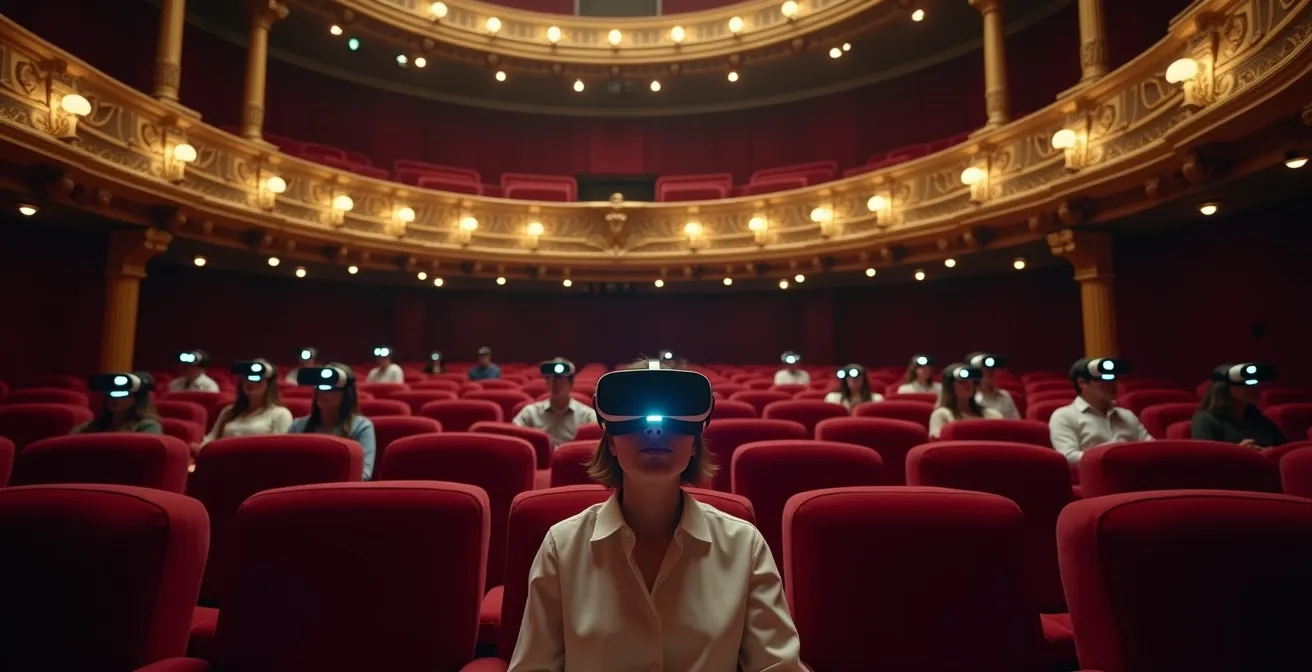
The soaring price of a West End ticket is no longer just about star power; it’s driven by a fundamental shift in value, where immersive technology is creating a new ‘experiential currency’.
- Productions increasingly use technology like VR and projection mapping not just as a spectacle, but to justify premium pricing based on unique, non-replicable audience participation.
- High-tech shows intentionally create scarcity—through limited capacity and promenade formats—turning attendance into a status-defining experience akin to collecting art.
Recommendation: When choosing a show, evaluate the ticket price not just on the seat, but on the ‘sensory bandwidth’ offered. Are you paying to passively watch, or to actively participate in the creation of a unique memory?
You see the price for a new West End show and the number makes you pause. It’s a familiar feeling for any London theatre-goer. The immediate assumption is to blame the usual culprits: the A-list actor headlining the cast or the prime real estate of the theatre itself. For years, these have been the primary drivers of cost. But a new, powerful force is at play, and it’s visible in the glow of VR headsets and the sweeping dance of light across the stage.
Immersive technologies—virtual reality, projection mapping, holograms—are no longer a novelty. They are a core component of production design, and with them comes a new financial logic. The conversation is shifting away from simply covering the cost of expensive hardware. Instead, we are witnessing a complete re-engineering of the ‘value contract’ between the production and its audience. The question is no longer just “what am I watching?”, but “what am I part of?”.
If the old currency of theatre was star power, the new currency is experience. This article, from the perspective of a production design critic, will dissect this new economic and artistic model. We will explore how technology is not merely inflating costs, but creating a new justification for them, built on principles of participation, manufactured scarcity, and the profound psychology of audience trust.
This analysis will guide you through the intricate relationship between technology and ticket price. By examining specific examples and the financial structures that support them, you will gain a clearer understanding of the value proposition behind the West End’s most innovative—and often most expensive—productions.
Table of Contents : An Analysis of Tech-Driven Value in London Theatre
- Why Certain West End Productions Use VR Headsets Instead of Physical Sets?
- Stalls vs Circle: Where to Sit for the Best Projection Mapping Effects?
- The Safety Briefing: What You Must Know Before Entering a Promenade Performance?
- Classic Plays vs Tech-Heavy Retellings: Which Is Better for First-Time Theatre Visitors?
- When Will Holographic Actors Be Standard in Regional Theatres?
- The Psychology of Trust: Would You Put Your Child in a Self-Driving Taxi?
- What Does “Audience Development” Mean in an Arts Council Bid?
- How to Buy Your First Original Artwork from an Independent Gallery for Under £500?
Why Certain West End Productions Use VR Headsets Instead of Physical Sets?
The decision to replace a tangible, physical set with a virtual reality headset is one of the boldest moves in modern production design. It is not, as some might assume, a simple cost-cutting measure. While it circumvents the need for elaborate construction, the investment in high-fidelity VR hardware, software development, and the staff to manage it is substantial. The real reason lies in the complete transformation of the ‘sensory bandwidth’ offered to the audience. A physical set, no matter how detailed, is something you look at. A VR world is a space you inhabit.
Productions like The War of The Worlds: The Immersive Experience exemplify this shift. They use this technology to achieve what physical sets cannot: placing the audience directly inside an alien invasion, complete with the sights, sounds, and visceral feeling of being present. The creators define this as a blend where Layered Reality™ combines live theatre with the latest digital technology. This isn’t just a visual gimmick; it’s a tool for creating an unparalleled sense of presence and scale. You are not watching a Martian Fighting Machine; you are cowering beneath one.
This heightened experience becomes the justification for a premium price. The ticket buys not a seat, but entry into another reality. The cost is amortised over the unique, un-replicable memory created for each participant. The production’s length, often around 1 hour and 50 minutes including a 20-minute interval, is structured to maximise impact without causing sensory fatigue, carefully curating the audience’s journey through this digitally augmented world. The value isn’t in the timber and canvas of a set, but in the code and pixels that build a world inside your head.
Stalls vs Circle: Where to Sit for the Best Projection Mapping Effects?
Unlike VR, which creates an individualised world, projection mapping transforms a shared physical space. This technology turns every surface of the theatre—walls, floors, architectural features, and even the actors themselves—into a dynamic canvas. The question of where to sit becomes less about proximity to the stage and more about finding the optimal vantage point for a 360-degree spectacle. Consequently, the traditional pricing hierarchy of theatre seating is being disrupted.
For shows heavily reliant on projection mapping, a seat in the front stalls might be the worst in the house. Being too close can break the illusion, revealing the pixel grid or causing image distortion. The best seats are often further back, typically in the front rows of the Dress Circle or Upper Circle, where the full sweep and scale of the projection can be appreciated. This is where the director and designers have calibrated the master image. Productions like ABBA Voyage have perfected this, blending spectacular lighting and digital avatars into an experience that feels cohesive from almost every angle, but truly shines from a central, slightly elevated position.
This recalibration of “good seats” has a direct impact on pricing strategy. Theatres can now monetise sections that were previously considered less desirable. This, combined with the general inflation of production costs, contributes to overall price increases. A recent analysis revealed a 9.3% rise in the average top-price West End ticket. While star power is a factor, the sophisticated technology required for flawless projection mapping—projectors, media servers, and extensive pre-production mapping—represents a significant upfront cost that must be recouped, often by redefining and repricing the entire auditorium.
The Safety Briefing: What You Must Know Before Entering a Promenade Performance?
When you attend a promenade performance like those pioneered by Punchdrunk, the ‘ticket’ buys you more than a show; it buys you a role. You are no longer a passive observer but an active explorer in a vast, multi-sensory world. This freedom, however, comes with its own set of rules and responsibilities, which are communicated in the all-important safety briefing. This briefing is the first and most critical part of the production’s design, setting the boundaries of a world that is intentionally designed to feel boundary-less.
The instructions are simple but vital: you will be masked and must remain silent, you can follow actors or explore on your own, but you must not run, and you must be aware of your surroundings and other audience members. This is not just about preventing injury in a dimly lit, complex environment. It is about establishing the psychological contract of the performance. The mask grants you anonymity, turning the audience into a legion of silent ghosts, while the rules ensure the intricate choreography of the show can unfold without disruption. This is ‘scarcity by design’ in action; the audience number is strictly limited to maintain the intimacy and safety of the experience.
This curated freedom is expensive to produce. As Time Out London notes, “Every Punchdrunk show is a monumental event, and the huge costs in staging them means that tickets aren’t cheap.” The cost reflects the enormous overhead: renting and converting huge warehouses, a large cast of performers who must be able to interact with a wandering audience, and intricate, multi-layered set designs. The safety briefing is the gateway, the moment the audience agrees to the terms of this high-cost, high-value experiential contract. You are paying for the privilege of getting lost.
Classic Plays vs Tech-Heavy Retellings: Which Is Better for a First-Time Theatre Visitor?
For a first-time theatre-goer, the choice between a classic, star-led production and a technologically dazzling retelling can be daunting. The decision often hinges on what one seeks from the experience: the raw power of traditional performance or the awe of a modern spectacle. From a production design perspective, these two approaches offer fundamentally different value propositions, which are clearly reflected in their pricing structures.
A classic play, such as a Shakespearean drama with traditional staging, places its entire value on the performance and the text. The production design is there to support, not to lead. The ticket price is often driven by the “star casting” factor. For instance, productions featuring major celebrities can see huge price surges; a recent example shows how for some tickets, this 9.3% rises to a 50% increase, especially for shows with big-name stars. Here, you are paying for proximity to fame and a masterclass in acting.
A tech-heavy retelling, on the other hand, makes the production itself the star. The design is not supportive; it is the main event. These shows use VR, projection mapping, and immersive elements to reinterpret a classic story for a new generation, often one more accustomed to the interactive nature of video games and digital media. The cost here is driven by the amortisation of the technology and the creation of a unique, shareable spectacle. The following table breaks down the typical pricing differences:
| Theatre Type | Top Price Range | Entry Level | Key Features |
|---|---|---|---|
| Classic Productions | £100-£200 | £24.58 average | Traditional staging, star casting |
| Tech-Heavy Shows | £200-£300 | £30+ average | VR elements, projection mapping, immersive tech |
| Immersive Theatre | £55-£95 | £25 rush tickets | Promenade format, 3-hour experiences |
Your Checklist for Choosing the Right Show:
- Audience Role: Do you want to watch passively or actively explore and participate?
- Primary Draw: Are you paying for a specific star actor or for a unique technological spectacle?
- Sensory Experience: Do you prefer the focus on dialogue and acting, or a multi-sensory experience with lights, sound, and digital effects?
- Budget vs. Value: Assess if the ticket price aligns with the type of value you’re seeking (performance-based vs. experience-based).
- Repeatability: Is this a story you want to see told well, or an experience you want to have once?
Ultimately, neither option is inherently “better.” The right choice depends entirely on the visitor’s expectations and what they value most in a live performance.
When Will Holographic Actors Be Standard in Regional Theatres?
The idea of holographic actors, once the stuff of science fiction, is now a reality in high-budget productions like ABBA Voyage. The question is no longer *if* this technology will become more widespread, but *when* and *how* it will trickle down to regional theatres across the UK. The primary barrier, as with all technological adoption, is cost. However, a significant push from cultural institutions is aiming to lower that barrier.
The key to democratising this technology lies in strategic investment in research and development. Recognising this, Arts Council England has partnered to launch a significant funding initiative. This £6 million investment from an Arts Council partnership is designed to help artists and cultural organisations unlock the creative potential of immersive technology. It’s a clear signal that this is seen not as a commercial gimmick, but as a vital new frontier for the arts.
This funding is about more than just buying equipment. It’s about building an ecosystem. As Culture Secretary Lucy Frazer stated, the goal is to “help even more of our brightest artists and creatives harness the power of this innovative technology.” This involves training, mentorship, and providing access to R&D labs. The long-term vision is to create a sustainable pipeline where the knowledge and tools for creating high-quality digital performances are accessible outside of London’s commercial theatre hub. While we may not see a holographic King Lear in every regional playhouse tomorrow, this investment lays the groundwork. The standardisation will likely happen in phases: first as special-event screenings, then as integrated elements in larger productions, and finally, as stand-alone holographic performances become economically viable for smaller venues.
The Psychology of Trust: Would You Put Your Child in a Self-Driving Taxi?
This question, while seemingly unrelated to theatre, strikes at the heart of the immersive technology debate: trust. To put on a VR headset is to cede control of your primary sense—your sight. You are placing absolute trust in the creators to guide your experience safely and effectively. It is a technological and psychological leap of faith, analogous to trusting an autonomous vehicle. You are surrendering to the “black box” in the hope of being transported somewhere extraordinary.
Producers of immersive experiences understand this fragile contract. They know that a single jarring or uncomfortable moment can shatter the illusion and break that trust. This is why audience feedback for successful shows is often peppered with praise for how seamless and believable the experience felt. Reviews for The War of the Worlds highlight this, with audiences saying, “The VR and special effects were amazing, felt like we were really there.” This feeling of “really being there” is the successful culmination of a trust contract fulfilled. The audience trusted the technology, and the technology delivered a convincing reality.
This threshold of trust is a critical consideration in production design. The onboarding process, the comfort of the equipment, and the reliability of the software are as important as the content itself. The price of the ticket, in this context, is not just for the spectacle; it’s a premium paid for a guaranteed safe passage into a digital world. The producers are selling not just an experience, but the confidence that you can surrender to it without risk. Just as the self-driving car industry must overcome public skepticism, high-tech theatre must continuously earn and maintain the trust of its audience to justify its existence and its cost.
What Does “Audience Development” Mean in an Arts Council Bid?
In the formal language of arts funding, “audience development” is the strategic process of attracting new and diverse groups of people to cultural events. Traditionally, this might have meant outreach programmes or targeted marketing. However, in the context of immersive technology, the term takes on a deeper, more transformative meaning. It’s no longer just about getting new people in the door; it’s about equipping them with the a new kind of literacy to appreciate a new form of art.
The major investments from bodies like Arts Council England, which include not just project-specific grants but a strategic plan involving £467 million from 2023-2026 plus £250 million from the National Lottery annually, are fundamentally bets on audience development. These institutions are investing in technology not as an end in itself, but as a powerful tool to engage a generation raised on interactive entertainment. The goal is to develop an audience that doesn’t just passively consume stories but actively participates in them. They are cultivating a demand for the very ‘experiential currency’ that these tech-heavy shows provide.
This is a long-term strategy. By funding the creation of more accessible and innovative digital experiences, the Arts Council is helping to build the audience of the future. They are teaching a new generation how to ‘read’ a VR performance or navigate a promenade piece. The high ticket prices of current commercial immersive shows are, in a way, the top end of a market that these public funding bodies are trying to build from the ground up. The subsidised, experimental work happening in smaller venues is developing the appetite and understanding that will eventually sustain the commercial behemoths of the West End. It’s a holistic ecosystem designed to ensure the theatre of tomorrow has an audience that understands and values its new forms.
Key Takeaways
- Immersive tech’s cost is secondary; its primary role is rewriting the ‘value contract’ to be about unique, participatory experiences.
- For tech-heavy shows, the best seat isn’t always the closest. Your location in the auditorium dramatically affects the value you receive from effects like projection mapping.
- Premium tickets for immersive theatre are priced for ‘scarcity by design’ and active participation, offering a status-defining experience rather than simple passive viewing.
How to Buy Your First Original Artwork from an Independent Gallery for Under £500?
At first glance, this question seems entirely out of place. Yet, it provides the most powerful metaphor for understanding the top-tier pricing of immersive theatre. When you buy a ticket for a premium, limited-capacity show like Punchdrunk’s, you are not simply paying for 90 minutes of entertainment. You are, in effect, acquiring a piece of non-replicable, personal art. The high price point positions the experience not as a disposable commodity, but as an investment in cultural and experiential capital.
Like an original artwork, your journey through an immersive show is unique. The path you take, the characters you choose to follow, the one-on-one interactions you might be granted—this combination of events will never be exactly replicated for any other person, on any other night. This manufactured uniqueness creates an inherent scarcity. While a traditional theatre sells 1,000 identical experiences (the same view of the same play), an immersive show sells 150 unique, intersecting journeys. The value is in the individuality of the experience.
This frames the pricing model in a new light. Just as a gallery prices a painting based on the artist’s reputation, uniqueness, and materials, an immersive production’s price is a function of its creative reputation (the Punchdrunk brand), its scarcity (limited audience slots), and its experiential richness (the vast, detailed world). Paying £95 for a premium ticket that offers queue-jumping and a free coat check isn’t just about convenience; it’s about elevating your status from a mere attendee to a patron, securing a superior version of this unique ‘artistic acquisition’. The ticket stub becomes a proof of purchase for a memory, a story that you alone own and can recount.
So, the next time you look at the price of a West End show, look beyond the cast list. Analyse the production design. Ask yourself: am I paying to watch a story, or am I paying to be written into it? The answer to that question will tell you everything you need to know about whether the price is right.
Frequently Asked Questions on How Are Immersive Technologies Changing Ticket Prices in the West End?
What makes an immersive theatre experience comparable to buying original artwork?
Like original art, each immersive theatre journey is unique – audiences explore different paths, encounter performances in varying orders, and create their own narrative experience that can never be exactly replicated.
How does scarcity affect immersive theatre pricing?
Limited capacity venues and intimate audience numbers create natural scarcity. Shows like Punchdrunk’s productions cap audiences to maintain the quality of individual experiences, driving premium pricing similar to limited edition artworks.
Can immersive theatre tickets be considered an investment in cultural capital?
Yes – experiencing landmark immersive productions provides lasting cultural currency and conversation value, similar to owning significant artwork. The memory and social status of having ‘been there’ for groundbreaking shows holds enduring worth.