
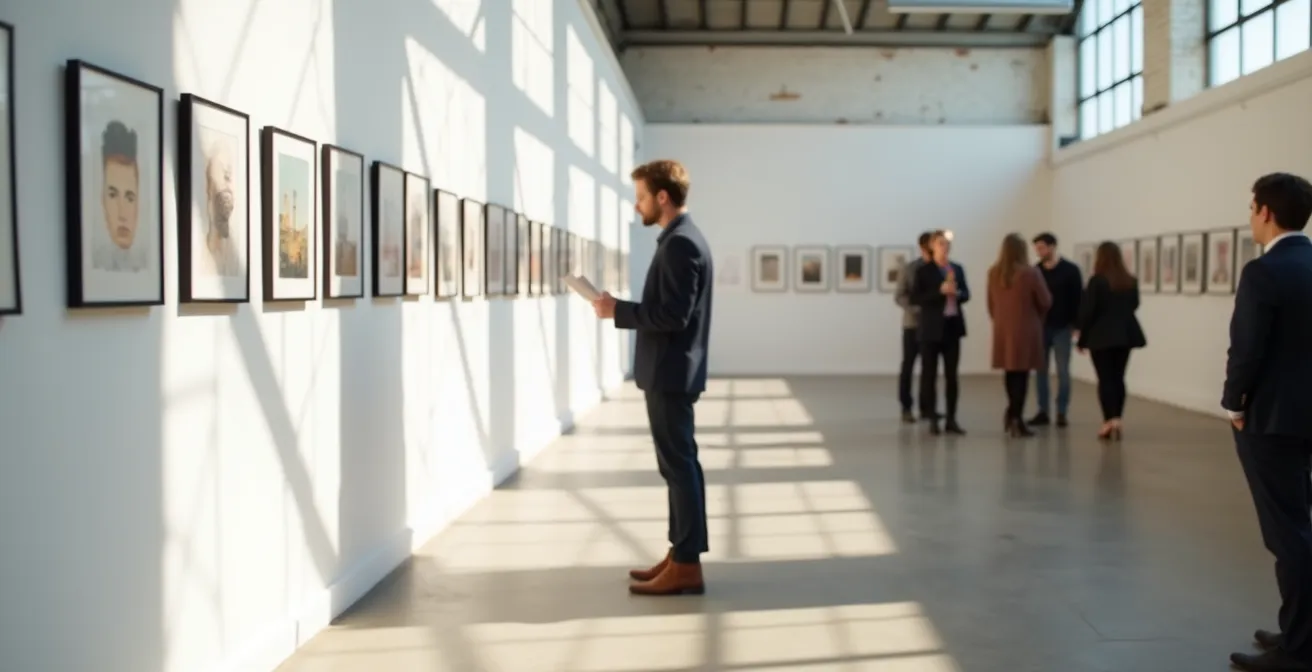
Buying your first original artwork isn’t about having a “good eye”—it’s about learning to read the industry’s signals of value to make a confident purchase.
- An original artwork’s price reflects the artist’s labour, studio costs, and gallery commission, not just materials.
- Look for professional validation signals, like Arts Council England grants or gallery curation, to identify promising artists.
Recommendation: Instead of negotiating prices, build relationships with gallerists and use schemes like Own Art to make purchases accessible.
The thought of owning an original piece of art is exciting. It’s a chance to bring a unique story into your home, support a creative career, and start a collection that reflects your personality. Yet, for many young professionals, the art world can feel like a private club with unwritten rules and intimidating price tags. The gallery door, with its pristine white walls and quiet atmosphere, can feel more like a barrier than an invitation. You want to buy your first piece for under £500, but you don’t know where to start or what to look for.
Most advice is generic: visit art fairs, browse online, or “just buy what you love.” While well-intentioned, this doesn’t help you understand the real value of what you’re buying or give you the confidence to engage with a gallerist. It leaves you wondering if you’re making a smart choice or simply overpaying for a pretty picture. This fear of the unknown is what keeps many potential collectors from ever starting.
But what if the key wasn’t about developing a mystical “eye” for art overnight? What if it was about learning to read the clear, practical signals the art world already uses to determine value? The truth is, the art market has a transparent logic. From understanding why a drawing costs more than a print to recognising the importance of a government grant on an artist’s CV, these signals empower you to move from an intimidated observer to a confident collector.
This guide will demystify the process by decoding those signals for you. We will break down the economics of art pricing, explore the etiquette of gallery interactions, and show you how to identify artists with long-term potential. By the end, you’ll have a practical framework for buying your first original artwork with both passion and intelligence.
To help you navigate this journey, we’ve structured this guide to answer the most pressing questions new collectors face. The following summary outlines the key areas we will explore, providing a clear roadmap to your first confident purchase.
Summary: Your Roadmap to Buying Your First Artwork
- Why Is a Print £150 but the Original Drawing £800?
- The Etiquette of Asking for a Discount: Is It Rude to Negotiate Art Prices?
- Grad Shows vs Galleries: Where Is the Best Place to Spot Future Stars?
- Glass or Acrylic: What Protects Your Art from UV Damage Best?
- Opening Nights: Why Attending Private Views Matters for Local Artists?
- Fractional Investing: Is Buying Shares in a Banksy Art Piece a Gimmick?
- Artist Fees: How Much Should You Pay Yourself in a Grant Application?
- How to Write an Arts Council England Grant Application That Actually Gets Funded?
Why Is a Print £150 but the Original Drawing £800?
The most common source of confusion for new buyers is the vast price difference between a print and an original. It seems illogical that two images, visually identical, could have such different values. The answer lies not in the image itself, but in the unique economics of creating art. A print is one of many copies, so its production cost is divided across the entire edition. An original artwork, however, is a singular object that bears the full cost of its creation.
This cost is far more than just canvas and paint. It includes the artist’s time, research, studio rent, and utilities. Crucially, when sold through a gallery, the price also incorporates the gallery’s commission. In the UK, galleries typically take a commission of 40% to 60%. This fee covers the gallery’s work in curating, marketing, and exhibiting the artist, providing a vital platform for their career.
Consider a real-world breakdown. For a £500 painting, the gallery might take a 50% commission, leaving the artist with £250. From that, they must deduct material and overhead costs. As one analysis of artist pricing highlights, the artist might only receive £150 for weeks of work. This is the core of artist economics: the price of an original doesn’t just pay for an object; it sustains a professional creative practice. The print is a more accessible product, while the original is an investment in the artist’s unique labour and career.
The Etiquette of Asking for a Discount: Is It Rude to Negotiate Art Prices?
Walking into a gallery, the fixed price on the wall can feel like a starting point for negotiation, similar to buying a car or furniture. However, in the world of independent galleries supporting emerging artists, asking for a discount is often considered a breach of etiquette. As we’ve seen, the prices are carefully calculated to ensure both the artist and the gallery can operate sustainably. Haggling directly undermines this delicate financial ecosystem.
Rather than being perceived as a savvy negotiator, you may inadvertently signal a lack of appreciation for the artist’s work and the gallery’s role. This can strain a potential relationship with the gallerist, who is a key ally in your collecting journey. Fortunately, there’s a much better, more respected way to make art affordable without asking for a price reduction.
This is where the Own Art scheme comes in. Supported by Arts Council England, this fantastic initiative is designed specifically for new collectors. It allows you to purchase art priced between £100 and £25,000 and spread the cost over 10 months with 0% interest. It’s not a discount, but a payment plan that makes the purchase manageable. Galleries that offer this scheme are actively welcoming new buyers and providing a structured, respectful way to manage your budget.
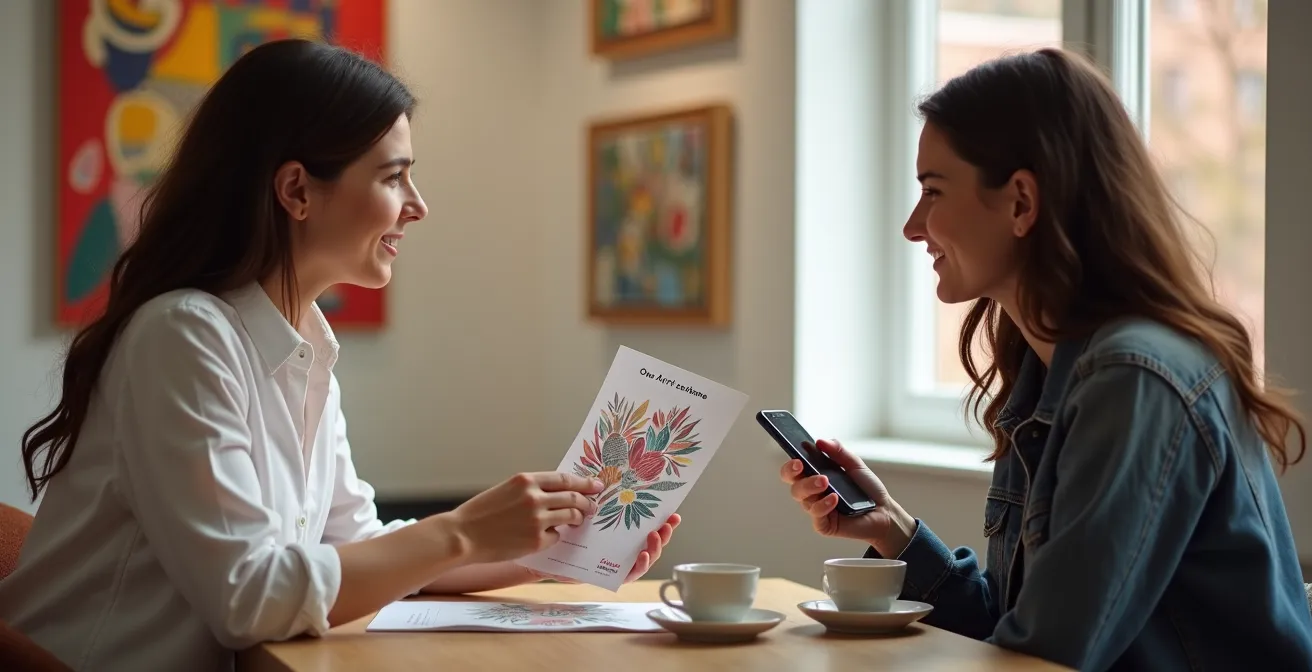
As confirmed by the success of the government-backed initiative, thousands of first-time buyers have used Own Art to start their collections. Asking a gallery “Do you participate in the Own Art scheme?” is the perfect conversation starter. It shows you are a serious, informed buyer and opens the door to a positive relationship with the gallery, preserving both the artist’s income and your future access to great art.
Grad Shows vs Galleries: Where Is the Best Place to Spot Future Stars?
For a new collector on a budget, the hunt for the “next big thing” is a thrilling prospect. Two primary hunting grounds present themselves: university graduate shows and established independent galleries. Each offers a distinct set of advantages and risks, and understanding the difference is key to building a smart collection strategy. Graduate shows are the raw, unfiltered frontier of the art world.
Here, you have direct access to artists at the very beginning of their careers. The excitement is palpable, and prices are often at their lowest, sometimes as little as £50-£500. You are buying directly from the artist, so there is no gallery commission. The potential for discovery is immense; you could be the very first person to buy a piece from an artist who goes on to achieve great success. However, the risk is also at its highest. There is no professional filter; you are relying solely on your own judgment to separate the promising from the provincial.
Independent galleries, on the other hand, offer a curated experience. The artists they represent have already been vetted. The gallerist has invested their professional reputation and resources in these individuals, which is a strong value signal. While prices are higher to account for commission, the risk is significantly lower. The gallery also provides professional support, from framing advice to documentation, which is invaluable for a new collector. The following table summarises the trade-offs:
| Factor | Graduate Shows | Independent Galleries |
|---|---|---|
| Price Range | £50-£500 | £200-£500+ |
| Risk Level | Higher – unproven artists | Lower – curated selection |
| Commission | 0% – buy direct | 40-60% included |
| Discovery Potential | Very high – first access | Moderate – already selected |
| Professional Support | Limited | Full gallery services |
For your very first purchase, an independent gallery offers a safer, more supportive environment. Once you have more confidence, visiting graduate shows can be an exciting way to take a calculated risk and potentially discover a hidden gem before anyone else.
Glass or Acrylic: What Protects Your Art from UV Damage Best?
Once you’ve acquired your first piece, protecting it becomes paramount. One of the biggest threats to any artwork, especially works on paper like drawings or photographs, is ultraviolet (UV) light from the sun or even indoor lighting. Over time, UV rays cause colours to fade and paper to yellow and become brittle. The choice of glazing—the clear material covering the art—is your primary line of defence.
The two main options are traditional glass and acrylic (often known by brand names like Perspex or Plexiglas). Standard picture-framing glass offers minimal UV protection. While it keeps dust off, it does little to prevent long-term light damage. For any piece you value, you must upgrade to conservation-grade glazing. This is where the real choice between glass and acrylic emerges.
Both materials are available with advanced UV-filtering coatings. However, modern acrylic has a distinct advantage. It is lighter than glass, making it safer for larger pieces, and it is shatter-resistant, which is a huge benefit for shipping or if the frame is accidentally knocked over. Most importantly, its protective capabilities are exceptional. As framing experts confirm, museum-quality UV-filtering acrylic blocks up to 99% of harmful UV rays. This level of protection is considered the gold standard for conservation framing.
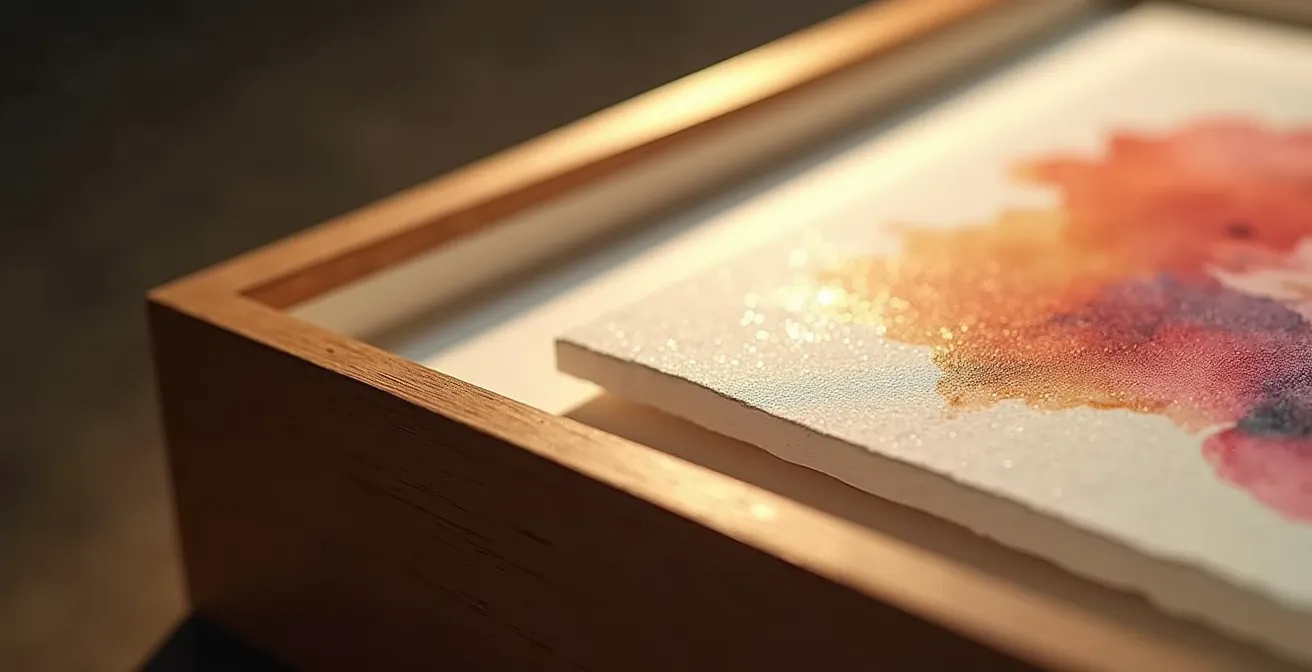
When buying from a reputable gallery, always ask about the framing. Inquire if they use conservation-grade materials, including acid-free mounts and UV-filtering glazing. While this might add to the initial cost, it is a non-negotiable part of safeguarding your investment. Paying for proper framing ensures that the artwork you love today will remain just as vibrant for decades to come.
Opening Nights: Why Attending Private Views Matters for Local Artists?
The title of this section asks why opening nights matter for artists, but the real question for you is: why do they matter for a new collector? The answer is access and relationships. A private view, or opening night, is far more than just a party with free wine. It is the central hub of the gallery’s community and your single best opportunity to immerse yourself in the local art scene, meet key people, and gain a significant advantage in your collecting journey.
Firstly, you get to meet the artist. Hearing them talk about their work in person provides a level of insight and connection you can’t get from reading a statement. This deepens your appreciation and adds a personal story to the artwork. Secondly, you meet the gallerist. In a relaxed, social setting, you can introduce yourself and start building a rapport. This is the foundation of a long-term relationship. A gallerist who knows you and understands your taste is more likely to offer you early access to new works that fit your budget.
Case Study: Building Relationships at London Gallery Openings
Grove Gallery director Serena Dunn emphasizes that passion, integrity, and transparency are essential for gallery relationships. Regular attendance at openings helps collectors develop connections with gallerists who can then offer early previews of works within their budget. Building these relationships over time leads to personalized recommendations and access to pieces before their public release, transforming the buying experience from a simple transaction into a collaborative partnership.
Attending private views consistently signals that you are a serious and engaged member of the community, not just a casual buyer. You’ll begin to see the same faces—other collectors, critics, and curators—and absorb the conversations that shape the art world. This is how you develop your taste and your confidence. To find these events, get on the mailing lists of galleries in areas like London’s Fitzrovia, Shoreditch, or Bethnal Green, and use apps like ArtRabbit. Making the effort to show up is the first step toward becoming a true insider.
Fractional Investing: Is Buying Shares in a Banksy Art Piece a Gimmick?
In the digital age, new models for art ownership have emerged, with fractional investing being one of the most talked-about. The concept allows you to buy a small “share” of a high-value artwork, like a multi-million-pound Banksy, for a relatively low price. For someone with a £500 budget, the idea of owning a piece of a legendary artwork can seem incredibly tempting. However, it’s crucial to understand what you are actually buying—and what you are not.
Fractional ownership is a purely financial instrument. You are buying a certificate that represents a tiny fraction of an asset’s value. You do not get to live with the art; it remains locked away in a secure vault. The emotional connection and daily enjoyment that come from having an original work in your home are completely absent. Furthermore, you are not directly supporting a living artist’s career. The money goes into a secondary market investment platform, which often comes with hidden management, storage, and exit fees.
Contrast this with buying an original £500 artwork from an emerging artist at an independent gallery. With full ownership, you get physical possession of the piece. You can hang it, live with it, and build a personal relationship with it. Every penny of your investment directly supports the artist and the gallery ecosystem that helps them thrive. While the financial upside might be less certain than a blue-chip name like Banksy, the personal and cultural return is infinitely greater. At events like the Affordable Art Fair, you can find original works from as little as £100, making true ownership highly accessible.
The table below clarifies the stark differences between these two approaches for a buyer with a sub-£500 budget:
| Aspect | Fractional Share (e.g., 0.01% Banksy) | Full Ownership (£500 Original) |
|---|---|---|
| Physical Possession | No – stored in a vault | Yes – hang it at home |
| Emotional Connection | Minimal – a line on a spreadsheet | Strong – daily enjoyment and connection |
| Supporting Artists | No – funds go to a platform/investors | Yes – direct support for an artist’s career |
| Hidden Fees | Storage, management, and exit fees | One-time purchase price |
For a first-time buyer, the choice is clear. Fractional investing is a financial gimmick that strips art of its primary purpose: to be seen, enjoyed, and lived with. Your £500 is far better spent on an original piece that brings you joy and makes a real difference to a living artist’s career.
Key takeaways
- An artwork’s price is a fair reflection of the artist’s labour, studio costs, and gallery commission—not just materials.
- True ownership of an original work offers an emotional and cultural return that fractional shares cannot match.
- Building relationships with gallerists and using schemes like Own Art are more effective and respectful than haggling prices.
Artist Fees: How Much Should You Pay Yourself in a Grant Application?
This question seems aimed at artists, but for a collector, it provides a crucial piece of the puzzle: understanding the financial reality of an artist’s life. Knowing how artists are professionally advised to value their time demystifies pricing and reinforces why original art costs what it does. It’s a look behind the curtain that fosters respect and appreciation for the creative process.
Professional bodies like Artists’ Union England and Arts Council England provide clear guidelines to ensure artists are paid fairly for their labour. For grant applications, artists are encouraged to calculate their time based on a daily rate. According to guidelines informed by Arts Council England, recommended day rates for professional artists range from £200-£350 per day. This isn’t an arbitrary number; it reflects the level of skill, experience, and expertise required to create high-quality work.
Let’s apply this to the £500 painting you might be considering. As we’ve seen, after a 50% gallery commission, the artist is left with £250. If the painting took just two full days to create (a very conservative estimate), their gross pay would be £125 per day, well below the recommended minimum. After deducting material and studio costs, their hourly wage often falls below the national minimum wage. This is the stark reality of artist economics.
Understanding this helps you see the £500 price tag not as an inflated figure, but as a modest price that barely covers the cost of professional artistic labour. It shows that by paying the full price, you are not making someone rich; you are providing a sustainable wage that allows a skilled professional to continue their practice. It transforms the purchase from a simple transaction into an act of patronage.
How to Write an Arts Council England Grant Application That Actually Gets Funded?
Again, this is a question for an artist, but the answer is one of the most powerful value signals for a collector. Arts Council England (ACE) is the national development agency for creativity and culture. Its funding is highly competitive and prestigious. An artist who has successfully secured an ACE grant has undergone a rigorous vetting process. For a new buyer, an ACE grant on an artist’s CV is a hallmark of quality and professional validation.
A successful grant application isn’t just about having good ideas. The artist must articulate a clear creative vision, connect their work to contemporary themes, and demonstrate a track record of professionalism. They must submit a detailed project plan, a realistic budget, and show how the grant will contribute to public engagement and their own artistic development. A panel of experts reviews these applications, so receiving a grant is a significant endorsement from the establishment.
As a collector, you can use this as a powerful filter. When you’re researching an artist, look at their CV or biography on the gallery’s website. Do they mention funding from Arts Council England or other regional bodies? Have they been awarded residencies or professional development bursaries? This kind of institutional support indicates that experts in the field believe in the artist’s potential. It reduces your risk as a buyer, as you are investing in someone whose talent has been formally recognised.
“A grant from Arts Council England or a regional body is a powerful form of professional validation.”
– Artists’ Union England, AUE Rates of Pay Guidelines 2024
This doesn’t mean you should only buy from grant-funded artists, but it is a strong indicator of quality, especially when you are just starting out and learning to trust your own judgment. The following checklist can help you evaluate an artist’s professional standing.
Your checklist for evaluating an artist’s professional validation
- Vision: Does the artist’s statement articulate a clear creative vision, free of confusing jargon?
- Track Record: Does their CV list past exhibitions, achievements, or publications?
- Funding History: Look for any mention of grants from Arts Council England or regional arts bodies.
- Institutional Support: Note any past participation in funded residencies or professional development awards.
- Coherence: Does their body of work show a consistent and developing practice?
Your journey as a collector starts not with a huge budget, but with the confidence to walk into a gallery and engage with the art and the people behind it. Use these signals and insights to visit a local independent gallery this weekend, start a conversation, and find a piece of original art that you’ll love for years to come.