
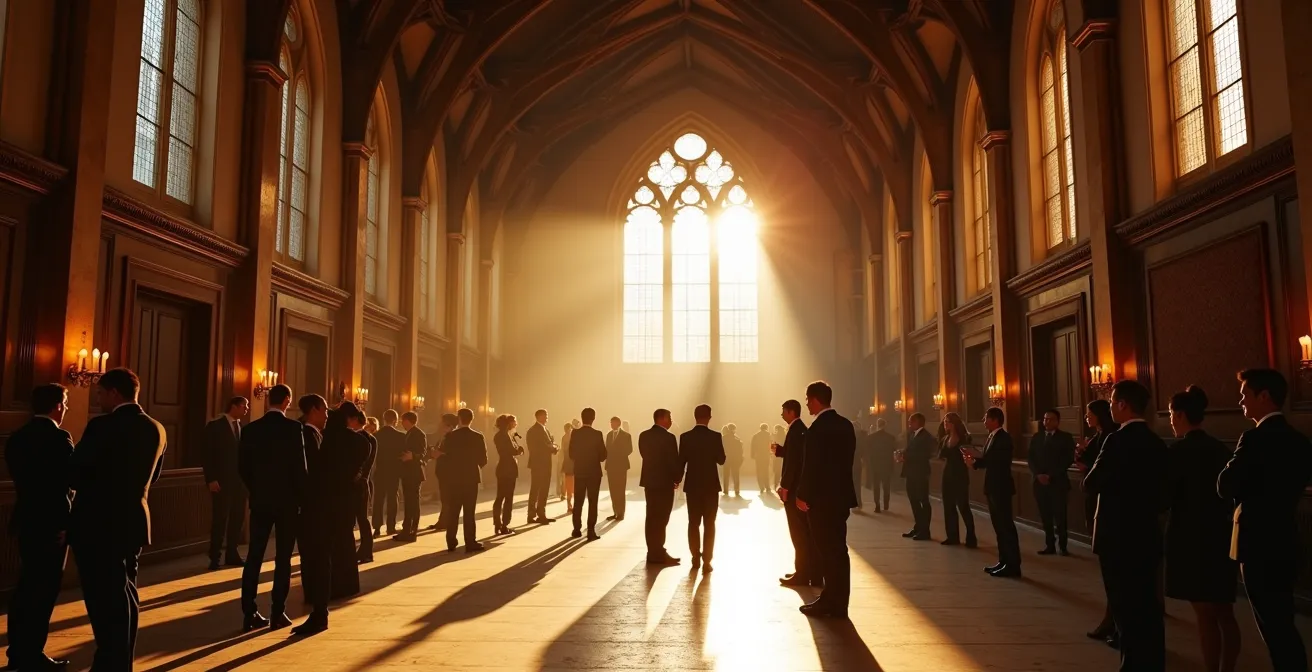
Hosting an event in a Grade I listed building isn’t about navigating restrictions; it’s about mastering heritage-specific operational solutions.
- Preservation rules are not barriers but technical challenges that have approved, professional workarounds.
- Success depends on proactive planning around non-negotiables like power limits, access constraints, and non-invasive fixings.
Recommendation: Shift your mindset from ‘what is forbidden?’ to ‘what is the approved method?’ and collaborate closely with venue-approved suppliers who have undergone rigorous due diligence.
For a corporate event planner, the allure of a Grade I listed venue is undeniable. The grandeur of a historic London palace or a stately country home offers a backdrop that no modern hotel can replicate. Yet, this prestige comes with a complex web of preservation rules that can seem daunting. Many planners focus on the perceived limitations: no tape on the walls, no modern power sockets, and limited access. This often leads to last-minute compromises or, worse, accidental damage and significant liabilities.
The common approach is to treat these venues with extreme caution, often sacrificing creative vision for the sake of safety. But what if this perspective is flawed? The key to a spectacular event in a heritage setting isn’t about tiptoeing around the rules. It’s about understanding the ‘why’ behind each rule and mastering the specialist, conservation-led solutions that turn constraints into creative opportunities. These buildings have hosted events for centuries; they are designed for it, provided you follow the correct operational protocols.
This guide, written from the perspective of a heritage venue manager, will not give you a list of “don’ts.” Instead, it will provide the “how-tos.” We will deconstruct the most common challenges—from power and fixings to insurance and accessibility—and reveal the professional, approved methods for overcoming them. You will learn to think not like a guest, but like a custodian, ensuring your event is both memorable and impeccably compliant.
To navigate these unique challenges effectively, this article breaks down the essential operational knowledge you’ll need. Explore the key topics below to build your expertise in managing events within these priceless settings.
Contents: Mastering Events in Heritage Venues
- Why You Cannot Use Standard Tape or Fixings on Historic Wood Panelling?
- How to Manage Power Supply for a DJ Set in a Venue with 13-Amp Limits?
- Public Liability vs Heritage Damage: What Insurance Do You Need for a Wedding at a Castle?
- The Wheelchair Access Challenge: How to Install Temporary Ramps in Listed Buildings?
- Timings for Load-In: Why Heritage Venues Require 2x More Time Than Hotels?
- The Parking Mistake at Rural Heritage Sites That Results in £60 Fines
- The Safety Briefing: What You Must Know Before Entering a Promenade Performance?
- How Are Immersive Technologies Changing Ticket Prices in the West End?
Why You Cannot Use Standard Tape or Fixings on Historic Wood Panelling?
The prohibition of standard tapes, Blu-Tack, or mechanical fixings on historic surfaces is not arbitrary; it’s a fundamental principle of preservation. Historic wood panelling, plasterwork, and stone can be centuries old. The adhesives in modern tapes contain acids that can permanently stain or lift the patina of aged wood. A simple nail hole can introduce moisture, leading to rot, or compromise structural integrity. The core principle is reversibility: any intervention must be completely removable without leaving a trace.
This is why heritage venues insist on a “no-touch” policy for their historic fabric. It’s not to make your job harder, but to protect an irreplaceable asset. Suppliers who do not understand this risk are a significant liability. This is why many venues, like Hampton Court Palace, maintain a list of accredited suppliers who have passed a rigorous due diligence process. They are trained to work within these constraints, using approved methods that respect the building’s integrity.
Case Study: Display Management at Hampton Court Palace
At Hampton Court Palace, event spaces are surrounded by priceless artefacts, such as the 17th-century tapestries depicting the story of Abraham. To protect these interiors, the venue enforces strict protocols, including a ban on glitter and naked flames. More importantly, they insist that event planners work with suppliers from their accredited list. These suppliers have been vetted to understand and respect the venue’s preservation requirements, using innovative, non-invasive solutions like column lighting and freestanding structures to create atmosphere and display branding without ever touching the historic fabric of the building.
Instead of thinking about what you can’t attach to the walls, the professional approach is to focus on what you can place in the room. Freestanding structures, from pop-up banners to custom-built exhibition frames with weighted bases, offer complete creative freedom without physical contact. For branding on glass, static-cling vinyl provides a perfect, residue-free solution. The mindset shift is from “wall-mounted” to “room-integrated” design.
How to Manage Power Supply for a DJ Set in a Venue with 13-Amp Limits?
A common shock for event planners is discovering that a magnificent 16th-century hall has the same electrical capacity as a small domestic kitchen. Historic buildings were not designed for the demands of modern event production. Wiring is often original, protected by the building’s listed status, and limited to standard 13-amp sockets. Attempting to run a DJ set, extensive lighting, and catering equipment from these circuits is a recipe for a power trip that can bring an entire event to a standstill.
The primary risk is overloading the historic electrical system, which can cause power failures and, in the worst-case scenario, create a fire hazard. Therefore, any supplier providing audio-visual or lighting equipment must submit a detailed risk assessment and method statement (RAMS). This document outlines their exact power requirements and their plan for managing them safely, which we, as the venue, review meticulously. This is not red tape; it’s a critical safety check.
The solution is almost always to bring in an independent power supply. This bypasses the venue’s internal wiring completely, providing a safe and reliable source for all your production needs. Depending on the scale of the event, several options are available, from small, portable power stations to large, silent generators.
Understanding the available power solutions is crucial for budgeting and logistics. The following table breaks down the most common options used for events in heritage venues, as highlighted in a recent analysis by Conference News.
| Solution Type | Capacity | Best For | Considerations |
|---|---|---|---|
| Film-grade Silent Generators | 10-100kVA | Large outdoor events | Must comply with local noise regulations |
| Portable Power Stations | 2-5kWh | Small DJ sets | EcoFlow/Jackery brands commonly used |
| Power Conditioners | Variable | Sensitive equipment | Essential for venues with old wiring |
| UPS Systems | 1-10kVA | Critical equipment | Protects against power fluctuations |
Engaging a professional production company from the venue’s accredited list is the most reliable path. They will conduct a site visit, assess your needs, and specify the correct power solution, ensuring everything runs smoothly on the day.
Public Liability vs Heritage Damage: What Insurance Do You Need for a Wedding at a Castle?
The topic of insurance can seem dry, but in a heritage venue, it’s a critical component of risk management. A common and dangerous mistake is assuming that a standard Public Liability (PL) policy is sufficient. It is not. With over 374,000 listed buildings in England, the risk is widespread and significant. You are operating in an environment where a spilled glass of red wine on an ancient tapestry could constitute a claim worth tens of thousands of pounds.
It’s essential to understand the two distinct types of risk. Public Liability insurance covers claims for injury to third parties (e.g., a guest tripping over a cable). Every event requires this, with a typical minimum cover of £5-10 million. However, this policy does *not* cover damage to the venue itself. For that, you need a separate policy or clause known as Damage to Venue Cover or Hired-In Premises Cover. For a Grade I listed building, the potential replacement or restoration costs are astronomical, so this cover can run into millions.
Many venues will also require a substantial security deposit (often £5,000-£25,000) to cover smaller incidents that may not meet the excess on the main insurance policy. This ensures that minor damages can be rectified quickly without lengthy claims processes. To navigate this complex landscape, working with a specialist event insurance broker is non-negotiable. They understand the unique requirements of heritage venues and can source a policy that provides comprehensive protection.
Your insurance checklist should therefore include the following distinct elements:
- Standard Public Liability: Essential for covering injury to your guests, with a minimum indemnity of £5-10 million.
- Damage to Venue Cover: A specific clause to protect the building’s historic fabric, with limits appropriate for a Grade I property.
- Hired-In Premises Cover: Protection that can be tailored to the specific rooms or areas you are using for the event.
- Contingency for Security Deposit: Ensure your budget accounts for the venue’s required deposit for minor damages.
The Wheelchair Access Challenge: How to Install Temporary Ramps in Listed Buildings?
Ensuring accessibility is not just a matter of good practice; it’s a legal requirement. However, in a listed building, this duty creates a direct conflict between two major pieces of legislation. As a heritage expert, this is a challenge we navigate daily.
Address the core legal conflict in England: The duty to make ‘reasonable adjustments’ under the Equality Act 2010 vs. the prohibition of unauthorised alterations under the Planning (Listed Buildings and Conservation Areas) Act 1990
– Historic England, Listed Buildings Legislation Framework
This legal tension means you cannot simply bolt a permanent ramp onto a flight of medieval stone steps. Any permanent alteration requires Listed Building Consent, a process that is often lengthy and may not be granted. The solution, therefore, lies in temporary and reversible interventions. The goal is to provide safe and dignified access for all guests without physically altering the historic fabric of the building.
Modern modular ramp systems are the industry standard. These are lightweight, free-standing aluminium structures that can be configured to navigate steps and uneven surfaces. They are designed to be installed without any drilling or fixing, often using weighted feet or counterbalances to ensure stability. They provide a safe, non-slip surface and come with handrails, fully complying with accessibility regulations.
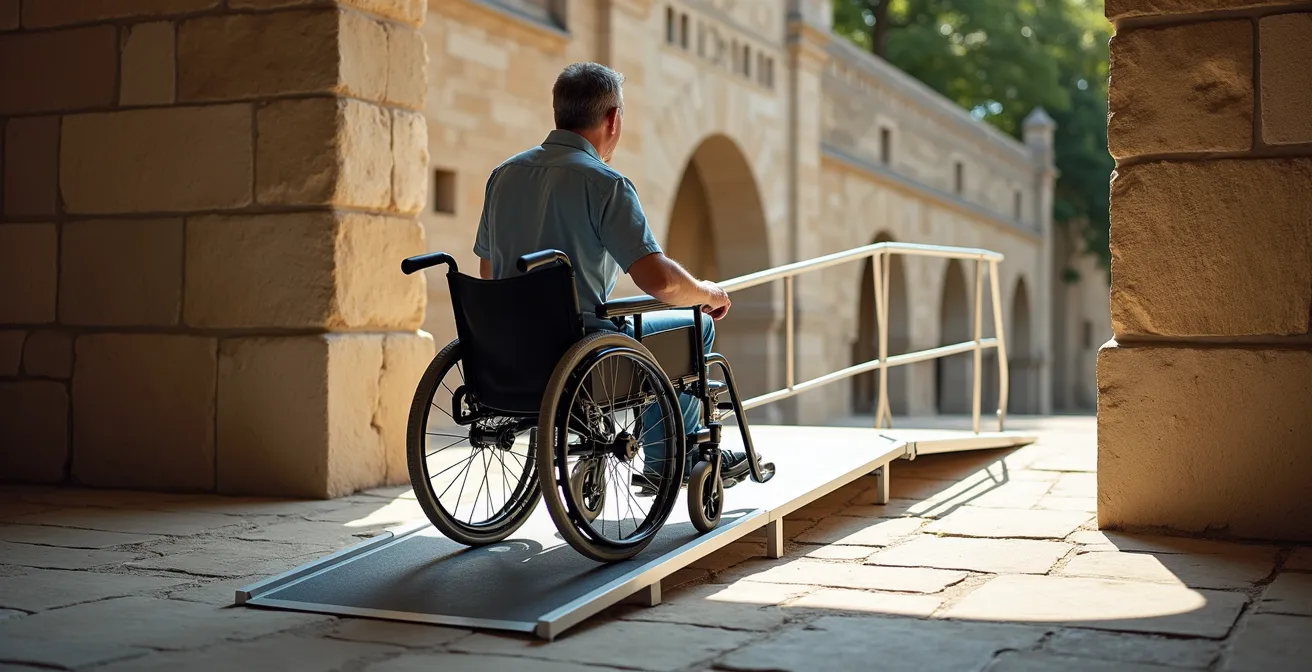
As the image demonstrates, a well-designed temporary system can integrate harmoniously with a historic entrance. Beyond ramps, venues often employ other creative solutions. Leeds Castle, for instance, provides wheelchair lifts for ground-floor access and offers fully accessible bedrooms in an adjacent building. For areas that remain inaccessible, they provide multimedia guides so guests can experience a virtual tour. The key is a multi-faceted approach that combines physical solutions with thoughtful alternatives.
Timings for Load-In: Why Heritage Venues Require 2x More Time Than Hotels?
One of the most common logistical errors made by planners new to heritage venues is underestimating the time required for load-in and setup. A schedule that works for a modern hotel conference centre will be completely inadequate for a Grade I listed property. As a rule of thumb, experienced production managers know that heritage venues typically require 1.5 to 2.5 times the standard hotel setup duration. This “Heritage Load-In Multiplier” is not a luxury; it’s an operational necessity.
Several factors contribute to this extended timeline. Access is often restricted to a single, small service entrance. There may be no service lifts, meaning every piece of equipment must be carried up historic staircases. Courtyards may be cobbled, requiring careful transport on trolleys with pneumatic tyres. Every major movement of equipment, such as a grand piano or a large stage section, must be supervised by a member of the venue’s curatorial or events team to ensure it navigates narrow doorways and fragile features without causing damage.
The process is inherently slower because it is more deliberate. Before any equipment enters the main rooms, protective floor coverings must be laid. Every corner and doorway must be navigated with precision. Unlike a hotel, where speed and efficiency are key, the priority here is preservation. Rushing is the single biggest cause of accidental damage. A detailed, phased schedule is therefore essential to prevent bottlenecks and ensure a stress-free setup.
Action Plan: Your Heritage Load-In Schedule
- Map all access constraints: Before anything else, conduct a thorough site visit to identify and measure narrow doorways, chart the route from the loading bay to the event space, and note the absence of service lifts or the presence of cobbled courtyards.
- Apply the Heritage Load-In Multiplier: Take your standard setup time and multiply it by a factor of 1.5 to 2.5, depending on the venue’s Grade listing and specific constraints.
- Account for curator supervision: Build in time for venue staff to oversee the movement of each major item. This is non-negotiable and will create pauses in your schedule.
- Create a phased schedule: Prioritise the most disruptive elements, like staging and large props, to be brought in first. Follow with lighting, sound, and finally floral and decorative elements.
- Coordinate supplier windows: To prevent a traffic jam at a single access point, assign strict arrival and departure windows for each supplier and enforce them.
Communicating this extended timeline to all suppliers from the outset manages expectations and ensures everyone understands that the pace of work is dictated by the needs of the building, not the deadline alone.
The Parking Mistake at Rural Heritage Sites That Results in £60 Fines
While much focus is placed on the building itself, a simple logistical oversight outside can lead to significant and unnecessary costs: parking fines. Many rural heritage sites, particularly those managed by large organisations like the National Trust or English Heritage, have outsourced their car park management to private companies. These often use ANPR (Automatic Number Plate Recognition) systems.
These systems are typically configured for tourist visits, with short-stay limits of 2-3 hours. They are not designed for event staff, crew, or suppliers who will be on-site for a full day or longer. An unregistered vehicle staying beyond the maximum time will automatically trigger a penalty charge notice, often around £60, which is sent directly to the vehicle’s owner. A single event with 20 supplier vehicles could result in over £1,000 in fines, creating a major headache and damaging supplier relationships.
The solution is simple but requires meticulous administration. You must work with the venue manager to pre-register every single vehicle that will be on-site. This is not something that can be done on the day. The process usually involves submitting a complete list of vehicle registration numbers at least 48 hours in advance. This list must be comprehensive and include:
- All main supplier lorries and vans.
- Crew and staff personal vehicles.
- Vehicles making even brief drop-offs.
For guests, the best practice is often to arrange a park-and-ride service from a nearby location, which also helps manage traffic flow and enhances the guest experience. It is your responsibility as the planner to brief every single person involved in the event about the ANPR system and the absolute necessity of pre-registration. Always ask for written confirmation from the venue that your vehicle list has been received and processed.
The Safety Briefing: What You Must Know Before Entering a Promenade Performance?
For any event, but especially for promenade or interactive performances where guests move through a space, the safety briefing is a legal and practical necessity. In a heritage venue, this briefing takes on an additional layer of importance: it protects not only the guests but also the building. A clear, concise briefing demonstrates due diligence under the UK’s Health and Safety at Work Act 1974, mitigating liability for both the organiser and the venue.
The content of the briefing must go beyond the standard ‘fire exits and first aid’ points. It must address heritage-specific risks. This includes warning guests about uneven medieval flagstones, low doorways, or narrow passages. It should also include conservation rules, such as not touching fragile tapestries (skin oils can cause irreversible damage) or restricting the use of flash photography, which can fade historic watercolours and textiles over time.
As the Health and Safety Executive highlights, managing these risks is a careful balancing act.
The VSG’s Historic Built Environment Subgroup provides a valuable framework for managing risks to visitors which is sensitive to the historic value of the properties and landscape and does not unduly restrict public access
– Health and Safety Executive, Managing Visitor Safety in the Historic Built Environment
However, a dry, list-based briefing can kill the atmosphere of an event before it begins. The most successful events integrate these warnings creatively. For a corporate treasure hunt, safety rules can be embedded as clues. For a themed gala, historical re-enactors can deliver the guidelines in character, making the information more engaging and memorable. An interactive digital map sent to guests beforehand can highlight both fascinating historical features and key safety considerations, preparing them before they even arrive.
Key Takeaways
- Solutions, Not Restrictions: Every preservation rule has a corresponding professional, non-invasive solution. Your job is to find it.
- Due Diligence is Non-Negotiable: Always use venue-accredited suppliers and provide detailed risk assessments. This is a core part of heritage event management.
- Plan for Time and Access: Heritage venues require significantly more time for setup due to physical constraints. Factor this into every schedule from day one.
How Are Immersive Technologies Changing Ticket Prices in the West End?
While the title references the West End, for the corporate event planner, the more relevant question is: how are immersive technologies transforming the *experience and cost* of events in listed buildings? The answer is profound. The very restrictions that prohibit physical decorations are catalysing a shift towards digital solutions that are more dynamic, creative, and often, more cost-effective than traditional methods.
The most powerful of these is projection mapping. This technology allows you to turn the ancient stone walls or architectural features of a venue into a dynamic digital canvas. You can display company branding, create moving backdrops, or project ambient ‘digital wallpaper’ that transforms the entire atmosphere of a room. This is the ultimate “conservation-led solution”: it offers spectacular visual impact with zero physical contact, damage, or residue. What was once a limitation (a bare wall you cannot touch) becomes your greatest creative asset.
This digital approach extends beyond visuals. In acoustically sensitive spaces with fragile plasterwork or where external noise is a concern, silent disco systems allow for a high-energy music event without generating sound pressure that could damage the building’s fabric. Similarly, battery-powered LED uplighting can create dramatic architectural highlights without the heat damage associated with older lighting or the need to run cables across historic floors.
These technologies are no longer prohibitively expensive and offer a range of options to suit different budgets. They represent a fundamental shift in event design for heritage spaces.
| Technology | Application | Heritage Benefit | Typical Cost Range |
|---|---|---|---|
| Projection Mapping | Wall branding, ambient effects | Zero physical contact with surfaces | £5,000-£50,000 |
| AR Experiences | Interactive venue tours | Adds digital layer without alterations | £3,000-£20,000 |
| Silent Disco Systems | Music events in acoustically sensitive spaces | Eliminates sound pressure on historic fabric | £500-£3,000 |
| LED Uplighting | Architectural highlighting | No heat damage, battery-powered options | £1,000-£10,000 |
By embracing these modern tools, you can deliver a cutting-edge experience that fully respects and even enhances the timeless beauty of a Grade I listed venue. To put these strategies into practice, the next logical step is to start a dialogue with a heritage venue’s in-house event management team to discuss the specific creative solutions available for your event.
Frequently Asked Questions About Heritage Venue Events
What specific heritage risks must be covered in briefings?
Briefings must cover risks unique to the historic environment, such as uneven medieval flagstones that pose a trip hazard, the vulnerability of fragile tapestries to oils from human skin, strict restrictions on flash photography to protect light-sensitive watercolours, and physical obstacles like low doorways or narrow passages that are integral to the building’s historic architecture.
How does a briefing demonstrate legal compliance?
Providing and documenting safety briefings (e.g., via invitations, welcome emails, and public announcements by the host at the event) serves as crucial evidence of due diligence under the UK’s Health and Safety at Work Act 1974. This documented communication helps protect event organisers from liability in the event of an incident by showing that reasonable steps were taken to inform guests of potential risks.
What creative delivery methods work for heritage briefings?
To avoid a dry presentation, integrate safety rules into the event’s theme. For example, use treasure hunts where clues contain safety information, employ historical re-enactors to communicate guidelines in character, or create interactive venue maps that highlight both historical points of interest and key safety considerations, making the information engaging and memorable.