

In summary:
- Feeling ignored by your council is a common frustration, but simple petitions are often ineffective.
- The key to forcing change is to move from complaining to building an undeniable, evidence-based case.
- Use the council’s own procedures, like Freedom of Information requests and public consultations, as leverage.
- Turn anecdotes into data to create a powerful narrative on issues from fly-tipping to school admissions.
- This guide provides the procedural tools to make your council listen and act.
Every resident in England has a story about their local council. A pothole that never gets fixed, a planning decision that seems nonsensical, or a service that doesn’t meet the community’s needs. The default response is often frustration, leading to signing a hopeful but ultimately ignored online petition. You feel powerless, and the town hall feels like an impenetrable fortress of bureaucracy. This feeling is valid, but the approach is flawed.
Most residents try to appeal to the council’s sense of duty. They complain, they plead, they share angry posts on social media. But councils don’t run on emotion; they run on data, procedure, and legal frameworks. The secret to being heard is not to shout louder, but to speak their language. It’s about shifting your mindset from a frustrated resident to a methodical community activist.
But what if the key wasn’t just petitioning, but preparing a case so thorough and well-documented that ignoring it becomes more difficult than acting on it? This guide will not tell you how to start another petition. Instead, it will equip you with the procedural tools and strategic thinking needed to build an evidence portfolio. We will explore how to use the council’s own systems to your advantage, transforming your grievances into a data-driven narrative they are duty-bound to address.
This article will walk you through a series of common frustrations, from council tax to school places, showing you the specific levers of power available in each scenario. By the end, you will understand how to dissect a problem, gather the right evidence, and present your case in a way that commands attention and, ultimately, action.
text
Summary: An Activist’s Guide to Forcing Local Change
- Band D Average: Why Is Your Council Tax Higher Than the Neighbouring Borough?
- Fly-Tipping vs Collection: How to Dispose of a Sofa Legally and Cheaply?
- The Postcode Lottery: How Council Boundaries Affect Your Child’s School Choice?
- Diesel Surcharges: Why Your Parking Permit Costs More Than Your Petrol Car?
- The Noise App: How to Gather Evidence of Neighbours’ Parties for the Council?
- Why Local Councils Reject 40% of Double Glazing Applications in Conservation Areas?
- The Geofencing Trap: Why You Can’t End Your Ride Outside Your Front Door?
- How to Improve the EPC Rating of a Victorian Terrace to Band C Without Ruining the Facade?
Band D Average: Why Is Your Council Tax Higher Than the Neighbouring Borough?
It’s a classic English frustration: your council tax bill arrives, and it’s gone up again. You look at the borough next door and see they pay less for what seems like better services. With the average Band D council tax in England for 2025-26 hitting £2,280, a 5% increase on the previous year, questions about value for money are more pressing than ever. Complaining that it’s “unfair” is ineffective. The powerful first step is to demand transparency through procedural leverage.
Every council’s budget is a public document, but the details are often buried. Your goal is to unearth them and make direct, undeniable comparisons. The most potent tool in your arsenal is the Freedom of Information (FOI) Act 2000. An FOI request is a formal, legal demand for information that a council is obligated to answer, typically within 20 working days. It moves you from the realm of opinion (“I feel our services are worse”) to fact (“Your council spends 30% less per capita on library services than the neighbouring borough”).
By requesting specific, line-by-line budget items—such as spend per mile on road maintenance or adult social care costs per resident—you can build a data-driven narrative. This isn’t about proving your tax is “too high” in the abstract; it’s about asking targeted questions backed by comparative data. This evidence forms the foundation of a serious conversation with a local councillor or even the local press.
Your Action Plan: Filing an FOI for Budget Comparison
- Identify Categories: Pinpoint specific budget areas for comparison. Don’t be vague; choose measurable items like ‘spend per mile on road maintenance’ or ‘library running costs per capita’.
- Draft Request: Write your FOI request specifying the exact departmental budgets and the timeframe you need (e.g., the last three financial years). Be clear and concise.
- Submit Formally: Use the council’s official FOI portal or email the designated officer. This creates a formal record and starts the legal 20-working-day response clock.
- Analyse Data: Once you receive the information, compile it in a spreadsheet. This will allow you to make clear, line-by-line comparisons between your council and others.
- Present Findings: Armed with hard data and clear visualisations (like charts or tables), present your findings to local councillors, community groups, or the local press to build pressure.
Fly-Tipping vs Collection: How to Dispose of a Sofa Legally and Cheaply?
The sight of a decaying mattress or a dismantled wardrobe dumped on a street corner is more than an eyesore; it’s a significant financial burden on your council. With over 1.15 million fly-tipping incidents dealt with by English councils in 2023/24, the cost of cleanup is passed directly to you, the taxpayer. Many residents resort to this out of frustration with the perceived cost and hassle of official bulky waste collections. This is where you can reframe the debate using a cost-benefit narrative.
Instead of just demanding more enforcement against fly-tipping, you can build a case that a more affordable and accessible bulky waste service is cheaper for the council in the long run. The cost of investigating and clearing a single fly-tipping incident often far exceeds the subsidy needed to make the official collection service a no-brainer for residents. Your argument is not “I want a cheaper service,” but “The council can save money by making the legal option the easiest option.”
This is a powerful example of how to align your interests with the council’s financial ones. Researching and presenting successful models from other councils can strengthen your case immensely.
Case Study: Cherwell Council’s Proactive Approach
Cherwell District Council provides a compelling model. By offering a bulky waste collection service starting at just £10.99 per item, they make the legal route highly competitive against the risks of illegal dumping. Crucially, they don’t stop there. They also actively promote free alternatives like charity furniture collections and sharing apps such as Freegle and Freecycle. This multi-pronged strategy attacks the problem from all angles: it makes the legal option affordable, provides free alternatives, and reduces the overall volume of waste, creating a win-win for residents and the council’s budget.
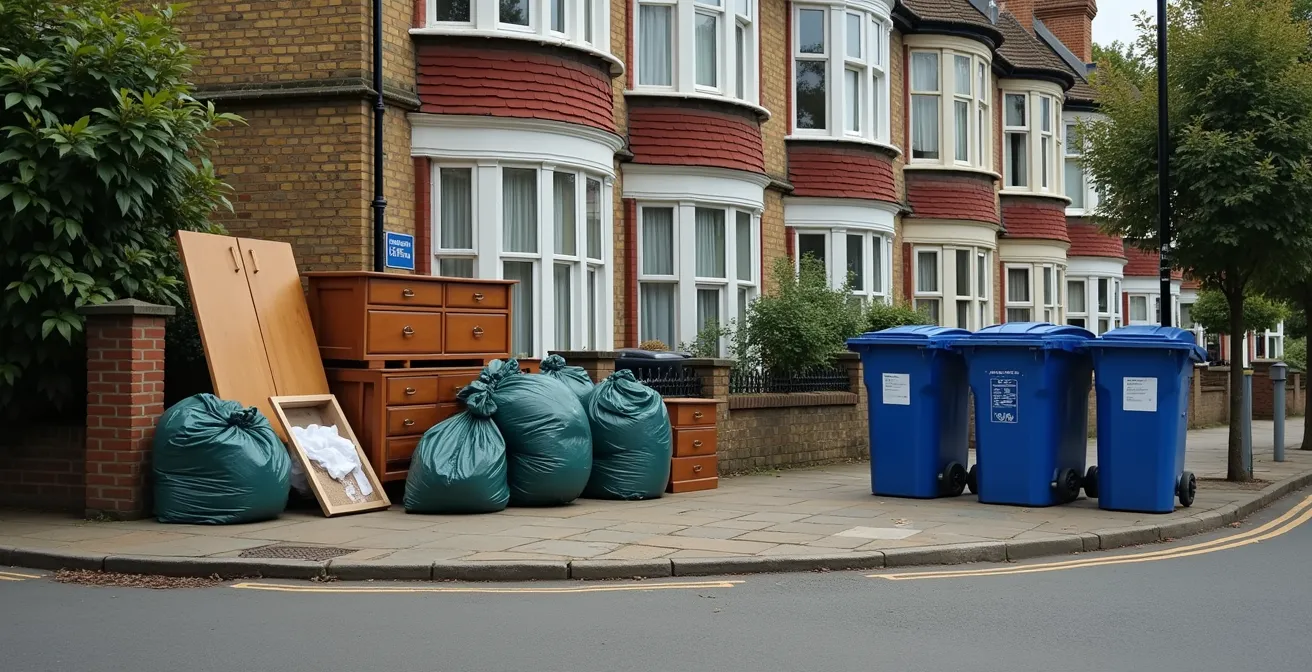
By advocating for a similar, holistic system in your own borough, you position yourself as a constructive problem-solver. You’re not just highlighting a problem; you’re presenting a proven, cost-effective solution. This proactive stance is far more likely to gain traction with council officers and elected members who are under pressure to deliver efficiencies.
The Postcode Lottery: How Council Boundaries Affect Your Child’s School Choice?
For parents, few things are as stressful as school admissions. You find the perfect school, only to discover you live a few streets outside the catchment area. This “postcode lottery” feels arbitrary and deeply unfair, especially when families living just 0.8 miles outside a catchment area can see their applications rejected. The key to navigating this emotional minefield is to stop seeing it as a lottery and start understanding it as a system with a strict, hierarchical rulebook. Power comes from knowing those rules better than anyone else.
School admissions are not random. They are governed by a published list of oversubscription criteria, which every admissions authority (the council or the school itself) must follow. Complaining about the injustice of your location is futile. Instead, your task is to analyse these criteria and understand exactly where you stand. An appeal panel is not there to sympathise with your commute; it is there to determine if the admissions authority made a mistake in applying its own rules.
Your evidence portfolio here is not about how much you want the school, but about demonstrating that either the rules were applied incorrectly, or that your child’s case for admission is so exceptional that it outweighs the prejudice to the school of admitting an extra pupil. Understanding this hierarchy is the first step to building a credible appeal.
This table, based on common criteria used across England, demystifies the process. As a report from the charity Child Law Advice shows, priority is a cascade, not a lottery.
| Priority Level | Criterion | Typical Success Rate |
|---|---|---|
| 1 | Looked After Children (LAC) | 100% |
| 2 | Within Catchment + Siblings | 85-95% |
| 3 | Within Catchment Only | 60-80% |
| 4 | Outside Catchment + Siblings | 20-40% |
| 5 | Outside Catchment by Distance | 5-15% |
Seeing the data laid out like this shifts the perspective. The challenge becomes less about “beating the system” and more about understanding precisely which category you fall into and whether there are grounds for an appeal based on a procedural error or truly exceptional social or medical need. This analytical approach gives you the best possible chance of success.
Diesel Surcharges: Why Your Parking Permit Costs More Than Your Petrol Car?
Many councils across England have introduced emissions-based charges for residential parking permits, often placing a heavy surcharge on diesel vehicles. While the environmental goal is understandable, the execution can feel punitive and unfair, especially if you own an older vehicle. You might find your permit cost has doubled, based on data you believe is inaccurate. The feeling of being penalised by a blunt, inflexible system is common, but here too, there is a path for a procedural challenge.
The core of the issue is often the data itself. Councils rely on information from the DVLA to determine your vehicle’s emissions band. However, this data isn’t always perfect. The key insight is that you have the right to challenge the council’s evidence with better evidence of your own. As UK Government guidance on council tax banding—a similar process of property categorisation—highlights, official data can be flawed.
Councils often use the DVLA’s data, which can be inaccurate for older vehicles or imports.
– UK Government Guidance, How domestic properties are assessed for Council Tax bands
This admission from an official source is your procedural leverage. If you believe your vehicle has been incorrectly categorised, you can commission an independent emissions test from an authorised MOT testing centre. If this test provides a different, more favourable result than what the DVLA holds, you have the basis for a formal challenge. You are no longer arguing about the fairness of the policy, but about the accuracy of the data used to apply it. This transforms a political complaint into a factual dispute, which the council has a duty to address.
The process involves gathering your proof—the new test certificate, manufacturer’s specifications—and submitting a formal request for recalculation to the council’s parking services department. It requires diligence, but it puts you back in control by focusing on verifiable facts rather than subjective fairness.
The Noise App: How to Gather Evidence of Neighbours’ Parties for the Council?
A noisy neighbour can make life unbearable, and when polite requests fail, the council’s Environmental Health department is your next port of call. Many councils now recommend using “The Noise App” to record disturbances. However, simply submitting a few audio clips is often not enough to trigger meaningful action. Council officers need more; they need a comprehensive evidence portfolio that proves a “statutory nuisance” is occurring.
Relying solely on an app is a common mistake. To build a case that the council can’t dismiss, you must think like a prosecutor. Your goal is to provide a rich, multi-layered body of evidence that paints a complete picture of the disturbance and its impact on your life. This goes far beyond a simple recording of a loud party.

This methodical approach transforms you from a complainant into a credible witness. It provides the Environmental Health officer with the robust evidence they need to justify formal action, whether it’s a warning letter, a noise abatement notice, or the seizure of equipment. It’s about making their job easier by giving them an open-and-shut case.
Building a Multi-Layered Evidence Portfolio
Councils that are successful in tackling noise nuisance recommend a comprehensive approach. This includes: a detailed written log with dates, times, duration, and crucially, impact statements (e.g., ‘woke up my child at 2am,’ ‘vibrations could be felt through the floor’). This should be supplemented by corroboration from other affected neighbours to demonstrate it’s a community issue, not a personal dispute. Furthermore, objective data from a smartphone decibel meter app provides numerical proof, while photographic or video evidence of gatherings (taken discreetly and legally) can strengthen the case for Environmental Health to take decisive action.
Why Local Councils Reject 40% of Double Glazing Applications in Conservation Areas?
Living in a Conservation Area comes with a responsibility to preserve the historical character of the neighbourhood. This often clashes with a homeowner’s desire for modern comforts and energy efficiency, like double glazing. It’s a source of immense frustration when your sensible application to replace draughty, single-glazed windows is rejected. Indeed, planning statistics indicate a startling 40% rejection rate for such applications in these protected zones.
The common mistake is to submit a standard application and hope for the best. This fails to recognise that in a Conservation Area, you are not dealing with standard planning rules. You are dealing with a specific individual: the Conservation Officer. Their job is to protect heritage, and your job is to make it easy for them to say “yes”. This is a form of bureaucratic acupuncture: applying precise pressure and information to the right decision-maker.
A successful application is built long before it’s submitted. Start by scheduling a free pre-application advice meeting with the Conservation Officer. This is not a confrontation; it’s a collaboration. Bring photos, research, and an open mind. Use the council’s own planning portal to research previously *approved* window applications in your area. This gives you a priceless list of approved manufacturers and ‘slimline’ unit specifications that the officer is already comfortable with.
Frame your application cleverly. Many councils have declared a ‘Climate Emergency’. Use this. Your application isn’t just for your own comfort; it’s helping the council meet its own carbon reduction targets. Quantify the EPC improvements and carbon savings. By presenting a well-researched proposal that respects heritage while aligning with the council’s own stated goals, you change the narrative from a request to a partnership.
The Geofencing Trap: Why You Can’t End Your Ride Outside Your Front Door?
The rise of rental e-scooters and e-bikes offers a convenient, green mode of transport. But it comes with a common frustration: the geofenced parking bay. You arrive at your destination only to find you can’t end your ride, forcing you to walk several hundred metres back from the nearest designated bay. It feels like a flaw in the system, but it’s actually a feature—and understanding it is the key to changing it.
These parking bays are not placed arbitrarily by the operators like Lime, Tier, or Forest. As transport planning experts explain, a bay’s location is often dictated by a legal document called a Traffic Regulation Order (TRO). A TRO is the formal mechanism councils use to manage their roads, from yellow lines to, in this case, e-scooter parking. This means complaining to the operator will achieve little; the power to create a new bay lies with the council’s transport department.
Herein lies your procedural leverage. Councils are legally required to hold public consultations before making or amending a TRO. This is your official window of opportunity to propose a new parking bay. To do this effectively, you must build a data-driven narrative. Contact the e-bike operators and ask for anonymised trip data for your area. They are often willing to share information that demonstrates demand. This allows you to identify ‘desire lines’—popular routes where many users unofficially end their trips. A proposal for a new bay located on a desire line, backed by usage statistics, is far more compelling than a simple request for convenience.
When you submit your proposal during the formal TRO consultation period, reference precedents like car club bays as an example of efficient use of road space. By using the council’s own formal process and backing your request with data, you are no longer just a resident complaining about an app; you are a stakeholder contributing to the city’s transport planning.
Key takeaways
- Effective change requires moving from emotional complaints to building a methodical, evidence-based case.
- Use the council’s own tools, such as Freedom of Information (FOI) requests and Traffic Regulation Order (TRO) consultations, as leverage.
- Frame your proposals in terms the council understands: cost-benefit analysis, data-driven narratives, and procedural compliance.
How to Improve the EPC Rating of a Victorian Terrace to Band C Without Ruining the Facade?
Owning a Victorian terrace is a love affair with character, but it’s often a battle with energy inefficiency. With rising energy costs and a government push towards better EPC ratings, improving your home’s performance is a priority. The challenge is achieving a target like Band C without stripping the building of its historical charm—or your bank account. The answer lies in focusing on non-invasive, high-impact upgrades that respect the building’s fabric.
Forget expensive and often damaging internal wall insulation for now. The most significant gains are often found elsewhere. A focus on the “big three” cost-effective upgrades—loft insulation, draught-proofing original windows, and insulating suspended timber floors—can deliver dramatic improvements while preserving the building’s character. For example, adding 300mm of loft insulation can save up to £250 a year, and professionally draught-proofing traditional sash windows retains their beauty while saving a significant amount on heating bills.
When you do consider wall insulation, understanding the building’s science is paramount. Victorian solid brick walls need to “breathe” to manage moisture. Using modern non-breathable insulation like Kingspan/PIR boards can trap moisture within the wall, leading to damp, mould, and long-term structural damage. The correct approach is to use breathable materials like wood fibre or cork board, which work in harmony with the original structure.
Choosing the right materials is crucial for the health of an old building. The following table compares common insulation types for solid brick walls, highlighting why breathable options are superior for heritage properties.
| Insulation Type | Moisture Permeability | Risk of Interstitial Condensation | Cost per sqm | Heritage Compatibility |
|---|---|---|---|---|
| Wood Fibre | High | Very Low | £60-80 | Excellent |
| Cork Board | High | Very Low | £50-70 | Excellent |
| Lime Plaster | Very High | None | £40-60 | Excellent |
| Kingspan/PIR | None | High | £30-50 | Poor |
By taking this informed, fabric-first approach, you can significantly boost your home’s EPC rating and reduce your energy bills, all while acting as a responsible custodian of a historic property. It’s about making smart choices, not just expensive ones.
Your frustration is valid. The feeling of being a small voice shouting at a monolithic institution is real. But you are not powerless. By shifting your approach from emotional complaint to procedural action, you change the dynamic. Your power lies not in the volume of your voice, but in the quality of your evidence. Start building your case today.