
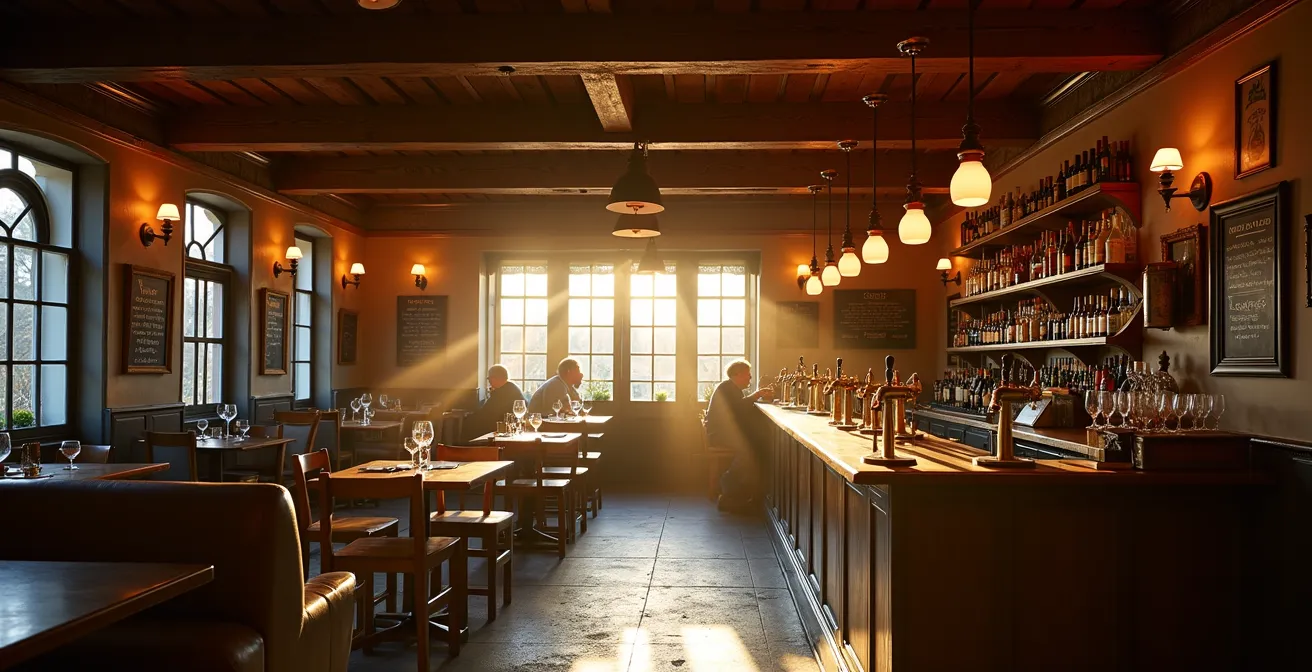
The difference between a memorable gastropub meal and a costly disappointment is rarely the price, but the culinary integrity hidden in the menu’s details.
- True seasonality and verifiable sourcing (named farms, PDO status) are non-negotiable quality markers.
- Staff knowledge and thoughtful pairings reveal a kitchen’s philosophy more than any marketing slogan.
Recommendation: Learn to read a menu for its operational signature, not just its list of dishes.
The term ‘gastropub’ is now so widespread across England that it has almost lost its meaning. Once a revolutionary concept—a public house dedicated to serving restaurant-quality food—it’s now a marketing label often used to justify a £18 burger. For the discerning diner, tired of glorified pub grub at inflated prices, the challenge is to separate establishments with genuine culinary integrity from those simply cashing in on a trend. The answer isn’t found in online reviews or chic decor, but in the document that reveals all: the menu.
Many will tell you to look for ‘local ingredients’ or ‘seasonal dishes’, but these have become platitudes. The real skill lies in decoding the subtle signals that a menu sends. It’s about understanding not just what is being served, but why. A truly great gastropub operates with a clear philosophy, and its menu is its manifesto. It tells a story of sourcing transparency, of technical skill, and of a deep respect for the produce that defines British cooking.
This guide moves beyond the obvious. We will adopt the mindset of a food critic to analyse the menu as a collection of evidence. Instead of being swayed by lyrical descriptions, you will learn to spot the glaring red flags and, more importantly, the quiet indicators of true quality. From the shocking appearance of summer berries in winter to the specific wording that betrays a chef’s technique, we will build a framework for identifying authentic culinary excellence. This is your defence against the ‘gastro-inflation’ that plagues the modern British pub scene.
To help set the scene, the following video explores the timeless atmosphere of one of London’s historic pubs, a reminder of the rich heritage from which the modern gastropub movement evolved.
This article provides a critical framework for evaluating a gastropub before you even make a reservation. The following sections break down the key areas of inspection, equipping you with the knowledge to make an informed choice.
Contents: A Critic’s Framework for Judging a Gastropub
- Why Seeing Strawberries in December Is a Red Flag for a Gastropub?
- Why Does a Pub Burger Cost £18 in the Cotswolds vs £12 in Town?
- How to Secure a Sunday Roast Table at a Top-Rated Pub Without Booking Months Ahead?
- IPA or Stout: Which Beer Pairs Best with Venison Pie?
- The Service Mistake That Ruins a Gastropub Experience Despite Good Food
- How to Cook Grass-Fed Beef to Medium-Rare Without It Becoming Tough?
- Dry or Sweet: Which Cider Goes Best with a Ploughman’s Lunch?
- Protected Designation of Origin: Why Is a Melton Mowbray Pie Special?
Why Seeing Strawberries in December Is a Red Flag for a Gastropub?
The most fundamental test of a kitchen’s philosophy is its respect for the seasons. Seeing strawberries, raspberries, or asparagus on a menu in the dead of winter is not a sign of luxury; it’s a declaration of ignorance or, worse, indifference. An establishment that relies on flavourless, globally-shipped produce is signalling that its priority is convenience, not quality. This lack of culinary integrity is the single biggest red flag, as it suggests a disconnect from the very essence of British food.
Diners are increasingly aware of this, and recent research shows that 49% of UK consumers are willing to pay more for meals with locally sourced ingredients. A genuine gastropub understands this and builds its reputation on it. Its menu should read like a calendar of the British Isles. Instead of generic terms, look for specifics that anchor a dish in its rightful season.
A discerning eye should be searching for these kinds of markers:
- Spring (April-June): The menu should celebrate the arrival of Wye Valley asparagus or Jersey Royals.
- Summer (June-August): This is the time for Cornish mackerel and crab, or sweet English berries used in desserts.
- Late Summer/Autumn (August onwards): The “Glorious Twelfth” of August marks the start of the grouse season, a true delicacy.
- Winter (January-March): Desserts should feature the vibrant, sharp flavour of Yorkshire forced rhubarb, while mains lean on root vegetables, preserved fruits, and pickles.
A menu that follows this rhythm isn’t just following a trend; it’s demonstrating a deep-seated respect for ingredients at their peak, a non-negotiable trait of any serious kitchen.
Why Does a Pub Burger Cost £18 in the Cotswolds vs £12 in Town?
Price is a sensitive subject, but a high price tag alone is not a reliable indicator of quality. The crucial question is whether the “Gastro Premium” is justified. A generic pub burger for £12 and a premium gastropub burger for £18 are fundamentally different products. The difference lies in the verifiable quality of the components and the labour involved, a concept central to the business model of the 57.16% of UK foodservice venues that are independents.
A true gastropub deconstructs and elevates a simple dish. The £18 price tag should reflect a clear investment in every element, a form of sourcing transparency that you can taste. Before dismissing the cost, interrogate the menu for details that justify it. A higher price is warranted if the menu specifies these kinds of upgrades.
This breakdown illustrates the economic reality behind a premium gastropub offering compared to its standard counterpart.
| Factor | Premium Gastropub (£18+) | Standard Pub (£12) |
|---|---|---|
| Beef Source | Named farm, rare breeds (Longhorn, Dexter) | Generic supplier |
| Cheese | Artisan (Montgomery’s Cheddar) | Standard cheddar |
| Preparation | Hand-cut chips, homemade condiments | Frozen chips, bottled sauces |
| Location costs | Prime Cotswolds real estate | Urban chain location |
When you see a burger for £18, don’t just see the price. See it as a claim. Your job is to check the menu for the evidence—named farms, specific cheese makers, house-made components—that proves the claim is valid. If the details are absent, you are likely paying for marketing, not a superior meal.
How to Secure a Sunday Roast Table at a Top-Rated Pub Without Booking Months Ahead?
The Sunday Roast is the weekly pilgrimage for many in England, and securing a table at a top-tier gastropub can feel like a competitive sport. These establishments are often at their busiest, making the experience a key test of their kitchen’s consistency and service team’s grace under pressure. While booking well in advance is always wise, there are insider tactics to improve your chances and, more importantly, your dining experience.

The goal isn’t just to get a table, but to get a table at the optimal time. The quality of a roast dinner can vary significantly during a long service. Arriving too late risks encountering tired joints of meat and exhausted staff. The key is to understand the rhythm of the service, its operational signature, and to position yourself at the front of the wave, not behind it. One seasoned diner on a TripAdvisor forum offered a piece of simple, yet profound advice for navigating this peak time.
It would be worth giving them a call to book a table though, as most pubs are busy around then. Go for 1230 rather than 1, which is when everyone arrives.
– London Forum Contributor, TripAdvisor London Forum
This isn’t just about avoiding the crowds. A 12:30 pm booking means you are likely among the first to be served. The beef will be perfectly rested and freshly carved, the Yorkshire puddings will be at their peak, and the kitchen team will be sharp and focused. By 1:30 pm, that same kitchen is under immense pressure. Choosing an earlier slot is a strategic move that significantly increases your chances of experiencing the roast as the chef intended.
IPA or Stout: Which Beer Pairs Best with Venison Pie?
A defining characteristic of a superior gastropub is not just the quality of its food or drink, but the thoughtful connection between the two. The drinks list is not an afterthought; it is an integral part of the culinary experience. When considering a rich, gamey dish like a venison pie, the obvious beer choices of a hoppy IPA or a heavy stout may not be the most sophisticated. An intentional pairing philosophy goes deeper.
The intense bitterness of many modern IPAs can clash with the savoury notes of the pie, while a very sweet, heavy stout can overpower it. A kitchen that truly understands flavour harmony will guide you towards a more nuanced choice. The ideal pairing often lies with a traditional English Porter, which offers roasted malt notes without excessive bitterness, or a malty English Best Bitter. The caramel notes in a Best Bitter beautifully complement the richness of the pastry and gravy, creating a cohesive and satisfying experience.
However, the ultimate test of a gastropub’s authenticity is not what is written on the menu, but the knowledge held by its staff. Here lies a simple but powerful inspector’s trick: put them to the test. Ask a direct and specific question: “Which of your local bitters would you choose for the venison pie and why?” The quality and confidence of their answer will tell you everything. A detailed response that explains the flavour interaction shows you are in an establishment that cares. A blank stare or a generic “they’re all good” tells you the “gastro” title is merely a facade.
In certain regions, particularly the West Country, this principle extends to cider. A truly authentic local pub will champion the regional pairing of a rich meat pie with a tannic, full-bodied farmhouse cider, creating a perfect harmony of local flavours.
The Service Mistake That Ruins a Gastropub Experience Despite Good Food
A perfectly cooked piece of fish or a beautifully presented dish can be rendered meaningless by a single, critical failure in service. It’s not about slow service or a forgotten drinks order; the most egregious error is one that shatters the entire illusion of the ‘gastro’ experience. An industry expert summarises it perfectly:
The single biggest service mistake is staff who lack product knowledge. A server unable to answer ‘Where is the venison from?’ shatters the illusion of culinary excellence.
– Industry Expert, Gastropub Service Standards Analysis
This is the moment where sourcing transparency is put to the test. The menu can boast of “Lune Valley Lamb” or “Creedy Carver Duck,” but if the person serving you cannot elaborate on that story, the words become hollow marketing. The front-of-house team is the final link in the chain of culinary integrity. They are the storytellers, the ambassadors for the chef’s philosophy and the producers’ hard work. Their knowledge is what elevates the experience from a simple transaction to a memorable meal.
This expectation is particularly acute when a 12.5% discretionary service charge is increasingly common on bills, a practice that implies a professional standard of service is expected, not just hoped for. The customer is paying for expertise. A server who can confidently recommend a wine pairing, explain the components of a dish, or share an anecdote about the cheese supplier is earning that charge. One who cannot is simply delivering plates.
Before you commit to a full meal, test the water. Ask your server a simple question about an ingredient’s origin. Their answer—or lack thereof—is one of the most reliable indicators of the establishment’s true commitment to the ‘gastro’ ideal.
How to Cook Grass-Fed Beef to Medium-Rare Without It Becoming Tough?
Grass-fed beef, particularly from native British breeds like Hereford or English Longhorn, offers a depth of flavour that grain-fed alternatives cannot match. However, it is leaner and requires significantly more skill to cook correctly. A kitchen that masters it is signalling a high level of technical competence. As a diner, you are not cooking it yourself, but your task is to identify the clues on the menu that reveal whether the chef has that mastery. The menu’s language is the key to unlocking the kitchen’s operational signature.
A confident kitchen will often hint at its methods. Look for terms that indicate a precise, controlled cooking process. The mention of ‘reverse searing’ is a very positive sign. This technique involves cooking the meat slowly at a low temperature before searing it at the end, resulting in a perfectly even medium-rare from edge to edge and avoiding the dreaded tough, grey band of overcooked meat common with high-heat-only methods.
Sourcing is another part of the puzzle. A menu that specifies ’35-day dry-aged’ beef is demonstrating a commitment to flavour development and tenderness. Furthermore, a gastropub that showcases ‘butcher’s cuts’ like hanger steak, feather blade, or onglet shows true whole-carcass expertise. These cuts are exceptionally flavourful but notoriously tricky to cook. A chef willing to put them on the menu is making a bold statement of confidence.
Finally, remember that the best cooking can be undone by impatience. A proper resting time is critical for a tender, juicy result. If your steak arrives suspiciously quickly after ordering, it may be a sign that this crucial final step has been rushed. True quality takes time, and a menu that proudly features high-quality, native-breed beef must be backed by a patient and skilled kitchen.
Dry or Sweet: Which Cider Goes Best with a Ploughman’s Lunch?
The Ploughman’s Lunch is a cornerstone of British pub culture, a simple platter where the quality of each component—the cheese, the pickle, the bread—is paramount. The same scrutiny must be applied to its liquid partner: the cider. The choice is not simply between ‘dry’ or ‘sweet’; a genuine gastropub will demonstrate a more profound, regionally-aware approach to this classic intentional pairing.
The right cider should cut through the richness of the cheese and complement the acidity of the pickle. As a general rule, a strong, tangy farmhouse Cheddar, typical of Somerset, calls for a dry, tannic ‘scrumpy’ cider from the same region. This is a pairing born of place, where the cider’s acidity and tannins cleanse the palate after each bite of rich cheese. A gastropub in the West Country that doesn’t offer this classic combination is missing a fundamental piece of its local identity.
The following guide illustrates how a thoughtful pairing strategy adapts to regional variations in cheese and cider styles.
| Region | Cheese Type | Recommended Cider | Why It Works |
|---|---|---|---|
| Somerset | Strong farmhouse Cheddar | Dry, tannic ‘scrumpy’ | Cuts through rich, tangy cheese |
| Kent | Milder cheese | Fruitier, medium cider | Complements without overpowering |
| West Country | Aged Cheddar | Traditional farmhouse cider | Regional harmony of flavours |
Beyond regionality, the ultimate sign of authenticity is once again found in the details. As one cider expert notes, specificity is key.
A genuine gastropub will offer ‘craft’ ciders, often naming the specific producer (e.g., Oliver’s, Burrow Hill, Pilton) and apple varieties.
– Cider Expert, CAMRA Real Cider Guidelines
When the drinks list exhibits the same level of sourcing transparency as the food menu, you can be confident you are in an establishment that takes its role as a purveyor of quality British produce seriously.
Key takeaways
- Read the Calendar: A menu ignoring British seasons (e.g., fresh strawberries in winter) is a major red flag for culinary integrity.
- Justify the Premium: An expensive dish must be backed by transparent sourcing on the menu (e.g., named farms, artisan producers).
- Test the Staff: Service staff who lack product knowledge shatter the ‘gastro’ illusion; their expertise should be part of the experience.
Protected Designation of Origin: Why Is a Melton Mowbray Pie Special?
In a world of vague marketing terms like ‘artisan’ and ‘traditional’, official certifications provide a rare and welcome guarantee of authenticity. Designations like Protected Designation of Origin (PDO) and Protected Geographical Indication (PGI) are legally binding quality marks. A gastropub that proudly highlights these on its menu is providing verifiable proof of its commitment to quality sourcing.
The Melton Mowbray Pork Pie (PGI) is a perfect case study. To bear this name, a pie must be made within a specific area around Melton Mowbray and adhere to a strict recipe: it uses fresh, uncured pork, is baked free-standing to create its signature bowed walls, and the meat has a natural greyish colour, not the pink of cured bacon. It is a product defined by a specific place and process. Serving a generic pork pie and calling it a ‘Melton Mowbray’ is not just inaccurate; it’s a deception that a serious kitchen would never commit.
This commitment to certified quality is the final and most powerful piece of evidence in your assessment. A menu that features these products demonstrates a level of culinary integrity that goes beyond the chef’s own kitchen. It shows respect for the wider network of Britain’s finest producers. The presence of the official blue and yellow PDO/PGI logos is a seal of approval you can trust implicitly.
Your Audit Checklist: Spotting Protected British Classics
- The Pie Test: Does the pork pie specify “Melton Mowbray (PGI)”? Look for the characteristic uncured pork filling and hot water crust pastry.
- The Pasty Protocol: Is it a “Cornish Pasty (PGI)”? This guarantees it was made in Cornwall to the traditional recipe, with a distinctive side-crimp.
- The Cheese Check: Does the cheeseboard feature “Stilton (PDO)” or “Yorkshire Wensleydale (PGI)”? These names guarantee origin and production method.
- The Meat Manifesto: Is “Welsh Lamb (PGI)” mentioned? This is a guarantee of quality and provenance for one of the UK’s most famous products.
- The Logo Hunt: Scan the menu for the official blue and yellow PDO/PGI logos. Their presence is an unambiguous sign of authenticity.
When you see these designations, you are not just seeing a high-quality ingredient. You are seeing a pub that respects tradition, supports specialist producers, and provides its customers with a guarantee of excellence.
Frequently Asked Questions on Gastropub Pairings
Should I choose IPA or stout for rich game dishes?
While popular, neither may be ideal. Consider an English Porter for its roasted malt notes without excessive bitterness, or a malty English Best Bitter where caramel notes complement pastry and gravy, offering a more balanced pairing.
How can I test a gastropub’s authenticity through drink pairing?
The ultimate test is to ask the staff a specific question, such as: ‘Which of your local bitters would you choose for the venison pie and why?’ The quality, detail, and confidence of their answer directly indicate the pub’s authenticity and the staff’s training.
What about cider with meat pies?
Absolutely. In regions like the West Country, a traditional and authentic pairing is to match rich pies with tannic, full-bodied local ciders. This regional harmony is a strong sign of a pub that understands its local food culture.