
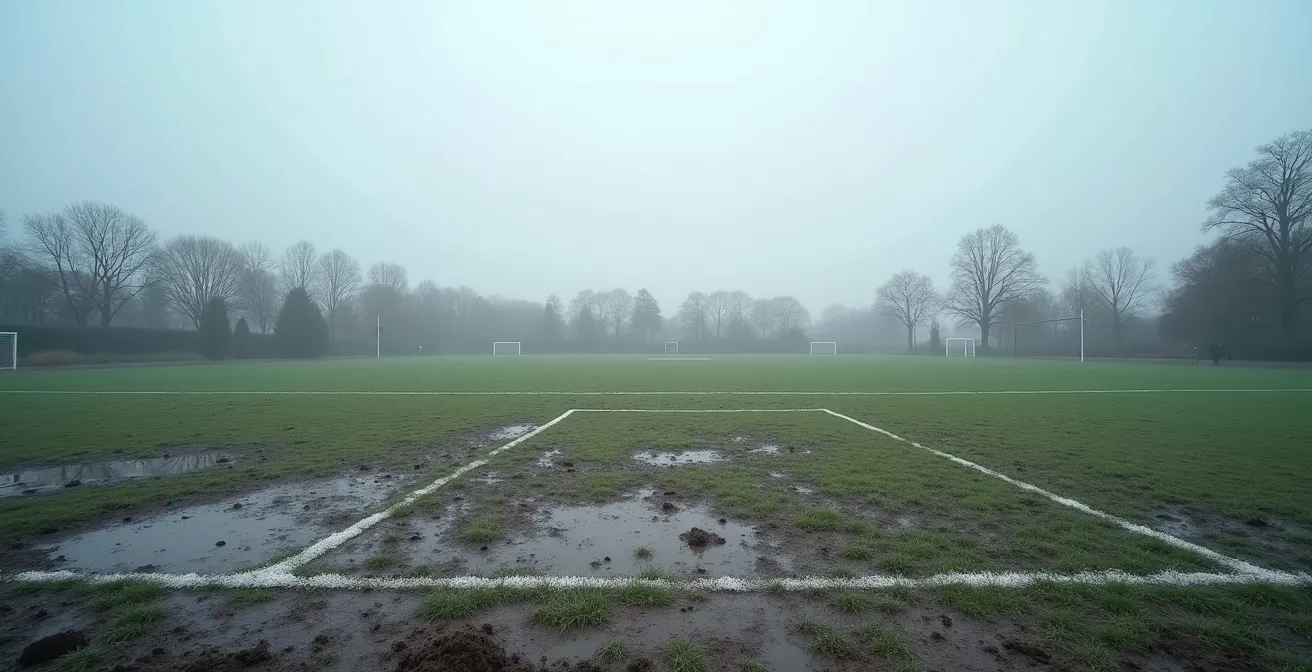
For the amateur footballer over 30, a wet winter season isn’t just about muddy kits; it’s a battle against muscle strains and persistent aches. The key to staying on the pitch isn’t about training harder, but smarter. This guide, from a sports physio’s perspective, reveals that injury prevention is a system—combining active recovery, pitch-specific equipment choices, and targeted strengthening to manage the unique biomechanical load that heavy English pitches place on your body.
That familiar Tuesday morning tightness in your hamstrings, the ache in your back as you get out of the car… for an amateur footballer over 30, these are the unwelcome medals of a hard-fought Sunday match on a heavy winter pitch. Many players accept this as an unavoidable part of the game, relying on the old advice to “stretch a bit more” or “just run it off.” They might even invest in new boots, hoping for a miracle cure for slipping and sliding in the January mud.
But what if the real solution isn’t found in a longer post-match stretch or a new piece of kit alone? What if the secret to an injury-free winter lies in a more intelligent, holistic approach? This isn’t about having the fitness of a pro, but the wisdom of a veteran. It’s about understanding the specific forces at play—the punishing biomechanical load of a waterlogged pitch on your joints and muscles—and building a simple, effective system to counteract them.
This guide moves beyond the generic advice. We will explore the real reasons your body aches days after a game and provide a practical system for recovery. We’ll demystify the crucial choice of studs for treacherous surfaces, look at the off-pitch discipline that keeps you available, and even delve into the simple ground maintenance that can transform your injury risk. It’s time to stop just surviving the winter season and start mastering it.
This article provides a comprehensive look at the strategies you can implement, both on and off the pitch, to ensure you remain a key player for your team all season long. The following sections break down everything from personal recovery to team-wide responsibilities.
Summary: A Practical Guide to Winter Sunday League Injury Prevention
- Why Your Hamstrings Feel Tight on Tuesday After a Sunday Match?
- Soft Ground vs Firm Ground Boots: Which Studs Prevent Slipping in January Mud?
- How to Negotiate Early Finishes on Fridays for Weekend Away Games?
- The Match Fee Mistake That Leaves Sunday League Captains Out of Pocket
- Red Cards and Fines: What Happens If You Don’t Pay Your County FA Fine?
- Why Does Water Sit on the Goal Mouth Even After Light Rain?
- Resistance Bands: How to Build Muscle Without Heavy Weights?
- How to Maintain a Natural Turf Pitch During a British Winter on a Tight Budget?
Why Your Hamstrings Feel Tight on Tuesday After a Sunday Match?
That two-day-later ache, known clinically as Delayed Onset Muscle Soreness (DOMS), is more than just a sign of a hard game. For your hamstrings, it’s a warning signal. On a heavy, muddy pitch, your leg swings through thick turf, and your foot often slips on contact. To control this instability, your hamstring muscles work overtime, performing intense ‘eccentric’ contractions—lengthening under load to act as brakes. This causes microscopic tears in the muscle fibres, leading to inflammation and that all-too-familiar stiffness.
For the over-30 player, recovery from this micro-trauma is slower. The issue is compounded by the explosive sprints required in a match, followed by periods of jogging or standing. This cycle of explosive effort and low-intensity movement is a perfect storm for hamstring strain, a problem that is dramatically on the rise in the sport. In fact, as shown by a UEFA study, hamstring injuries represent 24% of all player injuries in the men’s professional game, a figure that has doubled in two decades. In the amateur game, with its inconsistent training and challenging pitches, that risk is arguably even higher.
The solution isn’t to stop sprinting; it’s to implement a smarter active recovery process. Instead of collapsing on the sofa on Sunday night, your goal is to gently promote blood flow to the damaged muscle tissue. This helps flush out metabolic waste and deliver the nutrients needed for repair, significantly reducing the severity of DOMS and preparing you for the week ahead.
Ignoring these warning signs and simply “playing through it” is how a minor ache becomes a three-month tear. A proactive recovery routine is non-negotiable for season-long fitness.
Soft Ground vs Firm Ground Boots: Which Studs Prevent Slipping in January Mud?
Your choice of footwear is the most critical interface between you and a treacherous winter pitch. Using the wrong studs is like driving a car with bald tyres in the snow—you’re sacrificing control and inviting disaster. The common mistake is wearing ‘Firm Ground’ (FG) boots with moulded plastic blades on a pitch that is anything but firm. These short studs fail to penetrate the soft top layer of mud, leaving you skating on the surface. This not only reduces performance but dramatically increases the risk of groin strains, ankle rolls, and knee ligament damage as your body constantly fights for a stable base.
For the typical boggy, rain-soaked British Sunday League pitch, you need studs that offer deep penetration. This is where ‘Soft Ground’ (SG) boots come in. Traditionally, this meant a classic six-stud configuration with long, metal-tipped studs. While they provide excellent grip in deep mud, they can be risky if the ground underneath is hard, creating dangerous pressure points. The modern, and often safer, solution is a mixed-stud pattern (SG-Pro). These boots combine the deep-penetrating metal studs with shorter, moulded studs, offering a perfect blend of grip and stability across variable soft surfaces.
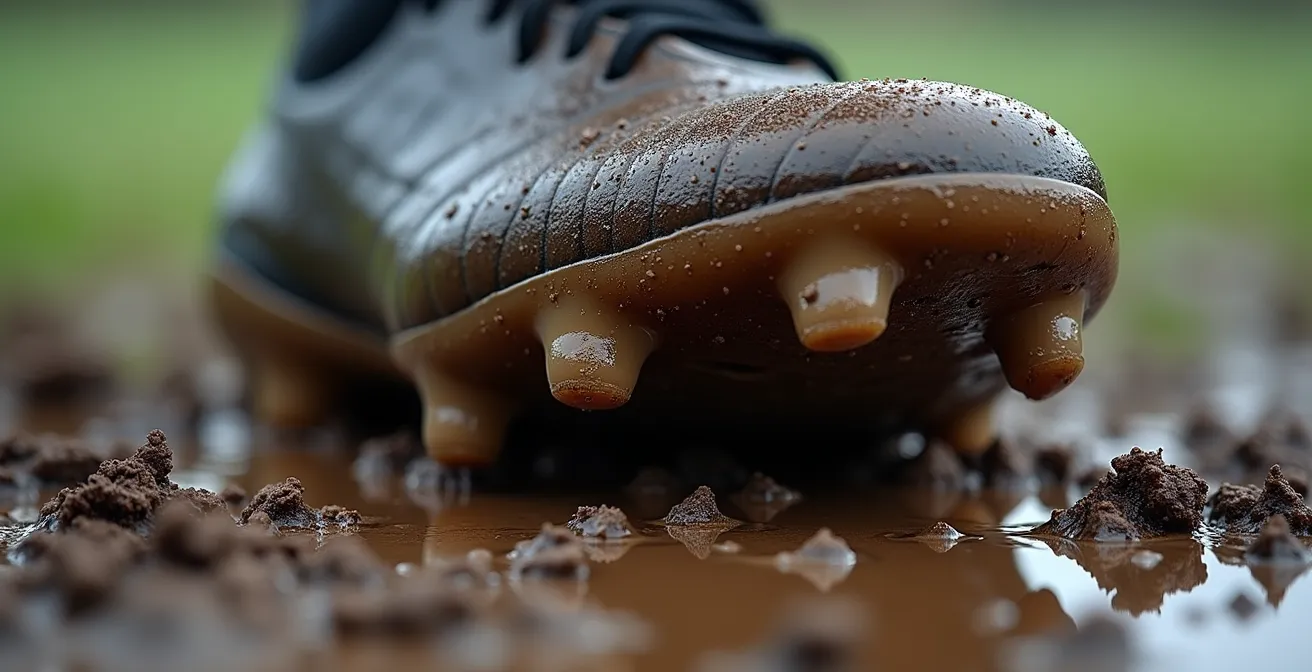
As the image above illustrates, the interaction between the stud and the turf is key. The right studs dig in, providing a firm anchor for movement, while the wrong ones slide across the top, forcing your stabiliser muscles and ligaments to take the strain. Choosing the correct stud pattern is a fundamental pillar of injury prevention in winter football. It’s not about brand; it’s about the right tool for the job.
The following table, based on UK pitch conditions, provides a clear guide for making the right choice. As analysis from sports retailers shows, a hybrid stud pattern offers a great balance of safety and performance on the unpredictable surfaces common in grassroots football.
| Pitch Condition | Recommended Stud Type | Injury Risk Level | Key Considerations |
|---|---|---|---|
| Soft/Muddy Top Layer | SG-Pro Mixed Pattern | Low | Combination of metal and moulded studs provides stability |
| Waterlogged Surface | Traditional 6-Stud Metal | Medium | Deep penetration but risk on harder base layer |
| Greasy/Slippery | AG/FG Hybrid | Low-Medium | Multiple contact points prevent rotation injuries |
| Variable (Soft/Hard Mix) | Avoid Bladed FG | High | Blades can catch causing ACL/MCL stress |
Ultimately, owning two pairs of boots—one for firm, early-season pitches and one for the soft winter slog—is not a luxury. It’s an essential investment in your own physical wellbeing.
How to Negotiate Early Finishes on Fridays for Weekend Away Games?
The commitment to Sunday League extends beyond the 90 minutes on the pitch. Long away trips, especially in winter, mean late Friday nights and early Saturday departures, which can clash with work responsibilities. For the amateur player, balancing this passion with a career requires professionalism not just in the tackle, but also in the office. Asking for an early finish isn’t about getting a favour; it’s about proposing a flexible working solution that benefits everyone.
The first step is to be prepared. Before you even approach your manager, research your company’s flexible working policy and familiarise yourself with your basic employment rights in the UK. Frame your request not as a disruption, but as a structured plan. Propose ‘front-loading’ your week, demonstrating how you will complete all your required tasks and deliverables by lunchtime on Friday. Offer reciprocal flexibility, such as starting earlier on Mondays or covering an unpopular shift for a colleague. This transforms your request from a problem into a proactive, responsible solution.
It’s also powerful to articulate the value that your sporting commitment brings. Team sports build resilience, communication skills, and a strong work ethic—all attributes that are highly valuable in the workplace. As one industry report highlights, the dedication required for grassroots sport is a positive indicator of an employee’s character. In their analysis, the Insure24 Sports Insurance Report states:
Sunday League football provides opportunities for players of all abilities, with thousands of amateur clubs representing the heart of grassroots sport in the UK. The commitment required demonstrates teamwork, resilience, and health benefits that translate directly to workplace performance.
– Insure24 Sports Insurance Report, Sunday League Football Insurance: Grassroots Amateur Club Protection
By presenting a well-thought-out plan and suggesting a trial period of 4-6 weeks, you show that you are serious about both your job and your sport. A successful negotiation ensures you arrive for the weekend’s game prepared and unstressed, reducing the mental fatigue that can often contribute to physical injury.
Once an agreement is reached, be sure to get it in writing. A simple email confirming the arrangement protects both you and your employer, ensuring a smooth and professional setup for the season.
The Match Fee Mistake That Leaves Sunday League Captains Out of Pocket
While not directly a physical injury, the financial and administrative stress placed on a team captain can lead to burnout, distraction, and a poorly organised team—factors that indirectly impact on-pitch safety and morale. The classic Sunday morning ritual of chasing players for match fees is a huge headache. Relying on cash is inefficient and often leaves the captain to cover shortfalls for players who “forgot their wallet.” This recurring mistake can lead to significant personal financial losses over a season.
The solution is to remove cash from the equation entirely and modernise team finances. Implementing a digital-first payment system is simple and immediately effective. Apps like Monzo, Revolut, or Starling allow for instant bank transfers and payment requests, creating a clear, transparent record of who has paid. This eliminates arguments and makes the captain’s job a matter of administration, not debt collection. A ‘no pay, no play’ policy, enforced through a team chat group, becomes much easier to manage when payments are digital and trackable.
Case Study: The Power of Digital Fee Collection
The evolution of Sunday League since its inception in England in 1925 shows a constant need for adaptation. Modern teams embracing technology are reaping the rewards. A study of grassroots clubs in North London revealed that teams using digital payment apps reported 40% better fee collection rates compared to those still relying on cash. One team successfully implemented a strict ‘no pay, no play’ policy managed via a team banking app. This approach reduced the captain’s personal losses from an average of £500 per season to zero, all while maintaining a full and committed squad.
This streamlined financial management does more than just save the captain money. It fosters a culture of shared responsibility and professionalism within the squad. When players are financially committed in advance, they are also more likely to be committed on the pitch. This simple administrative change reduces pre-match stress, allowing the captain and players to focus on what matters: the game itself.
Setting up a dedicated, ring-fenced team account using a digital-first bank is a 15-minute task that can save hundreds of pounds and countless hours of stress throughout the winter season.
Red Cards and Fines: What Happens If You Don’t Pay Your County FA Fine?
Discipline, or a lack thereof, is intrinsically linked to injury risk. A moment of madness—a reckless challenge born of frustration—not only harms an opponent but also comes with serious consequences for you and your club. Beyond the immediate red card and suspension, there is a mandatory fine levied by your local County FA. Ignoring this fine is a grave mistake with escalating repercussions. The consequences are not just financial; they can remove you from the game entirely.
If a player fails to pay a fine within the specified deadline (usually 14 days), the County FA will impose a ‘sine die’ suspension. This is a Latin term meaning ‘without a day’—an indefinite ban from all forms of football. You cannot play, coach, or even manage a team until the fine and any associated administrative fees are paid in full. This suspension applies to your entire club, meaning the club itself can be barred from fixtures if its players’ debts are not settled. The FA’s Whole Game System is an efficient, automated machine; there is no escaping it.
From a physiotherapy perspective, the link is clear: poor discipline leads to dangerous play. A mistimed, aggressive tackle is a primary cause of impact injuries like fractures and ligament tears. In fact, it’s not just a perception; as legal data shows that around 23% of football injuries result from reckless challenges that could lead to disciplinary action. Therefore, maintaining on-pitch discipline is a core component of your own injury prevention strategy. Staying calm under pressure and avoiding retaliation not only keeps you on the pitch and saves you money but also protects you and your fellow players from harm.
The process is simple: report any red card to your club secretary immediately, check the Whole Game System for the official notification, and ensure the fine is paid promptly. It’s a small price to pay to ensure you can continue playing the game you love.
Why Does Water Sit on the Goal Mouth Even After Light Rain?
It’s the dreaded feature of almost every council pitch in winter: the goal mouth bog. Even after a light shower, this area can become a waterlogged mess, while the rest of the pitch remains playable. This isn’t just bad luck; it’s a direct result of extreme soil compaction. The goal mouth and six-yard box are the highest traffic areas on a pitch, subjected to constant running, jumping, and landing from goalkeepers and attackers. This intense activity squeezes the air and life out of the soil.
Think of healthy soil as a sponge, full of tiny pores and channels that allow water to drain away. An in-depth analysis of UK council football pitches revealed that goal mouths endure 8-10 times more foot traffic than the centre circle. This compresses the soil particles together, destroying the porous structure. This compaction can reduce the vital pore space by up to 70%, effectively creating an impermeable clay-like layer just below the surface. Water hits this layer and simply sits there, creating a slippery, unstable, and dangerous playing surface. A slip in a waterlogged goal mouth is a classic mechanism for groin pulls, ankle sprains, and hamstring tears.
The good news is that even on a tight budget, there’s a simple, highly effective solution: aeration. Taking a few minutes before a match or training session to manually aerate the goal mouth can make a world of difference. This doesn’t require expensive machinery. A standard garden fork is all you need to break up the compacted top layer and reintroduce drainage channels. The same study found that this simple act can improve local drainage by as much as 40%, significantly firming up the surface and reducing injury risk.
Your Action Plan: Pre-Match Goal Mouth First Aid
- Arrive 30 minutes early armed with a standard garden fork for crucial goal mouth aeration.
- Systematically fork the entire six-yard box in a grid pattern, ensuring holes are spaced about 6 inches apart and go several inches deep.
- If permitted by the council or club, apply a sand and grass seed mix to the most heavily worn and waterlogged areas to aid recovery.
- Move all team warm-up drills, especially shooting practice, to the corners of the pitch to minimise pre-match damage to the goal areas.
- Implement a team policy to rotate which goal is used for shooting practice each week to distribute the wear and tear.
This small investment of time is a collective team responsibility that pays huge dividends in playability and, most importantly, player safety.
Resistance Bands: How to Build Muscle Without Heavy Weights?
For the amateur footballer, finding time for strength training in a gym can be difficult. Yet, building resilient muscle is fundamental to surviving a winter season. This is where resistance bands become your most valuable training partner. They are cheap, portable, and incredibly effective at building the specific type of strength needed for football: proprioceptive stability and eccentric control. Unlike heavy weights, which focus on raw power, bands train your muscles to control movement and stabilise joints, which is essential for navigating a slippery, uneven pitch.
Resistance bands work by providing variable resistance throughout a movement. This forces your smaller, stabilising muscles—particularly around the hips, knees, and ankles—to fire up and work in coordination. Exercises like monster walks and banded squats are not about lifting heavy; they are about teaching your body to maintain alignment and control under pressure. This directly translates to better balance when challenged, a more stable standing leg when striking the ball, and a reduced risk of the non-contact ligament injuries that are so common on poor surfaces.
Furthermore, bands are perfect for activating key muscle groups just before a match. A 10-minute pre-match routine can “wake up” your glutes and hamstrings, ensuring they are ready to handle the explosive demands of the game. As one expert explains, this type of training is crucial for on-pitch performance.
Plyometric exercises develop power when football players train to move their body weight as quickly and explosively as possible. When completing plyometrics with resistance bands, players improve body control which translates directly into improved performance on heavy, muddy pitches.
– Dr. Christopher Wild, Orlin & Cohen Sports Physical Therapy
Incorporating a simple, band-based activation routine into your warm-up is one of the highest-impact changes you can make. It prepares your body for the specific stresses of a winter match in a way that jogging and static stretching simply cannot.
This small piece of elastic is your secret weapon for building a body that is not just strong, but resilient and intelligent enough to handle the chaos of Sunday League football.
Key Takeaways
- Injury prevention is a system, not a single action. It combines recovery, equipment, and targeted training.
- Active recovery that promotes blood flow is more effective for DOMS than passive stretching.
- Your choice of studs (SG-Pro is best for winter) is a critical safety decision, not a style choice.
- Simple, low-cost pitch maintenance like forking the goalmouth can dramatically reduce injury risk.
How to Maintain a Natural Turf Pitch During a British Winter on a Tight Budget?
The state of the pitch is the single biggest environmental factor affecting injury risk in winter. While most Sunday League teams don’t have access to a professional groundskeeper, this doesn’t mean you are helpless. A culture of collective responsibility and a few low-cost, high-impact habits can make a significant difference in preserving your home pitch through the winter months. The goal is to move from being passive users of a pitch to active custodians of it.
The most effective strategies require zero budget—only commitment. The single most powerful habit a team can adopt is a post-match ‘divot walk.’ After the final whistle, every player should spend just five minutes walking the pitch and replacing any turf that has been kicked up. This simple act prevents the exposed soil from turning into a muddy hole in the next downpour. It helps the grass recover and maintains a more even, safer playing surface for the following week. This community-focused approach has proven to be incredibly effective at a global level.
Case Study: FIFA’s Grassroots Pitch Maintenance Success
FIFA’s injury prevention programs, rolled out in over 70 countries, have consistently shown that simple, low-budget strategies are highly effective. Research on amateur clubs that implemented a mandatory 5-minute post-match divot replacement routine found that this habit alone reduced overall pitch degradation by an astonishing 60% over a season. By using volunteer player labour and basic materials like a shared bag of sand/seed mix, these clubs maintained playable surfaces throughout winter without any professional groundskeeping budget, proving that collective engagement is more powerful than expensive equipment.
Beyond divot replacement, other small changes add up. Moving warm-ups away from the already-worn central spine and goal areas, minimising intense drills in the wettest parts of the pitch, and communicating persistent issues (with photos) to the local council can all contribute to better conditions. This isn’t about creating a Premier League carpet; it’s about marginal gains that make a grassroots pitch safer and more enjoyable for everyone who uses it.
Ultimately, a team that takes care of its pitch is a team that takes care of its players. Fostering this collective responsibility is the final, crucial piece of the injury prevention puzzle.