
In summary:
- Verifying “Cornish” seafood requires looking beyond the label; it’s about investigating the story behind the catch.
- “Local” does not automatically mean “sustainable.” The fishing method is often more important than the origin.
- Key freshness indicators (eyes, gills, flesh) are non-negotiable, especially for fish intended to be eaten raw.
- Supporting day-boat fishermen directly benefits coastal communities and promotes more sustainable practices.
- Match the type of fish to the cooking method to respect both its flavour and its cost.
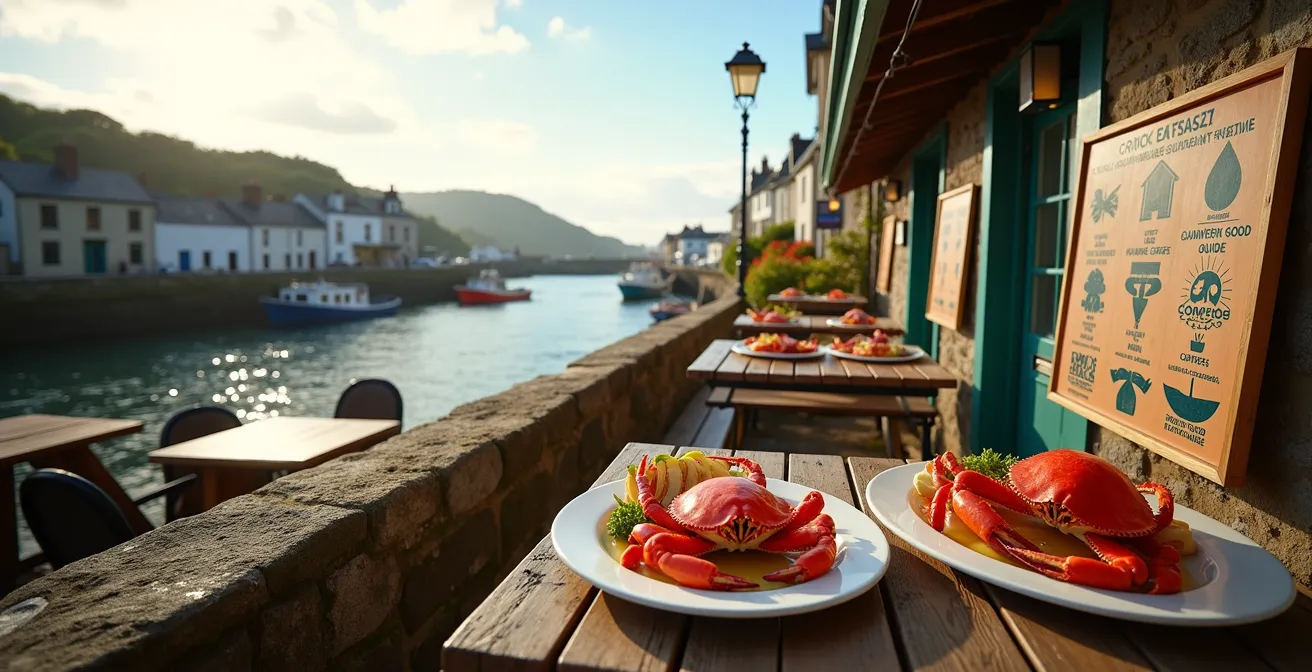
The dilemma is familiar to any conscientious diner in England. You see “Fresh Cornish Crab” on a menu and feel a sense of satisfaction. You’re choosing something local, delicious, and supporting a cherished coastal industry. We’ve all been taught to prioritise local food, assuming it’s inherently the most sustainable and ethical choice. We trust the label, pay the premium, and enjoy our meal, confident we’ve made the right decision.
But what if that trust is misplaced? The term “Cornish” is a powerful marketing tool, but it’s a statement of provenance, not necessarily of sustainability or even authenticity. Behind the simple menu description lies a complex supply chain where details about fishing methods, stock health, and the real economic impact on communities can be obscured. The true key to responsible consumption isn’t just buying local; it’s becoming a ‘seafood detective’ armed with the right questions and knowledge to see past the marketing.
This guide moves beyond the simple platitudes. Instead of just telling you to ‘ask your fishmonger’, it will teach you *what* to ask and how to interpret the answers. We will explore the science behind old fishermen’s tales, learn professional techniques for handling live seafood, and critically examine the widespread belief that local is always best. You will gain the tools to verify freshness, understand the economics of the fishing industry, and ensure your choices genuinely support the sustainable future of Cornwall’s fisheries.
This article provides a complete framework for making informed decisions. By navigating through these key topics, you’ll learn how to transform from a passive consumer into an active and knowledgeable advocate for authentic, high-quality Cornish seafood.
Contents: Your guide to becoming a Cornish seafood detective
- Why You Should Never Buy Native Oysters in Months Without an ‘R’?
- How to Prepare a Live Crab at Home Without Getting Pinched?
- Wild Sea Bass vs Farmed: Is the Taste Difference Noticeable in a Curry?
- Cloudy Eyes and Gill Color: The 3 Signs a Fish Is Not Fresh Enough to Eat Raw
- Day Boats vs Trawlers: Why Buying from Day Boats Supports Coastal Communities?
- Stargazy Pie: The History and Recipe of Cornwall’s Most Famous Dish
- The Local Food Trap: Why “Local” Doesn’t Always Mean Sustainable?
- Veg Box Schemes: Are They Really Cheaper Than the Supermarket?
Why You Should Never Buy Native Oysters in Months Without an ‘R’?
The old saying to only eat oysters in months with an ‘R’—September through April—is one of the most enduring pieces of seafood folklore. It’s not just an old wives’ tale; it has a firm basis in biology and the history of English fisheries. The rule applies specifically to the native European flat oyster (Ostrea edulis). During the warmer summer months (those without an ‘R’), native oysters are spawning. In this state, they become milky and soft, with a texture and flavour that is considered undesirable by most connoisseurs. Consuming them during their reproductive cycle also hinders the natural replenishment of wild stocks.
However, in the modern seafood market, this rule has become less of a universal truth. The majority of oysters now sold are the hardier Pacific oyster (Crassostrea gigas), which are farmed year-round. Furthermore, many of these are “triploid” or sterile oysters, which do not spawn at all and thus maintain their firm texture and clean flavour throughout the summer. Therefore, a true seafood detective needs to go beyond the calendar.
Instead of relying on the month, your investigation should focus on the species and origin. When you see oysters on a menu, asking the right questions is paramount to understanding what you’re truly getting. This is the only way to know if you’re enjoying a sustainably sourced local delicacy or a mass-produced import. Reputable suppliers, especially those recommended by the Cornwall Good Seafood Guide, will be happy to provide these details. The key questions to ask are:
- Is this a native European flat oyster or a Pacific oyster?
- Where exactly was this oyster farmed or harvested from?
- If it’s a Pacific oyster, is it a triploid (sterile) variety?
- What was the harvest date?
How to Prepare a Live Crab at Home Without Getting Pinched?
Bringing a live, feisty Cornish crab into your kitchen can be an intimidating prospect. The primary concern for most is avoiding those powerful claws, but for a conscientious cook, the focus should be equally on humane and efficient preparation. The professional method prioritises both safety and animal welfare, ensuring a clean process and the highest quality meat. Forget trying to wrestle a fully active crab; the key is to induce a state of stupor first.
The most humane and widely accepted method, compliant with the UK’s Animal Welfare (Sentience) Act, is to place the crab in the freezer for approximately two hours. This process doesn’t kill the crab but renders it completely immobilised and insensible, making the next steps safer for you and less stressful for the animal. Once the crab is in this torpid state, you can handle it without fear of being pinched.
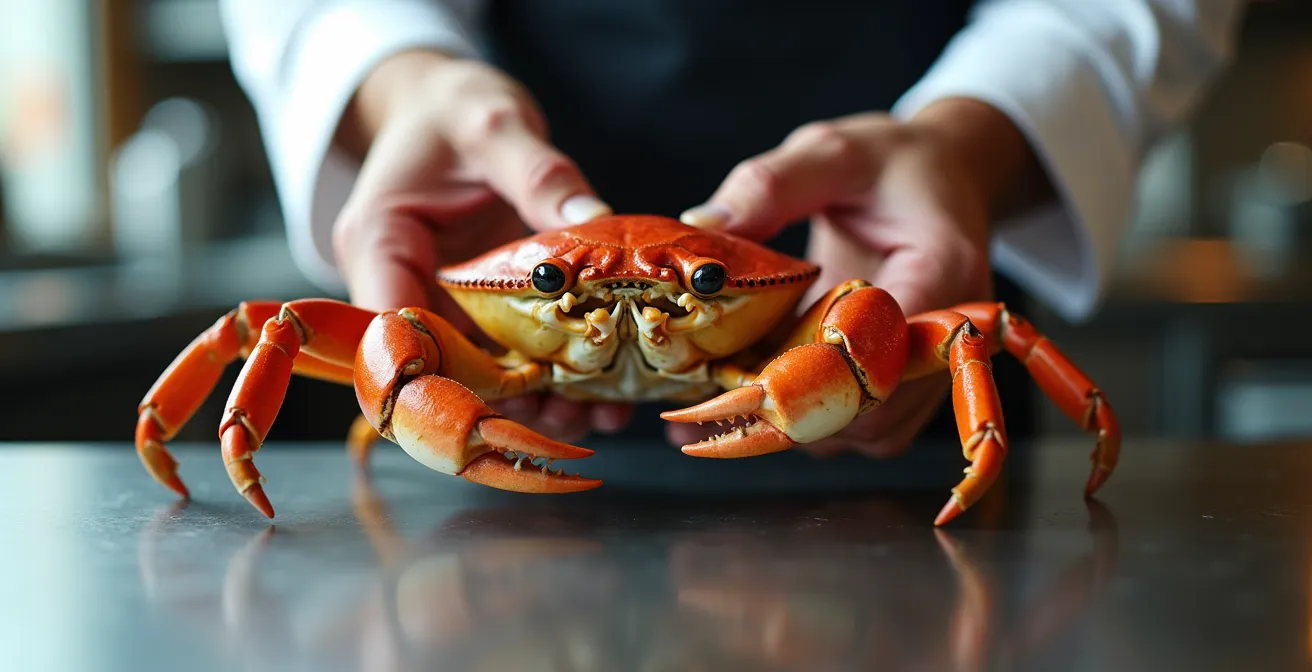
As the image demonstrates, the safest way to handle the crab is from behind. The “tail flap” on the crab’s underside provides a natural and secure gripping point, keeping your hands far from the claws. With the crab immobilised and held firmly, the final dispatch can be performed quickly and cleanly with a sharp, heavy knife or a specialised spike, targeting the nerve centres. This pro-chef method ensures minimal suffering and preserves the delicate texture of the meat, which can be compromised by stress hormones. It transforms a daunting task into a controlled, respectful culinary process.
Wild Sea Bass vs Farmed: Is the Taste Difference Noticeable in a Curry?
The choice between wild Cornish sea bass and its farmed Mediterranean counterpart presents a classic dilemma for the seafood shopper: quality versus cost. A line-caught wild bass from Cornish waters is a premium product, celebrated for its delicate, flaky texture and subtle, clean flavour. This quality comes at a price, often two to three times higher than farmed bass. The question is, is that extra cost ever justified, and when is it simply a waste of a magnificent ingredient?
The answer lies entirely in the preparation. When a fish is destined for a dish with powerful, complex flavours like a Thai green curry or a rich tomato-based stew, the subtle nuances that make wild bass so special are completely overwhelmed. In this context, the firmer, more resilient texture of farmed bass is actually an advantage, as it holds up better to vigorous cooking without falling apart. The taste difference, once masked by coconut milk, chilli, and spices, becomes negligible.
This is not a matter of one being “better” than the other, but of choosing the right fish for the right job. As the Cornwall Wildlife Trust’s seafood guidelines aptly put it:
Using a delicate, line-caught Cornish wild sea bass in a heavily spiced dish is a waste of its subtle flavour and higher cost.
– Cornwall Good Seafood Guide, Cornwall Wildlife Trust Seafood Guidelines
To reserve wild Cornish sea bass for simple preparations like pan-frying with butter and lemon, where its superior qualities can truly shine. For your curries and flavour-packed dishes, a good quality farmed bass is not only more economical but arguably better suited to the task.
| Characteristic | Wild Cornish Sea Bass | Farmed Mediterranean Bass |
|---|---|---|
| Texture | Delicate, flaky | Firm, resilient |
| Price per kg | £25-35 | £8-12 |
| Food Miles | 0-50 miles | 1500+ miles |
| Best Preparation | Simple pan-frying | Suitable for curry |
| Sustainability Rating | MCS Rating 3-4 | ASC Certified |
Cloudy Eyes and Gill Color: The 3 Signs a Fish Is Not Fresh Enough to Eat Raw
When selecting fish, especially for preparations like sashimi, ceviche, or sushi, there is no room for error. Freshness is not just a matter of taste; it is a critical aspect of food safety. While a fish that is a few days old might be perfectly fine for cooking, consuming it raw requires it to be in peak condition. A seafood detective relies on a series of sensory checks, a “fisherman’s handshake” that provides an instant assessment of quality.
The most telling signs are found in the eyes, gills, and flesh. First, look at the eyes. They should be bright, clear, and slightly bulging. Cloudy, sunken, or dull eyes are the first and most obvious indicator that the fish is past its prime. Second, lift the gill cover and examine the gills. In a truly fresh fish, they will be a vibrant, bright red, similar to the colour of fresh blood. As the fish ages, the gills will fade to a dull pink, then brown, and finally a slimy grey—a clear warning sign of deterioration.

Finally, perform the press test. Gently but firmly press the flesh with your finger. On a fresh fish, the flesh will be firm and elastic, springing back immediately to leave no indentation. If your fingerprint remains, the flesh has begun to break down, and the fish is not suitable for raw consumption. Beyond these physical checks, a reputable Cornish fishmonger will be proud to tell you the name of the boat that caught the fish and the date of the catch. This transparency is the ultimate sign of a quality product.
Your Seafood Detective’s Checklist: Verifying Freshness for Raw Consumption
- Visual Inspection: Scrutinise the fish for clear, bulging eyes and check under the gill cover for a vibrant, bright red colour. Reject any with cloudy eyes or brown gills.
- Tactile Test: Press the flesh firmly with your thumb. It must feel firm and spring back instantly. If an indentation remains, the fish is not fresh enough.
- Provenance Query: Engage the fishmonger. Ask for the specific boat that landed the fish and the exact date of the catch. A proud, transparent answer is a mark of quality.
- Safety Protocol: Crucially, for raw consumption, confirm that the fish has been frozen at -20°C for a minimum of 24 hours. This is an essential FSA safety step to kill potential parasites.
- Documentation Check: Look for a Cornwall Good Seafood Guide “Recommended” sticker or other credible sustainability certifications on the display. This is a quick indicator of an audited supply chain.
Day Boats vs Trawlers: Why Buying from Day Boats Supports Coastal Communities?
The term “Cornish fish” paints a picture of small boats bobbing in a picturesque harbour, but the reality of the fishing industry is far more complex. The fleet is broadly divided into two main categories: the small-scale “day boat” fleet and the larger industrial trawlers. Understanding the difference is fundamental to making a choice that genuinely supports Cornwall’s coastal communities and promotes a more sustainable fishing model.
Day boats, typically under 10 metres in length, are exactly what their name implies. They leave port in the morning and return the same day, landing their catch within hours. They often use more selective, lower-impact fishing methods like pots, traps, and handlines. This model has a direct and profound impact on the local economy. The money from the sale of their catch circulates directly within the community, supporting the fishermen, their families, and ancillary businesses from boat maintenance to local cafes. Buying from a day boat is a direct investment in the social and economic fabric of towns like Newlyn, Mevagissey, and Looe.
In contrast, larger trawlers may stay at sea for several days, and their catch often enters a more complex, industrial supply chain. While they are a significant part of the industry, their economic impact can be less concentrated at the local level. Organisations like the Cornish Fish Producers’ Organisation (CFPO) work to represent fishers from across the spectrum, but the most direct way to ensure your money supports the grassroots of the community is to seek out seafood with clear day-boat provenance. It is the lifeblood of a sustainable and diverse fishing fleet in Europe.
Stargazy Pie: The History and Recipe of Cornwall’s Most Famous Dish
Of all the dishes in Cornwall’s culinary canon, none is as iconic or as visually startling as Stargazy Pie. The dish, a pastry-topped pie with the heads of fish poking through the crust as if “gazing at the stars,” originates from the village of Mousehole. Legend tells of a 16th-century fisherman named Tom Bawcock, who braved a fierce winter storm to fish when the village was facing starvation. His heroic catch was baked into a huge pie, with the fish heads emerging to prove it was full of fish.
Traditionally, the pie is made with local pilchards, also known as Cornish sardines. These fish have a rich history in the region, though commercial canning operations had ceased for decades. In a sign of Cornwall’s resurgent food culture, Cornish Sardines are now being canned in Cornwall again for the first time in over 40 years, reviving a lost tradition. These sardines also boast PGI (Protected Geographical Indication) status, a legal guarantee of their Cornish origin.
For the modern cook looking to recreate this dish with a sustainable mindset, the spirit of the recipe is more important than strict adherence to a single species. When sardines are out of season or unavailable, a seafood detective can adapt. The key is to choose an alternative that is both sustainable and locally sourced. A responsible approach to a modern Stargazy Pie involves:
- Using the Cornwall Good Seafood Guide to find recommended species when sardines are not available.
- Considering sustainable alternatives like line-caught mackerel or herring, which have a similar oily texture.
- Sourcing your chosen fish directly from day boats at harbours like Newlyn or Mevagissey for guaranteed freshness and provenance.
- Always looking for the PGI label on Cornish Sardines to ensure you are buying the authentic, protected product.
- Following seasonal availability calendars to ensure your choice aligns with healthy fish stocks.
The Local Food Trap: Why “Local” Doesn’t Always Mean Sustainable?
The “buy local” mantra is powerful and well-intentioned. It evokes images of supporting small producers and reducing food miles. However, when it comes to seafood, this simple rule can be dangerously misleading. This is the “Local Food Trap”: the assumption that because a fish was caught in Cornish waters, it is automatically a sustainable and ethical choice. The truth, as any seafood detective knows, is that the how and what of the catch are far more important than the where.
A fish’s sustainability rating depends on the health of its stock and the environmental impact of the fishing method used to catch it. A locally caught fish can be from a depleted stock or caught using a destructive method like bottom-trawling, which damages the marine ecosystem. This can make it a far worse environmental choice than a sustainably farmed fish from further afield. As the UK’s leading authority on the subject, the Marine Conservation Society, makes clear, the two concepts are not interchangeable.
‘Cornish’ describes the origin (provenance) but not the fishing method or stock health (sustainability).
– Marine Conservation Society, MCS Good Fish Guide 2024
The table below, based on MCS ratings, illustrates this perfectly. Pot-caught Cornish crab is an excellent sustainable choice. However, monkfish caught by bottom-trawlers in the same Cornish waters is rated as a fish to avoid. In this instance, choosing ASC-certified farmed salmon from Scotland would be the more sustainable option, despite the greater food miles. This demonstrates why a conscious consumer must investigate beyond the “local” label.
| Seafood Type | Origin | Fishing Method | MCS Rating | Sustainability |
|---|---|---|---|---|
| Monkfish | Cornwall | Bottom-trawled | 4 | Avoid |
| Salmon | Scotland | ASC-certified farm | 2 | Good choice |
| Crab | Cornwall | Pot-caught | 2 | Good choice |
| Sole | Cornwall | Beam-trawled | 3-4 | Think twice |
Your 5-Step Audit Plan for Truly Sustainable ‘Local’ Seafood
- Identify Touchpoints: Note all places you get information—the menu description, the fishmonger’s label, the server’s answer, or the packaging details.
- Gather Intel: Ask for three non-negotiable facts: the specific origin (e.g., ‘off the Lizard’), the exact fishing method (e.g., ‘pot-caught’), and the date of the catch.
- Cross-Reference for Coherence: Use your phone to check the stated species and fishing method against the online Cornwall Good Seafood Guide or MCS Good Fish Guide. Does the rating match your sustainability goals?
- Gauge Authenticity: Assess the seller’s response. Are they proud, knowledgeable, and transparent (a great sign)? Or are they vague and defensive (a major red flag)? The story is part of the proof.
- Formulate Your Action Plan: Based on the sustainability rating, make your decision: proceed with the purchase, choose an alternative ‘Good Choice’ fish from the guide, or avoid the product entirely if it doesn’t meet your standards.
Key takeaways
- “Cornish” guarantees origin, not sustainability. The fishing method and stock health are more critical factors.
- Become a “seafood detective” by asking specific questions about species, fishing method, and catch date.
- Match the fish to the cooking style. Don’t waste delicate, expensive wild fish in heavily spiced dishes.
- Support day-boat fishermen to ensure your spending directly benefits Cornwall’s coastal communities.
Veg Box Schemes: Are They Really Cheaper Than the Supermarket?
While the question of cost is central to the popularity of vegetable box schemes, their true value proposition goes far beyond a simple price comparison with the supermarket. These schemes represent a fundamental shift in how we think about our food supply chain. They build a direct connection between producer and consumer, champion seasonality, and create a transparent, accountable system. This very model provides a powerful blueprint for how we should approach buying seafood.
Imagine a “fish box” scheme that operates on the same principles. Instead of a faceless transaction at a supermarket counter, you have a relationship with the person who caught your food. This is the reality when you buy directly from a day boat or a specialised fishmonger who champions them. As noted by advocates for the Cornish food scene, small day boats land fish within a few hours of being caught and often use far more sustainable methods than larger trawlers. This mirrors the veg box promise of freshness and a lower-impact process.
This parallel economy, one on land and one at sea, is built on the same core values: quality, transparency, and community. The veg box teaches us to embrace what’s in season, even if it’s not what we originally planned to cook. Applying this to seafood means being flexible, choosing the abundant and sustainable species of the day, rather than demanding a specific fish that may be out of season or unsustainably caught. It’s about trusting the producer to provide the best of what’s available.
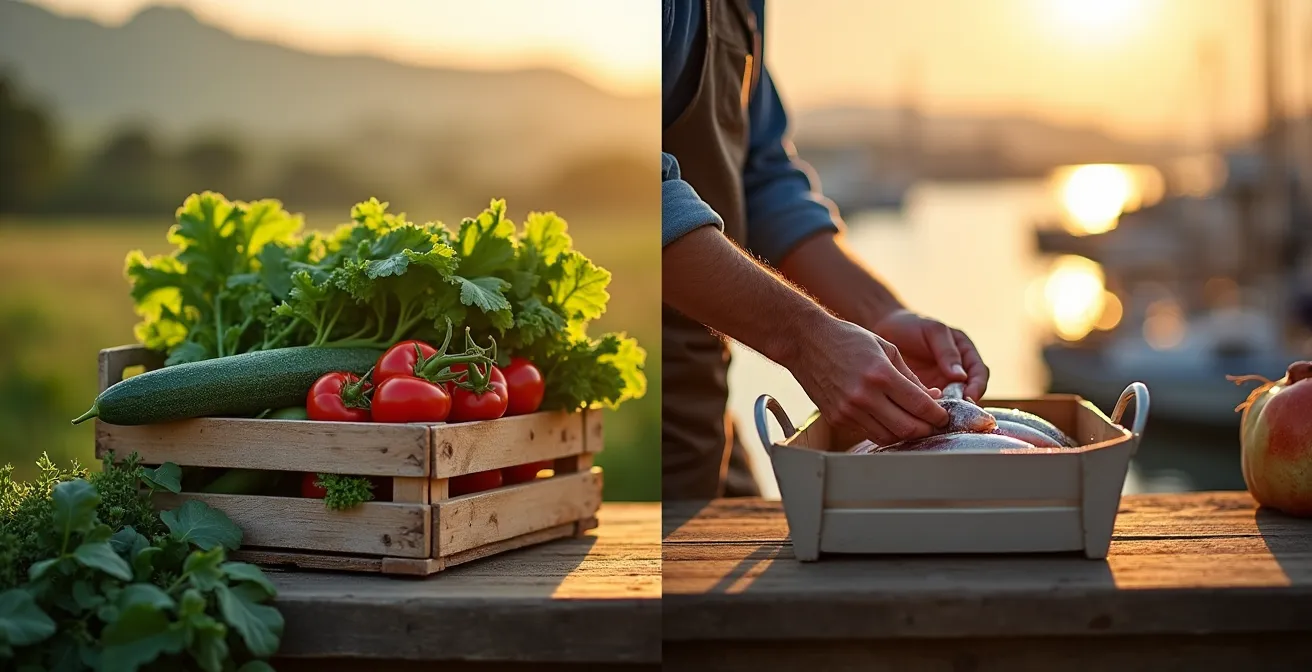
Ultimately, the veg box model’s greatest lesson is that true value isn’t just the price tag. It’s the story, the freshness, the reduced environmental impact, and the direct support for a local producer’s livelihood. By applying this mindset to our seafood choices, we can move away from the anonymous, industrial system and towards a more resilient and rewarding local food culture, both on land and at sea.
The next time you see “Cornish seafood” on a menu or at a fish counter, you are equipped with more than just an appetite. You have the investigative tools to ask the right questions and make a choice that is truly informed. Become an advocate for authentic, sustainable food with every meal you choose.