
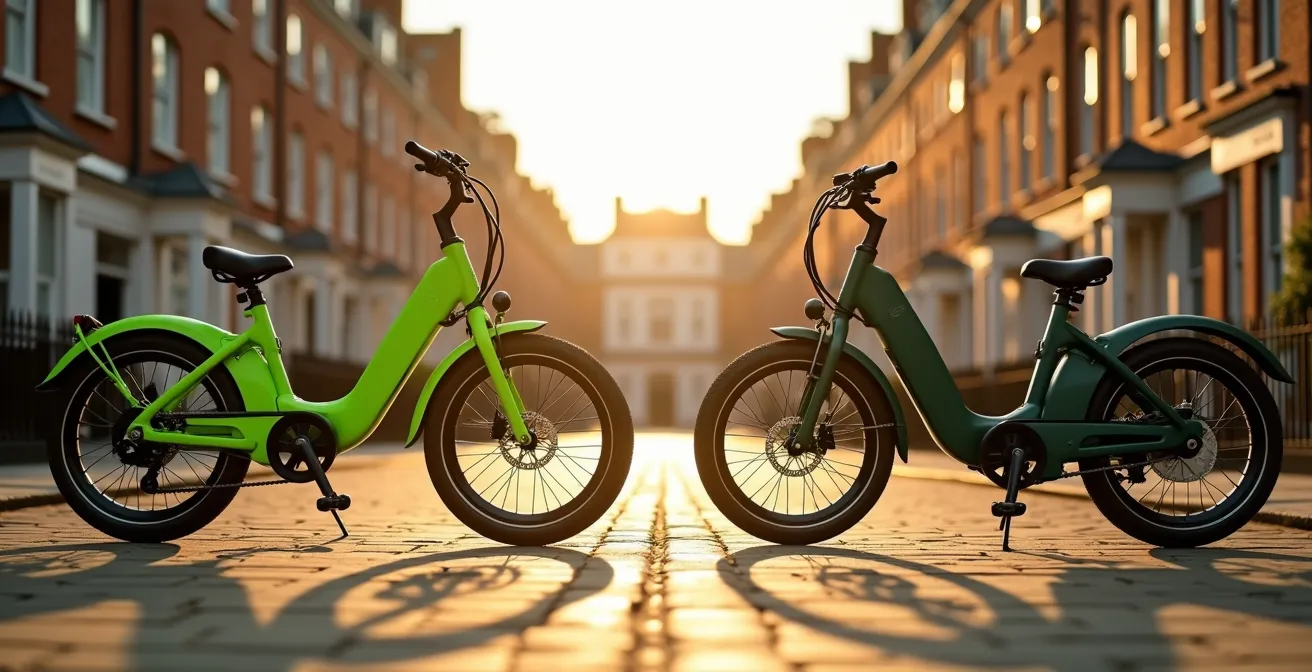
The cheapest e-bike for your London commute isn’t just about the per-minute price; it’s about mastering the hidden fees and logistics unique to your route.
- Forest often wins on short trips with its daily free minutes, but has stricter, smaller operating zones.
- Lime offers wider coverage and more powerful bikes, but its pricing structure and parking penalties can quickly become expensive.
Recommendation: Map your typical commute within the apps first. The best service is the one with ample bikes and convenient, penalty-free parking at both ends of your journey.
The daily London commute is a calculated battle against time and expense. You’ve weighed the Tube’s rush-hour crush against the unpredictable crawl of a bus. Now, a new option glimmers on every street corner: the dockless e-bike. Services like Lime and Forest promise a breezy, cost-effective alternative. But as any seasoned Londoner knows, headline prices are rarely the full story. Many analyses stop at comparing the unlock fee and per-minute rate, a rookie mistake.
This approach misses the crucial details that separate a savvy commuter from a frustrated one spending more than a Zone 1-3 travelcard. The real value lies not in the advertised price, but in mastering what can be called the ‘Total Cost of Commuting’. This includes navigating a minefield of geofencing rules, performing critical safety checks on worn-out hardware, and strategically integrating the bike into a multi-modal journey. It’s about understanding how a blazer can emerge from a bike basket ready for a board meeting, and how the bike itself becomes an extension of your professional life.
Forget the simple cost-per-minute. This guide drills down into the factors that truly determine the best e-bike service for a London professional. We’re moving beyond the basics to give you a strategic framework for choosing the right wheels for your daily grind.
This article breaks down the essential considerations, from hidden costs to practical commuting realities, to help you make the most financially savvy choice for your daily travel.
Summary: Lime vs Forest: A London Commuter’s Guide to Real E-Bike Costs
- The Geofencing Trap: Why You Can’t End Your Ride Outside Your Front Door?
- The Helmet Dilemma: How to Protect Your Head When Using Spontaneous Hire Bikes?
- Unlock Fees and Per Minute Rates: How a 15-Minute Ride Can Cost More Than the Tube?
- Brakes and Tyres: The 30-Second Check You Must Do Before Unlocking an E-Bike
- The Last Mile: How to Link E-Bike Rides with Train Commutes Smoothly?
- Smart Roads: Why Autonomous Cars Need 5G and Better Line Markings?
- Packing a Commuter Bag: How to Fold a Blazer So It Emerges Wrinkle-Free?
- How to Wear Technical Fabrics in a Corporate Setting Without Looking Like a Cyclist?
The Geofencing Trap: Why You Can’t End Your Ride Outside Your Front Door?
The dream of a door-to-door e-bike commute shatters against the hard reality of London’s geofencing. You cannot simply end your ride wherever you please. Both Lime and Forest operate within strict virtual boundaries, and failing to park in a designated bay can hit your wallet hard. Think of these rules not as a nuisance, but as a predictable ‘Geofencing Tax’ on poor planning. With councils cracking down, this is a cost you must factor into your commuting budget. For instance, Westminster Council revealed that operators face fines of £10 to £100 per misparked bike, a cost inevitably passed on to users.
The financial penalties for users differ significantly between the two main providers, making this a crucial point of comparison. A misplaced bike isn’t just an inconvenience; it’s a direct and escalating cost. Understanding the specific penalty structures is key to managing your Total Cost of Commuting.
This comparative table breaks down the potential penalties, a critical factor for any money-savvy commuter choosing a service based on their route’s parking availability, as detailed in a report by the City of London.
| Penalty Type | Lime | Forest |
|---|---|---|
| Out-of-bay parking | £2-£20 progressive fines | £1.50 flat fee |
| Out-of-zone parking | Escalating fines + ban risk | Unspecified fine amount |
| Coverage area | Larger zone coverage | More restricted zones |
| Parking bay availability | Must use designated bays in 8 boroughs | Green bays required in Camden/West London |
For the daily commuter, this data is illuminating. Forest’s lower, flat-rate penalty for out-of-bay parking seems more forgiving for a one-off mistake. However, its more restricted zones could mean a longer walk to your final destination, a hidden time cost. Lime’s wider coverage is a major advantage, but the threat of a £20 fine for improper parking demands military-grade discipline in ending your ride. The right choice depends entirely on the density of approved parking bays around your home and office.
The Helmet Dilemma: How to Protect Your Head When Using Spontaneous Hire Bikes?
While not a legal requirement in the UK for adults, the helmet question looms large over every spontaneous e-bike journey. Unlike a personal bike, you don’t have your trusty helmet with you. This creates a genuine dilemma: do you risk the ride unprotected, or abandon the convenience? For the daily commuter, this isn’t a philosophical question; it’s a practical risk assessment. The bikes are heavier and faster than you might expect, and London’s roads are notoriously unforgiving. The potential ‘cost’ of an accident far outweighs any subscription fee.
The risk is not merely theoretical. The high-torque acceleration and user-unfamiliarity can lead to incidents, making the lack of a helmet a serious concern. This has not gone unnoticed by medical professionals on the front lines.
London doctors call lime bike leg breakers due to all the accidents they are causing
– London medical professional, Harringay Online Forum
This stark warning underscores the importance of personal safety. Regular commuters are increasingly opting for collapsible helmets that can be easily stored in a work bag. Investing in one is a smart move that shifts the balance of the helmet dilemma firmly in favour of protection. It’s another factor in the Total Cost of Commuting, but one that pays dividends in peace of mind and personal safety. The alternative is to rely on hope, a poor strategy on busy city streets.
Unlock Fees and Per Minute Rates: How a 15-Minute Ride Can Cost More Than the Tube?
This is where most comparisons begin and end, but a savvy commuter knows to look deeper. The headline figures—typically a £1 unlock fee followed by a per-minute charge—are only part of the equation. For short, frequent trips, these costs can accumulate surprisingly quickly, often exceeding the price of a single Tube journey. Forest has a distinct edge here for certain users, as Forest offers significantly better value with its daily offer of the first 10 minutes free after the initial unlock fee. This makes it a formidable choice for quick hops between a station and an office.
To illustrate the real-world financial impact, let’s move beyond abstract rates and look at a concrete example. The visual below represents the kind of cost-benefit analysis a commuter might do, weighing the convenience against the real price.
The numbers tell a compelling story, especially when you factor in time. A quick ride might seem cheap, but traffic lights and pedestrian crossings can turn a 10-minute journey into a 15-minute one, fundamentally altering the cost calculation. Here’s a practical breakdown.
Real-world cost comparison for London commute
A 30-minute ride costs a hefty £9.10 on Lime (£1 unlock + 30 mins at £0.27/min). The same journey on Forest would be £6.80 (£1 unlock + 20 mins chargeable at £0.29/min after the first 10 free minutes). This already shows a significant saving with Forest for longer commutes. For comparison, a Santander e-bike ride costs just £1.65 for 30 minutes, but this is contingent on finding a docking station, which introduces a different kind of logistical challenge.
This case study proves that for any ride over 10 minutes, the “free minutes” from Forest become a powerful cost-saving tool. For the money-savvy commuter, this makes Forest a strong contender, provided the journey starts and ends within their more limited operational zones.
Brakes and Tyres: The 30-Second Check You Must Do Before Unlocking an E-Bike
Shared bikes live a hard life on London streets. They are used by thousands of riders and subjected to the elements, leading to significant wear and tear. Unlocking a bike with a fault isn’t just an inconvenience; it’s a genuine safety hazard. This is why elevating the casual once-over into a disciplined ’30-Second Audit’ before you pay is a non-negotiable part of the savvy commuter’s routine. The state of maintenance can vary wildly, not just between services, but from bike to bike.
User feedback often highlights these inconsistencies, painting a picture of a fleet with variable reliability. One bad experience with faulty equipment can sour a user on a service for good, and for valid reasons.
On my ride the front brake barely worked and the rear brake made a sound so loud and piercing that it turned the heads of the masses when applied. Forest does not use disc brakes as others do.
– User review on Cycling Electric
This testimony highlights a key hardware difference: Lime has been more aggressive in upgrading its fleet. Lime’s latest fleet upgrade data shows a significant investment, with 2.4 million trips taken in 2023 on their newer Gen4 bikes, which feature improved motors and braking systems. This continuous hardware improvement is a crucial factor, suggesting a potentially more reliable and safer ride on average. However, it doesn’t remove the need for your own pre-ride check.
Your 5-Point Pre-Ride Audit
- Brake Check: Squeeze both brake levers firmly before unlocking. They should feel tight, not spongy, and stop the wheel from turning.
- Tyre Pressure: Give both tyres a hard squeeze. They should be firm to the touch to handle London’s potholes. A soft tyre is unsafe and inefficient.
- Saddle & Power: Adjust the seat to your height. Briefly lift the back wheel and push the pedal to ensure the electric assist engages smoothly.
- Visual Inspection: Quickly scan the frame, pedals, and handlebars for any obvious damage. Check the basket is secure.
- End-of-Ride Photo: Get in the habit of taking a photo proving you parked correctly. This is your only defence against unfair fines.
The Last Mile: How to Link E-Bike Rides with Train Commutes Smoothly?
For many Londoners, the e-bike isn’t the entire commute; it’s a vital component of a larger journey, bridging the gap between a train station and the final destination. This is the classic ‘First-Mile/Last-Mile’ problem, and how well a service solves it is a massive factor in its true value. It’s no good saving ten minutes on a bike if you spend fifteen searching for one near the station. This integration with public transport is not a niche use case; it’s fundamental. In fact, TfL data reveals that an astonishing one in three shared e-bike trips in London connects directly to a public transport hub.
This highlights the importance of bike availability and permissible parking areas around major termini like King’s Cross, Victoria, or Waterloo. The experience here can make or break a service’s utility for a train commuter, as the image below captures the energy of this daily transition.

The reality on the ground can be frustrating, with different services offering vastly different levels of convenience at these critical choke points. A seamless connection is the goal, but often elusive.
King’s Cross Station Parking Challenges
Commuters frequently report major difficulties finding available Lime bikes near King’s Cross. The app often shows bikes tantalisingly close, only for the user to discover they are in restricted zones or require a long walk through construction sites to access. In contrast, Forest is often praised for its system in these areas. It clearly marks its designated green parking bays on the app map, and users report a higher density of these bays around major stations, making the train-to-bike transition far more predictable and efficient.
This practical example demonstrates that for the train commuter, Forest’s strategy of creating clear, numerous parking hubs around transport links can be a game-changer, potentially outweighing Lime’s broader city coverage.
Smart Roads: Why Autonomous Cars Need 5G and Better Line Markings?
While the title points to autonomous cars, for the daily e-bike commuter, the “smart road” is something far more immediate: London’s cycling infrastructure. The quality of cycle lanes, the clarity of road markings, and the overall safety of the network are what make a route smart or stupid. You don’t need 5G to appreciate a well-protected cycle lane during rush hour. The intelligence of the road network, from a cyclist’s perspective, is its ability to provide a safe and efficient path separate from heavy traffic. This is the environment in which your e-bike commute will either thrive or falter.
Thankfully, the city is evolving. Transport for London is actively expanding the network, creating more of these “smart” corridors for cyclists. The growth is tangible and makes a real difference to commuter confidence and route viability. According to recent figures, TfL’s network expansion shows the network has grown to 431km, a 7% increase in just 12 months. This ongoing investment is a powerful endorsement of cycling as a key part of London’s transport future and a critical factor when considering a shift to e-bike commuting.
A “smart road” for an e-bike user isn’t about futuristic tech; it’s about practical safety and efficiency. It’s a route with clear signage, a surface that isn’t riddled with potholes, and separation from cars and buses. When choosing between Lime and Forest, it’s wise to check your potential route against the TfL cycle map. A route that utilizes these expanding “smart” cycleways is likely to be faster, safer, and more pleasant, regardless of which colour bike you’re riding.
Packing a Commuter Bag: How to Fold a Blazer So It Emerges Wrinkle-Free?
The transition from cyclist to corporate professional happens in the final moments before you walk into the office. A key part of this is your bag and its contents. The e-bike itself plays a role here, specifically the front basket. Its size, shape, and sturdiness determine what kind of bag you can carry and how your belongings, including a neatly folded blazer, will fare on the journey. This is a practical detail that has a big impact on ‘Commuter-Readiness’.
The two services have taken different approaches to basket design, a detail that taller riders or those with larger bags should note. The seemingly minor detail of saddle height can also impact comfort and efficiency for those with a longer inseam.
Forest bikes have good basket capacity but saddles don’t go as high as Lime’s for taller riders. Lime’s basket design varies across their fleet but generally accommodates standard commuter bags well.
– User review on Electroheads
Beyond the bike’s hardware, what you pack is equally important for a smooth commute. A well-prepared commuter bag is a toolkit for success, containing not just your laptop but solutions for London’s unique challenges.
Here are some essentials for your London e-bike commuter bag:
- A bag specifically chosen to fit within standard e-bike basket dimensions.
- A portable power bank, as running navigation on your phone for a new route can drain the battery surprisingly quickly.
- Lightweight waterproofs, because London weather is, and always will be, unpredictable.
- A bag with a dedicated padded laptop compartment to protect your tech from the vibrations of the road.
- A small microfiber cloth for cleaning spray off your glasses or phone screen after an unexpected downpour.
Key Takeaways
- Calculate the ‘Total Cost of Commuting’ including potential fines and last-mile logistics, not just the per-minute rate.
- The non-negotiable 30-second pre-ride audit (brakes, tyres, power) is your best insurance against a faulty bike and a ruined day.
- The best service is route-dependent: check the app for parking bay density and zone boundaries around your specific home and work locations before committing.
How to Wear Technical Fabrics in a Corporate Setting Without Looking Like a Cyclist?
The final frontier of e-bike commuting is cracking the dress code. You want the performance benefits of technical fabrics—breathability, stretch, water resistance—without broadcasting to the entire office that you just hopped off a bike. This is especially relevant as e-bikes attract a new demographic of riders. Data shows that these services are a gateway to cycling for many professionals, particularly women. For example, a Steer report found that an impressive 71% of female Lime riders were not regular cyclists before using the service. These new commuters are looking for solutions that blend performance with professional aesthetics.
The secret is in the subtlety of modern materials. The market has exploded with ‘stealth’ performance wear: blazers made from merino wool blends that breathe and resist wrinkles, and trousers with hidden stretch panels. The focus is on texture and quality, as shown in the detailed shot below.

The key is to choose fabrics that look and feel premium up close but offer hidden technical advantages. Look for brands that specialise in ‘urban technical’ or ‘commuter’ apparel. These garments are designed with articulated joints for movement and discreet reflective details that are only visible when needed. The goal is to invest in a few high-quality, versatile pieces that can handle a sweaty ride and still look sharp for a 9 AM meeting. Think dark, solid colours and classic tailoring that conceals a wealth of modern fabric technology. This is how you win the commute and the day, arriving cool, comfortable, and impeccably dressed.
By choosing smart, dual-purpose clothing, you eliminate the need for a full change of clothes at the office, streamlining your routine and making the e-bike an even more efficient part of your professional life.
Ultimately, the choice between Lime and Forest is deeply personal and route-specific. By applying this framework and calculating your own ‘Total Cost of Commuting’, you can move beyond simple price comparisons and make a genuinely smart, strategic decision that enhances your daily London life.