
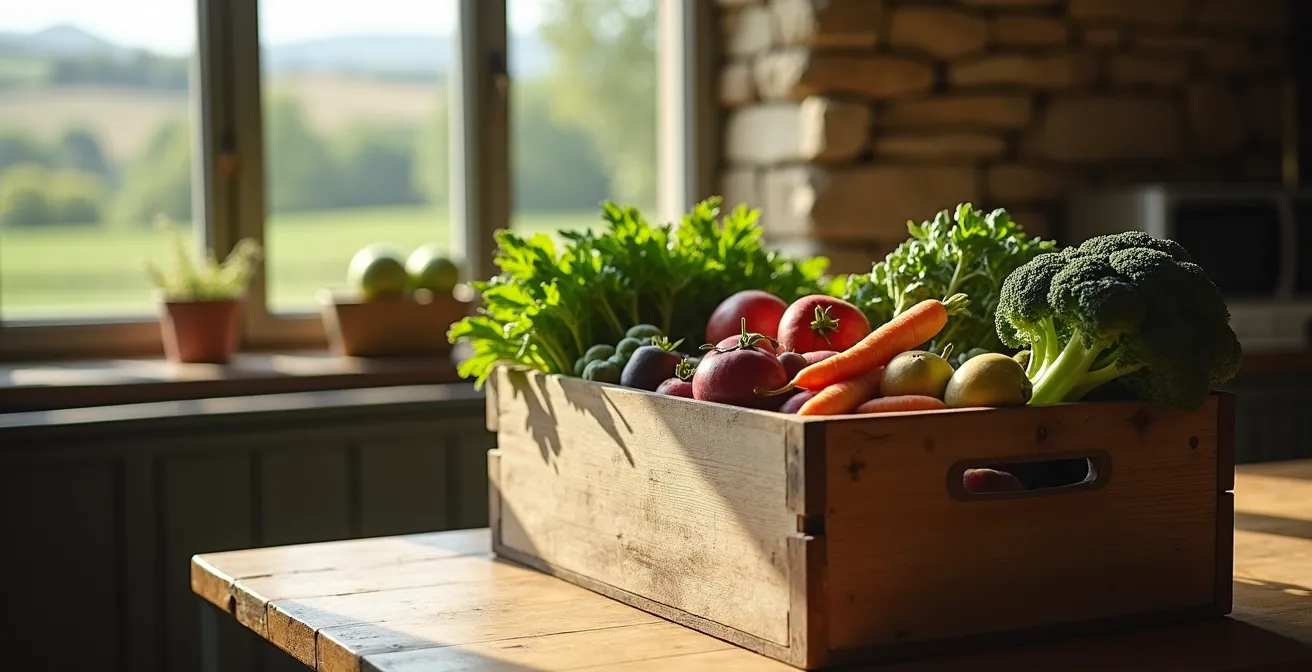
Beyond the weekly bill, a veg box scheme represents a superior long-term economic investment compared to a supermarket shop.
- It reduces household food waste by encouraging the creative use of every item.
- It directly funds the preservation of the English landscape and biodiversity.
- It keeps a significant portion of every pound spent within your local community.
Recommendation: Evaluate a veg box not on its sticker price, but on its ‘true economic value’—the sum of its benefits for your kitchen, community, and countryside.
The dilemma is a familiar one for any budget-conscious cook in an English supermarket. You reach for the organic carrots, see the price, and hesitate. You want to eat well, support local agriculture, and maybe even reduce your carbon footprint, but the weekly shopping bill is a hard reality. The siren song of a local veg box scheme promises seasonal, fresh produce delivered to your door, but the core question remains: is it actually cheaper? It’s a debate often filled with anecdotes about knobbly parsnips and overwhelming amounts of chard.
Most discussions get stuck comparing the checkout price of a £15 box to a £15 supermarket trolley. This approach, however, is fundamentally flawed. It ignores crucial economic factors that dramatically shift the value equation. We often hear that it’s “better for the environment” or “supports farmers,” but these are treated as vague, feel-good bonuses rather than tangible financial benefits. What if the real key to understanding the cost isn’t in a simple pound-for-pound comparison, but in analysing the true economic value of your food choices?
This article moves beyond the superficial price debate. As a food economist, I will guide you through a more holistic cost-benefit analysis. We will deconstruct the value hidden within that weekly box, from turning “weird” vegetables into delicious, low-cost meals to understanding how your spending directly protects the English landscape. We will explore why eating seasonally is a powerful economic choice and how even the way you cook your meat is an act of financial prudence. The goal is to equip you with a new framework for evaluating your food spend, proving that a veg box is not just a purchase, but a smart, multi-faceted investment.
To fully understand this perspective, this article will explore the tangible benefits and practical skills that unlock the full value of local, seasonal eating. The following sections break down exactly how this investment pays dividends, from your kitchen to the countryside.
Contents: A Food Economist’s Guide to Veg Box Value
- Celeriac and Chard: What to Cook with the “Weird” Veg in Your Box?
- Market Days: How to Find Genuine Producers vs Resellers?
- Pickling and Freezing: How to Save Your Surplus Summer Berries?
- The Asparagus Season: Why You Should Only Eat It in May and June?
- Open Farm Sunday: Why Visiting a Farm Changes How You Value Meat?
- How to Cook Grass-Fed Beef to Medium-Rare Without It Becoming Tough?
- Farm Shops vs Supermarkets: Why Spending £20 Locally Protects the Landscape?
- Brisket and Shoulder: How to Turn Cheap Cuts into Tender Feasts?
Celeriac and Chard: What to Cook with the “Weird” Veg in Your Box?
One of the first economic shocks for a new veg box subscriber is not the cost, but the contents. The arrival of an intimidating, gnarled celeriac or a colossal bunch of Swiss chard can feel less like a bounty and more like a culinary challenge. It’s this moment that defines the initial return on investment. If these items wilt in the fridge, the box’s value plummets. But if they are transformed into delicious meals, the cost-per-meal plummets too. The key is to see them not as “weird veg” but as high-value, versatile ingredients.
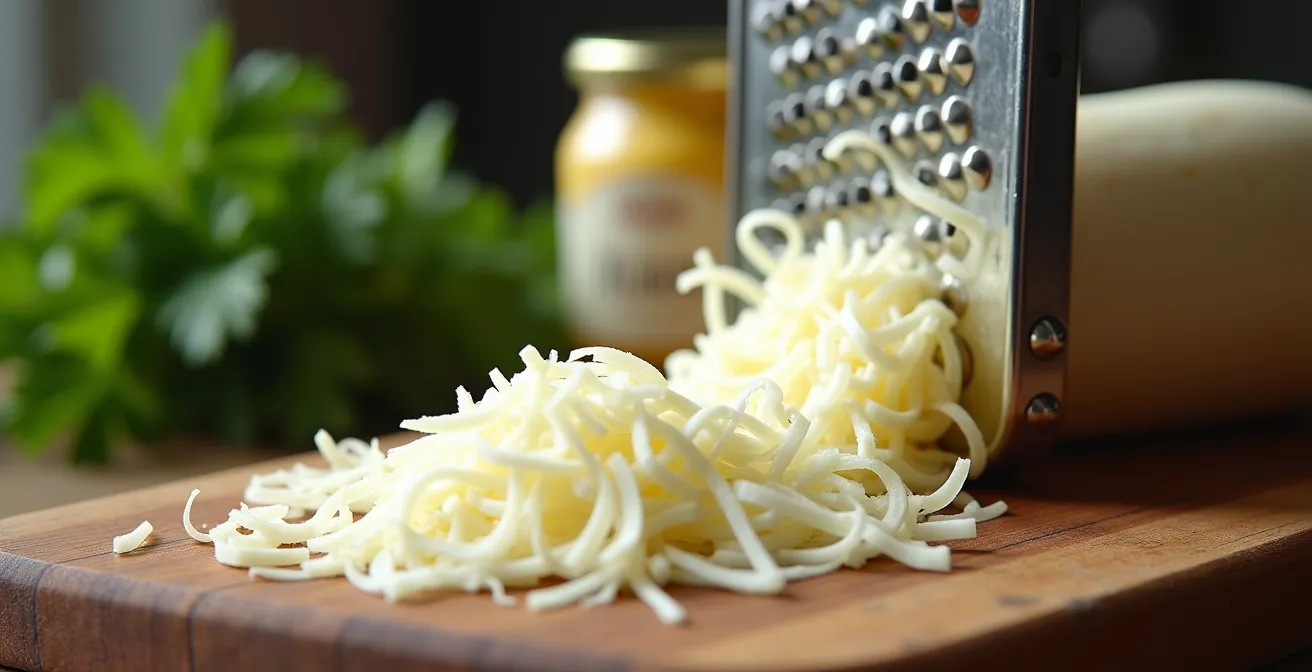
Celeriac, for example, is a powerhouse of thrift and flavour. Raw, it can be grated into a classic remoulade that lasts for days, providing a side dish for multiple meals from a single root. When you roast it, it develops a deep, nutty flavour, and when mashed with potatoes, it elevates a simple dish while stretching a more expensive ingredient. The illustration below shows the first step in creating a celeriac remoulade, a perfect example of turning a seemingly odd vegetable into a versatile, cost-effective staple.
Similarly, Swiss chard is a two-for-one vegetable. The vibrant leaves can be used anywhere you would use spinach (sautéed, in pies, wilted into pasta), while the sturdy stalks can be chopped and cooked like celery in stews or gratins, ensuring zero waste. Mastering a few simple techniques for these less-common vegetables is the first step in unlocking the true, hidden value of your veg box, turning every delivery into a net gain for your food budget.
Your Action Plan: Unlocking the Value in ‘Weird’ Veg
- Raw Preparation: Grate celeriac for remoulade or slice it into matchsticks for slaws; it pairs beautifully with apple and fennel.
- Roasting Method: Cut celeriac into chunks and roast at 180°C for 30-40 minutes until golden and nutty for a simple, flavourful side.
- Mashing Technique: Boil celeriac for 20 minutes with an equal amount of potatoes for a half-and-half mash with subtle, delicious celery notes.
- Preservation Tip: While prepping, keep cut celeriac pieces in water with a squeeze of lemon juice to prevent browning and preserve freshness.
- Chard Substitution: Use chard leaves anywhere you’d use spinach, but remember its sturdier texture may require a slightly longer cooking time.
Market Days: How to Find Genuine Producers vs Resellers?
The economic promise of “supporting local farmers” is only fulfilled if your money is actually reaching them. The term “farmers’ market” is not legally protected in the UK, which means some markets are populated by resellers who buy produce from wholesale markets and simply sell it on. This breaks the economic link between consumer and producer, diminishing the local multiplier effect and often resulting in you paying a premium for produce that is no different from a supermarket’s.
Identifying a genuine producer is a crucial act of economic diligence. A real farmer will have what can be called “total product knowledge.” They won’t just know the price; they’ll know how the weather last week in their specific part of the country affected the crop, or which of their heritage apple varieties is best for a crumble versus a sauce. They will have seasonal limitations; a stall piled high with perfect, uniform peppers in April should raise suspicion. They can tell you exactly where their farm is, and their hands often show the signs of real farm work.
Fortunately, you don’t have to be an expert interrogator. The National Farmers’ Retail & Markets Association (FARMA) provides a robust solution. Their certification scheme acts as a guarantee of authenticity. Markets displaying the FARMA logo have been independently audited to ensure that at least 75% of stallholders are the primary producers of what they sell. According to their research, this provides a vital layer of trust. The case study of Thames Valley Farmers’ Market Co-operative, for example, showed that achieving FARMA certification directly led to increased customer confidence and a stronger market. Seeking out this certification is the single most effective way to ensure your spending is a direct investment in local agriculture.
Pickling and Freezing: How to Save Your Surplus Summer Berries?
The English summer brings a glorious, but fleeting, bounty of soft fruits. A veg box in July might overflow with strawberries, raspberries, or gooseberries. Eaten fresh, they are a delight, but their short shelf-life presents an economic risk: spoilage. Letting a punnet of beautiful Kentish strawberries go mouldy is the equivalent of throwing cash in the bin. The true economist, however, sees this surplus not as a problem, but as an opportunity to lock in peak-season value for the winter months.
Preservation is the art of time-shifting value. A £5 punnet of fresh, local strawberries in July, when they are abundant and cheap, can be transformed into jam, cordial, or frozen berries that will replace a £4 punnet of air-freighted, flavourless imports in December. The most straightforward method is freezing. Spreading berries on a tray to freeze individually before bagging them prevents clumping and preserves their shape, making them perfect for winter crumbles and smoothies. Using a vacuum sealer can extend their freezer life from a standard 6-9 months to an incredible 2-3 years, maximizing your initial investment.
Beyond freezing, traditional English preservation methods offer further value. Making a “shrub” (a drinking vinegar) from raspberries is a historic technique that creates a sophisticated, high-value cordial for a fraction of the retail price. Turning Worcestershire plums into chutney or Herefordshire cherries into jam not only saves money but also creates unique, artisan products. By dedicating a few hours in the summer to preservation, you are actively managing your household food budget, combatting future price inflation, and ensuring a supply of high-quality ingredients all year round.
The Asparagus Season: Why You Should Only Eat It in May and June?
Nothing symbolises the principle of seasonal eating more than English asparagus. Its season is famously short, typically lasting just eight weeks from St. George’s Day in late April to the summer solstice. Yet, you can find asparagus in supermarkets all year round, typically flown in from Peru. While it may look the same, the economic and environmental reality is worlds apart. Choosing to eat asparagus only during its short English season is one of the most powerful statements a consumer can make.
The cost of out-of-season asparagus isn’t just on the price tag; it’s an externalised cost paid by the environment. The carbon footprint of air-freighted Peruvian asparagus is vastly higher than that of spears grown in the Vale of Evesham and transported by lorry. But the argument goes deeper, into the very structure of our rural economy. English asparagus farming is a high-risk, labour-intensive enterprise. The entire year’s profit depends on a very short sales window. When consumers buy imported asparagus in January, they are not just making a neutral choice; they are actively undermining the fragile business model of local producers.
This fragility has been amplified by recent economic pressures. As one industry analysis points out, the viability of these farms is more critical than ever. In a report on the UK farming sector, experts highlight this delicate balance:
The unique, fragile business model of English asparagus farms relies on a short profit window, making consumer support during the short season more critical than ever, especially with post-Brexit labour shortages.
– Agricultural industry analysis, UK farming sector reports
Therefore, paying a premium for English asparagus in May is not an indulgence. It is a direct capital injection into a vulnerable part of our agricultural landscape. It ensures these farms can survive, hire labour, and be ready for the next season. It is an investment in the future availability of one of England’s most prized crops.
Open Farm Sunday: Why Visiting a Farm Changes How You Value Meat?
For many, the price difference between a supermarket chicken and a free-range, pasture-raised bird from a local farm is the biggest hurdle to buying local meat. The gap can seem enormous, making the cheaper option feel like the only rational choice. This perception changes, however, when you understand what that higher price is actually paying for. Events like Open Farm Sunday, or simply visiting a local farm shop that welcomes visitors, are not just a nice day out; they are an essential part of a consumer’s economic education.
A farm visit transforms abstract concepts like “high welfare” and “sustainable farming” into tangible realities. You can see firsthand the infrastructure that your money supports: well-maintained shelters, extensive pasture for grazing, and wildlife corridors like hedgerows that boost biodiversity. You can observe the animals’ behaviour and understand the difference between a life of confinement and one with the freedom to express natural behaviours. This visit provides a crucial piece of information that is absent in a supermarket: the context of production.
This context is vital for understanding the price. As outlined in studies on Environmental Land Management schemes in the UK, high-welfare farms are not just producing meat; they are also delivering public goods. They are managing the landscape, improving soil health, and creating habitats for wildlife. The premium price for their meat is, in part, a contribution to this landscape stewardship—a service that cheap, intensively farmed meat does not provide. When you see a farmer moving their cattle in a pasture rotation system, you’re not just seeing healthy animals; you’re seeing a direct investment in soil regeneration that prevents erosion and protects local waterways. This makes the higher price less of a cost and more of a co-investment in a healthier ecosystem.
How to Cook Grass-Fed Beef to Medium-Rare Without It Becoming Tough?
Investing in high-quality, grass-fed beef from a local farm is a sound economic decision, offering superior flavour and nutritional benefits. However, this investment can be completely wasted if the meat is cooked improperly. Grass-fed beef is significantly leaner than its grain-fed counterpart. It has less intramuscular fat (marbling), which means it cooks faster and has a smaller window for achieving a perfect medium-rare. Overcooking it is an expensive mistake that turns a tender, flavourful steak into a tough, disappointing meal.
Protecting your investment requires precision. The single most important tool in your arsenal is a digital meat thermometer. Cooking by time is unreliable; cooking to temperature is a science. For cuts like sirloin or ribeye, you are aiming for an internal temperature of 54-57°C. Removing the meat from the heat at this point is crucial. The second, equally critical step, is resting the meat. This allows the muscle fibres to relax and reabsorb their juices. As British beef experts often state, slicing into a steak too early can ruin the final product, effectively wasting a significant portion of its value in tenderness and flavour.
The specific cut also dictates the method. While a quick, high-heat sear is perfect for a flat-iron steak, a reverse sear (cooking slowly in a low oven before searing) is often better for a thicker sirloin, ensuring an even cook from edge to centre. Understanding these nuances is not about being a gourmet chef; it’s about being a savvy economist in your own kitchen.
Cooking grass-fed beef requires precision to protect its inherent value. This guide provides key temperatures for popular British cuts:
| Cut | Internal Temp (Medium-Rare) | Resting Time | Cooking Method |
|---|---|---|---|
| Sirloin | 54-57°C | 10 minutes | Reverse sear or pan-fry |
| Rump | 55-58°C | 10 minutes | Lower initial heat |
| Flat-iron | 52-55°C | 8 minutes | Quick sear both sides |
| Ribeye | 54-57°C | 12 minutes | Cast iron sear |
Farm Shops vs Supermarkets: Why Spending £20 Locally Protects the Landscape?
The most profound economic argument for shifting your food spend from a national supermarket to a local farm shop or veg box scheme is the local multiplier effect. This isn’t a sentimental concept; it’s a measurable economic phenomenon. When you spend £20 in a large supermarket chain, a significant portion of that money is immediately extracted from your local area to pay for distant suppliers, corporate overheads, and shareholder dividends. In contrast, money spent with a local producer tends to stay and recirculate locally.
The numbers are compelling. Landmark research by the New Economics Foundation shows that for every £1 spent with a local business like a farm shop, around 63p is kept in the local economy. This compares to just 40p for larger, chain businesses. For veg box schemes specifically, the impact can be even greater, with some models generating up to £3.70 in social, economic, and environmental value for every £1 spent. That recirculated 63p is used by the farmer to buy supplies from a local merchant, pay a local accountant, or spend in the village pub, creating a virtuous cycle of economic activity.
This effect has a direct impact on the physical landscape. A powerful case study is that of a farm shop in the Yorkshire Dales. When a customer buys a piece of Wensleydale cheese there, that money is not just paying for cheese. It is directly funding the farmer who maintains the iconic dry-stone walls and species-rich hay meadows that define the Dales. These are “public goods” — features of our landscape that we all value, but whose upkeep is not funded by the low-margin sourcing models of major supermarkets. Your £20 spend becomes a direct investment in the preservation of England’s agricultural heritage and natural beauty.
Key Takeaways
- The ‘true economic value’ of a veg box goes far beyond its sticker price, factoring in reduced waste, nutritional quality, and community impact.
- Spending money at local farm shops or with veg schemes keeps significantly more money (up to 63p per £1) circulating in your local economy.
- Supporting seasonal, local producers is a direct investment in the preservation of the English landscape and its agricultural heritage.
Brisket and Shoulder: How to Turn Cheap Cuts into Tender Feasts?
The final pillar of the local food economy is embracing the entire animal. Supermarkets have conditioned us to favour a narrow range of expensive cuts like fillet steak and chicken breast, leaving a surplus of so-called “cheaper” cuts. For the budget-conscious cook, cuts like brisket, shoulder, and shin represent the ultimate flavour-per-pound value proposition. When sourced from a high-welfare, locally-reared animal, these cuts offer unparalleled depth of flavour for a fraction of the price of their prime counterparts.
The secret to unlocking their value lies in one simple technique: low and slow cooking. These cuts are rich in connective tissue (collagen), which makes them tough if cooked quickly. However, when cooked slowly at a low temperature (around 140°C in a standard oven or on low in a slow cooker for 6-8 hours), that collagen breaks down into gelatin. This process not only makes the meat incredibly tender but also enriches the braising liquid, creating a deeply flavourful sauce. A single, inexpensive joint of brisket can form the basis of several meals: a Sunday roast, Monday’s cottage pie, and Wednesday’s pulled beef tacos.
As British meat specialists often argue, these cuts are the smartest buy in the entire meat market. A citation from a guide on sustainable meat highlights their importance, stating that “these cuts from high-welfare, locally-reared animals offer the best flavour-per-pound value proposition in the entire meat market”. This approach completes the economic circle. It provides the consumer with multiple, low-cost, high-flavour meals while ensuring the farmer can sell the entire animal, creating a more sustainable and economically viable model for all.
To translate this economic understanding into tangible savings and better meals, the next logical step is to explore the FARMA-certified farmers’ markets or veg box schemes in your local area and start your own value analysis.