
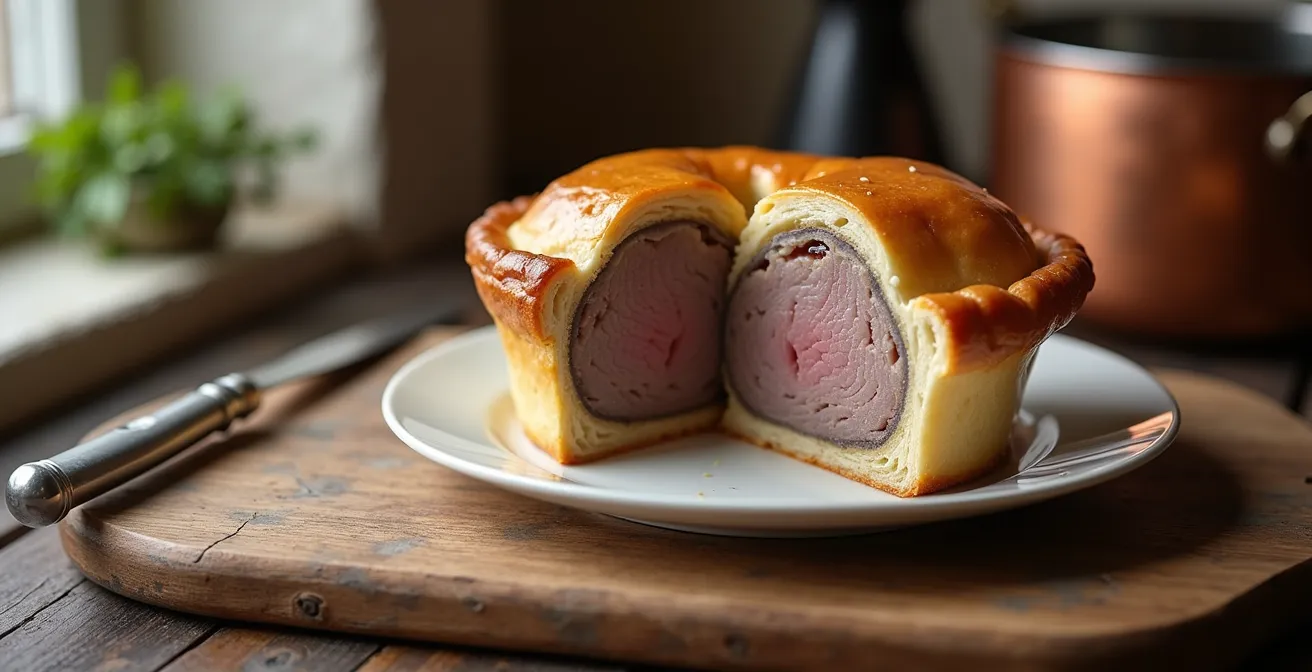
The unique character of a Melton Mowbray pork pie comes not just from its recipe, but from its legally protected ‘terroir of circumstance’—a specific blend of geography, agricultural history, and traditional craft.
- Its PGI status is a legal guarantee of origin, linking it to a specific area in Leicestershire and surrounding counties.
- The pie’s existence is a direct result of the historical symbiosis between local Stilton cheese making and pig farming.
Recommendation: To truly appreciate British food heritage, learn to identify the provenance marks on products and ask sellers about the origin of their food, moving beyond generic labels.
The Melton Mowbray pork pie is an icon of British culinary culture. Sat proudly on a pub counter or nestled in a picnic hamper, its bowed sides and golden-brown crust are instantly recognisable. For many, it’s simply a satisfying, savoury snack. The common understanding is that it’s a high-quality pork pie, perhaps enjoyed by fox hunters in centuries past. But this only scratches the surface. The real story of why this particular pie is so special lies not just in its ingredients, but in its deep connection to a specific place and a unique agricultural history that is now enshrined in law.
While other regions boast their own iconic dishes, from Cornwall’s Stargazy Pie to the famous cheeses of Wensleydale, the Melton Mowbray pie represents a perfect case study in what food historians call ‘terroir’. This isn’t just about the soil or climate; it’s a ‘terroir of circumstance’, a convergence of social practices, economic necessity, and farming logic that could only have happened in one place. Understanding this pie means looking beyond the kitchen and into the very landscape and history of the English Midlands.
This article will deconstruct the “special” nature of the Melton Mowbray pie. We will explore how geography shapes flavour, how traditional methods are protected, and how the surprising relationship with cheese production gave birth to this culinary artifact. By the end, you will not only understand why a Melton Mowbray pie is different but also how to spot the genuine article and appreciate the rich story it represents.
This guide will walk you through the key elements that define legally protected foods, using the Melton Mowbray pie as our central example. From its history to its modern-day authentication, here is the full story.
Summary: Protected Designation of Origin: Why Is a Melton Mowbray Pie Special?
- Stargazy Pie: The History and Recipe of Cornwall’s Most Famous Dish
- Cheddar vs Wensleydale: How Geography Affects Cheese Flavor?
- The Sourdough Myth: Is Traditional British Bread Actually Sourdough?
- Dry or Sweet: Which Cider Goes Best with a Ploughman’s Lunch?
- Rare Breeds: Why Eating Gloucester Old Spot Pork Saves the Breed?
- Day Boats vs Trawlers: Why Buying from Day Boats Supports Coastal Communities?
- How to Plan a Tudor History Road Trip for Key Stage 2 Students?
- How to Spot a Genuine Gastropub Menu Before You Book a Table?
Stargazy Pie: The History and Recipe of Cornwall’s Most Famous Dish
Every corner of Britain has its signature dishes, culinary flags that declare a region’s identity. Cornwall’s Stargazy Pie, with its pilchards gazing skyward through the crust, is a dramatic and unforgettable example. While visually startling, its purpose was deeply practical: to signal a plentiful catch and celebrate the bounty of the sea. These hyper-localised recipes are living history, telling a story of a community’s relationship with its environment and resources.
The Melton Mowbray pork pie, while less theatrical, is no less a product of its specific home. Its fame is such that it has become synonymous with quality across the country and beyond. The travel guide ‘Lonely Planet’, for example, describes Melton Mowbray as the town ‘which gave the world the best pork pies under the sun’. This reputation is not accidental; it’s built on a foundation of quality and tradition that has made the pork pie industry a significant economic force. The market for pork pies in the UK is substantial, with data showing that consumers spend around £165 million per year on them.
Unlike the Stargazy pie, whose story is largely confined to the village of Mousehole, the Melton Mowbray pie’s story has become one of national significance. Its journey from a local speciality to a legally protected food name is a testament to the power of provenance and the desire to preserve culinary heritage from generic imitation. This legal protection ensures that when you buy a Melton Mowbray pie, you are buying a genuine piece of that heritage.
This protection is not merely about a name, but about safeguarding a specific combination of place, ingredients, and method that defines the product.
Cheddar vs Wensleydale: How Geography Affects Cheese Flavor?
The concept of ‘terroir’ is most famously applied to wine, but it is just as crucial in understanding other foods like cheese. The difference between a sharp, earthy West Country Farmhouse Cheddar and a crumbly, lactic Wensleydale is not just a matter of recipe; it is a direct result of their geographic DNA. The breed of cow, the grasses and herbs of their pasture, the mineral content of the water, and even the ambient microflora in the ageing rooms all contribute to the final flavour profile. A cheese is, in essence, a taste of a particular landscape.
This is why the environment for ageing is so critical. Traditional Cheddar, for example, was often matured in natural caves, where the consistent cool temperature and high humidity allowed complex flavours to develop over many months. This connection between a product and its specific place is the entire basis for food protection laws.
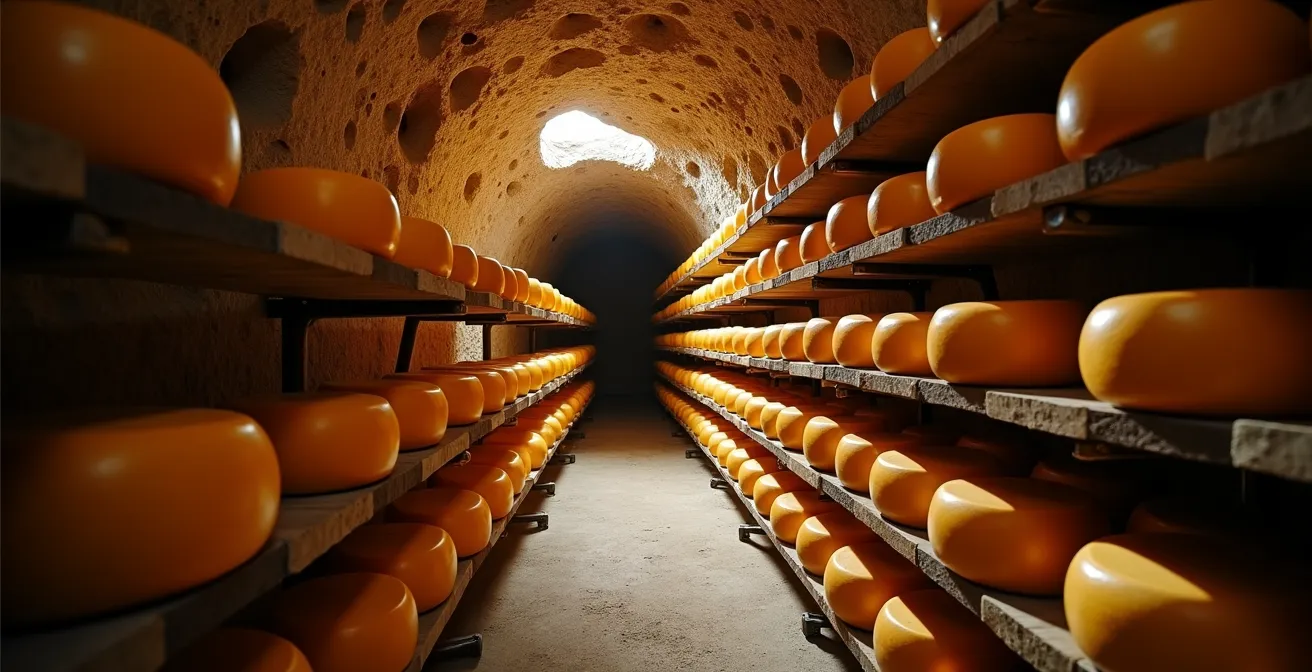
The Melton Mowbray pork pie is subject to the same logic. Its Protected Geographical Indication (PGI) status is not arbitrary. The application, granted in 2008, legally restricts the name “Melton Mowbray Pork Pie” to pies made within a defined area of around 1,800 square miles centred on Leicestershire. This legal guardianship ensures that any pie bearing the name is tied to the historical and geographical heartland of its production, preventing manufacturers elsewhere from cashing in on its hard-won reputation.
This legal boundary protects more than a name; it protects the entire ecosystem of local suppliers and craftspeople who uphold the tradition.
The Sourdough Myth: Is Traditional British Bread Actually Sourdough?
In food, “traditional” is a powerful but often misused word. The modern resurgence of sourdough has led some to question what constitutes a traditional loaf. Similarly, the term “pork pie” can describe a vast range of products, from mass-produced pucks in plastic wrapping to the genuine article. The key difference lies in the authenticity of the method. The Melton Mowbray pie’s protected status codifies not just where it’s made, but how it’s made.
The UK’s food protection scheme, which mirrors the EU’s, has several tiers. The two most common are PDO (Protected Designation of Origin) and PGI (Protected Geographical Indication). The distinction is crucial for understanding a product’s link to its region. PDO requires that every stage, from sourcing ingredients to final processing, must take place in the defined area. PGI is slightly more flexible, requiring only that at least one key stage of production occurs there. The Melton Mowbray pie holds PGI status.
This table from the UK Government’s official documentation clarifies the difference:
| Protection Type | Geographic Link | Production Requirements | Example Products |
|---|---|---|---|
| PDO (Protected Designation of Origin) | All stages must occur in defined area | Strict rules on ingredients and methods | West Country Farmhouse Cheddar |
| PGI (Protected Geographical Indication) | At least one stage in defined area | Less restrictive than PDO | Melton Mowbray Pork Pie, Wensleydale |
A core part of the pie’s traditional method is its pastry. As The Melton Mowbray Pork Pie Association explains, “a hot water crust pastry was used as the edible casing raised by hand around a bottle or wooden dolly, hence the expression hand raising a pie“. This technique, along with the use of fresh, uncured British pork and the absence of artificial additives, is a non-negotiable part of its identity. The PGI status provides legal force to these traditional methods, protecting them from industrial shortcuts.
This ensures that the skills passed down through generations remain at the heart of the product, delivering a quality that cannot be replicated by mass production.
Dry or Sweet: Which Cider Goes Best with a Ploughman’s Lunch?
Authenticity in food extends beyond a single product to the entire experience of eating it. A classic Ploughman’s Lunch is a perfect example: a slab of good cheese, a hunk of bread, some pickle, and crucially, a pint of cider or ale. The choice of drink is not incidental; it’s an integral part of the flavour balance. A sharp, dry cider from Somerset cuts through the richness of a mature Cheddar from the same region, creating a pairing that is both delicious and geographically coherent.
This principle of “what grows together, goes together” is the best way to approach pairing a traditional food like a Melton Mowbray pie. The pie’s rich, savoury pork filling and buttery crust call for a drink with enough acidity and character to stand up to it. A traditional English ale or a dry, tannic cider from the Midlands would be a far more authentic and complementary partner than a generic lager or a sweet, fizzy commercial cider.
Choosing an authentic pairing is an act of appreciating the full context of the food. It honours the agricultural landscape and the traditions that produced not just the food, but the drinks designed to go with it. To help navigate this, one can follow a simple audit process to ensure a genuine regional experience.
Your Action Plan: Verifying Authentic Food Provenance
- Check the Label: Look for official PGI/PDO logos and the full, protected name (e.g., “Melton Mowbray Pork Pie,” not just “Pork Pie”).
- Question the Origin: Ask the seller where the product and its main ingredients come from. A knowledgeable seller of a genuine product will know the answer.
- Assess the Ingredients: A genuine product will have a simple, recognisable ingredient list free from artificial colours, flavours, or preservatives. For a Melton Mowbray pie, this means fresh, uncured pork.
- Look for Seasonality and Variation: Truly artisanal products often show slight variations. A menu that never changes or products that are unnaturally uniform can be red flags.
- Complete the Terroir: When pairing, choose drinks and accompaniments from the same region to create a coherent and authentic taste experience (e.g., English ale with your pie).
This approach transforms eating from a simple act of consumption into an exploration of place and history.
Rare Breeds: Why Eating Gloucester Old Spot Pork Saves the Breed?
The story of the Melton Mowbray pie is inextricably linked to another giant of the region’s food landscape: Stilton cheese. This connection is the absolute core of the pie’s origin story and a perfect example of agricultural symbiosis. It demonstrates how nothing in a traditional farming economy went to waste and how one industry’s by-product became the foundation for another.
Case Study: The Symbiotic Relationship of Cheese and Pigs
Melton Mowbray’s rise as a pork pie hub was no accident. The area was, and still is, a centre for dairy farming and cheese production, particularly Stilton. The cheese-making process creates a significant amount of whey, a liquid by-product rich in protein. For centuries, farmers saw this not as waste but as a valuable, free food source for pigs. As a result, where there were dairies, there were pigs. This symbiotic link between dairy and pork farming created a local abundance of high-quality pork, naturally leading to the development of products like the famous pork pie.
This historical logic underpins the quality expectations for the modern pie. The PGI rules specify that the pie must have a minimum 30% meat content, using coarsely chopped fresh British pork. This commitment to quality and authenticity often commands a 10-15% price premium over generic counterparts, a price consumers are willing to pay for a superior product. This premium, in turn, supports the farmers, including those who raise traditional rare breeds like the Gloucester Old Spot, creating a market that helps ensure their survival.
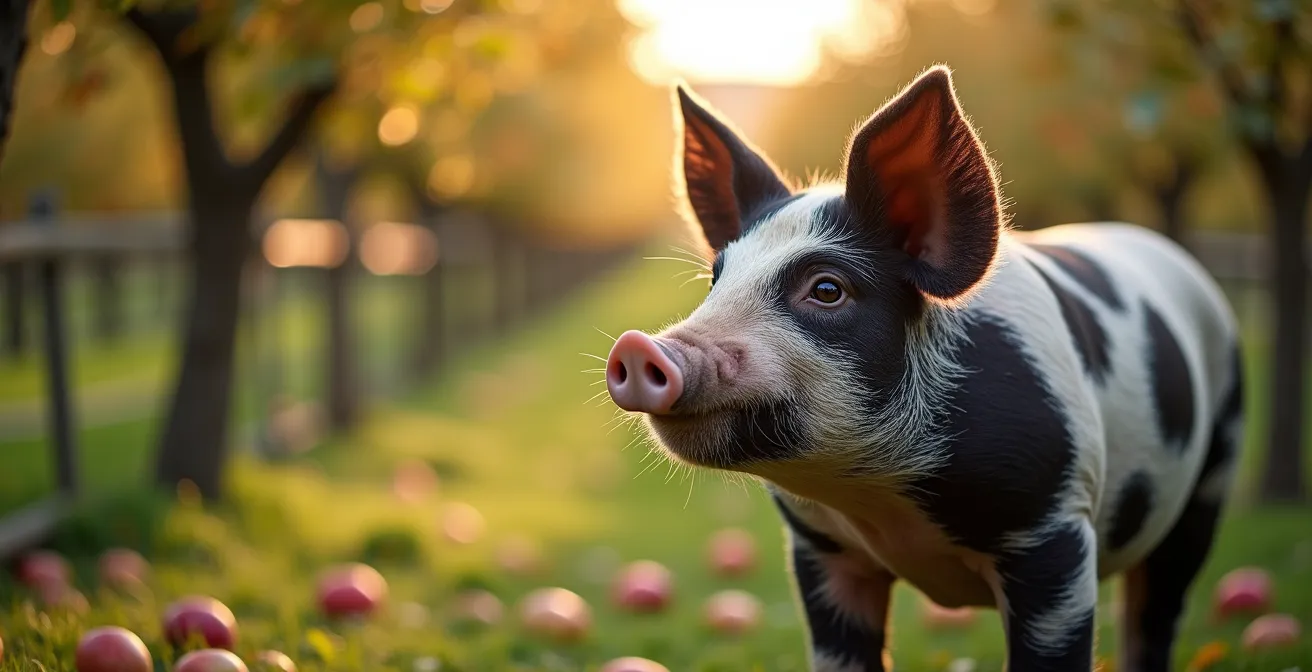
Therefore, choosing a genuine Melton Mowbray pie is not just a culinary choice; it’s a vote for a more sustainable and historically-grounded food system.
Day Boats vs Trawlers: Why Buying from Day Boats Supports Coastal Communities?
In the world of seafood, the term “day boat caught” has become a powerful byword for quality, freshness, and sustainability. It tells the consumer a story: this fish was caught by a small boat that returned to port within 24 hours, was handled with care, and supports a local fishing community. It distinguishes the product from that of large, industrial trawlers that may be at sea for weeks. This language of provenance helps consumers make informed choices.
The name “Melton Mowbray” on a pork pie functions in exactly the same way. It is a shorthand, a mark of authenticity that conveys a wealth of information to those who understand its meaning. It signifies a product made in a specific place, using a traditional method, with high-quality, uncured pork. It speaks of a history rooted in the local dairy industry and the traditions of the hunt. Just as one might ask a fishmonger, “Was this caught by a day boat?”, a discerning food lover can use the PGI mark to identify a genuine culinary artifact.
The challenge for consumers is to learn this language of provenance. It requires moving beyond simple product names and looking for the official seals and geographical indicators that guarantee authenticity. By doing so, we not only ensure we are buying a better quality product but also actively support the producers and communities that are the custodians of these great food traditions. This conscious consumerism is vital for their preservation.
It’s about recognising that not all products that look the same on the shelf share the same story or quality.
How to Plan a Tudor History Road Trip for Key Stage 2 Students?
While the Melton Mowbray pie as we know it today was perfected in the 18th and 19th centuries, its lineage stretches back much further. The concept of enclosing meat in a pastry case—a “pye”—is medieval in origin. The very first recorded recipe for a pork pie dates to 1390, found in the kitchens of King Richard II’s court. However, these early pies were very different from their modern descendants.
In the medieval and Tudor periods, the pastry case, often made with a simple flour and water paste, was primarily an inedible container. Its job was to preserve the meat filling during cooking and storage, much like a modern casserole dish or plastic container. The thick, hard crust would be broken open, the contents eaten, and the case itself often discarded or given to the poor. It was a purely functional vessel.
The great evolution occurred in the 18th century. It was then that the hot water crust pastry was perfected, creating a firm but edible casing that could be “hand-raised.” This development coincided with the Enclosure Acts, which transformed the Leicestershire landscape and spurred the dairy farming that led to the pie’s symbiotic relationship with the cheese industry. The final piece of the puzzle was the rise of fox hunting in the 19th century; the pie’s sturdy, portable nature made it the perfect snack for gentlemen out on a hunt, cementing its iconic status.
This long, rich history is precisely what the PGI status seeks to honour and protect from modern, industrialised imitation.
Key Takeaways
- A Melton Mowbray pie’s special status comes from its legally protected ‘terroir of circumstance’—a unique combination of geography, history, and agricultural symbiosis.
- Its PGI (Protected Geographical Indication) status guarantees it is made in a specific region using traditional methods, including hand-raising a hot water crust and using only fresh, uncured British pork.
- The pie’s historical development is directly linked to the local Stilton cheese industry, whose whey by-product was used to feed the pigs that supplied the pork.
How to Spot a Genuine Gastropub Menu Before You Book a Table?
Having explored the deep history and specific characteristics of a genuine Melton Mowbray pie, the final step is to apply this knowledge in the real world. Whether in a butcher’s shop, a deli, or a gastropub, being able to distinguish the authentic article from a generic imitation is a skill that empowers you as a consumer and honours the tradition. A menu that simply lists “Pork Pie” is a world away from one that proudly states “Melton Mowbray Pork Pie (PGI)”.
The clues are often in the details. An establishment that respects provenance will name its suppliers, highlight the protected status of its ingredients, and build its menu around seasonal, local availability. Vague descriptions are a red flag, while specific, confident naming is a green flag. Learning to read a menu for these signs of authenticity is the key to a better dining experience.
The following table provides a simple guide to help you identify a pub or restaurant that genuinely cares about the quality and origin of its food.
| Red Flags | Green Flags |
|---|---|
| Generic ‘Pork Pie’ without provenance | ‘Melton Mowbray Pork Pie (PGI)’ with supplier named |
| Identical menu year-round | Seasonal changes reflecting local availability |
| No supplier information | Named farms, dairies, and fishing boats |
| Missing traditional pub staples | Classic pies alongside creative dishes, local ales on tap |
| Vague descriptions like ‘Ploughman’s’ | Specific details: ‘West Country Cheddar Ploughman’s’ |
Now that you are equipped with this knowledge, the next logical step is to actively seek out and support the producers and establishments that champion these great British food traditions. Ask questions, read labels, and choose the genuine article.
Frequently Asked Questions about Protected Foods
What is the real difference between a protected food and a generic one?
A protected food, such as one with a PGI or PDO logo, has a legally guaranteed link to a specific geographical area and often a traditional production method. This provides a level of quality control and authenticity that a generic product, which can be made anywhere by anyone, does not have.
How does a food’s origin really affect its quality and taste?
Origin impacts quality through ‘terroir’—the unique combination of local climate, soil, and ingredients (like specific pastures for cows)—and ‘method’—the traditional skills and craft passed down through generations. These factors create a flavour and texture profile that is difficult to replicate elsewhere.
What questions should I ask a seller to verify a food’s authenticity?
To identify a genuine product, ask: ‘Is this an authentic [Protected Name] product with PGI/PDO status?’, ‘Can you tell me which farm or producer it comes from?’, and ‘What is special about the ingredients or method used?’ A knowledgeable seller of authentic goods will be happy to share the story of their food.