

A £3,000 Savile Row suit delivers a measurable Return on Investment (ROI) by acting as a strategic tool for career advancement in the City of London.
- It visually signals a transition from junior to senior status, aligning perception with ambition.
- The construction is engineered for the unique demands of a London banker’s life, from the daily Tube commute to high-stakes boardroom meetings.
Recommendation: View the cost not as a luxury expense, but as a calculated capital investment in your professional brand and long-term career trajectory.
For a senior manager navigating the competitive landscape of London’s financial district, the transition from high-performer to leadership requires more than just excellent Q4 results. It demands a shift in perception. You’ve earned your place through intellect and diligence, but in an environment where non-verbal cues carry immense weight, your professional image becomes a critical component of your personal brand. The common advice to “dress for the job you want” is often thrown around, but it lacks a strategic framework. Many will point towards expensive off-the-rack brands or accessible made-to-measure services as a sufficient upgrade.
This approach, however, misses the fundamental point. It treats clothing as a superficial layer rather than a functional asset. The real question isn’t whether to spend money on a suit, but how to invest it for a quantifiable return. What if the key wasn’t simply looking “smarter,” but equipping yourself with a piece of ‘professional armour’ engineered specifically for the City ecosystem? The leap to a £3,000 entry-level bespoke suit from a Savile Row tailor is not an act of extravagance; it is a calculated decision in strategic signalling and performance enhancement.
This article deconstructs that investment. We will move beyond the platitudes of “quality” and “fit” to analyse a bespoke suit as a tangible career asset. We will explore the specific, data-backed differences that justify the cost, the technical choices that make it perform under pressure, and the maintenance strategy that ensures its longevity and maximises its ROI. This is a guide to understanding the Total Cost of Ownership and the tangible career benefits of commissioning a true piece of Savile Row craftsmanship.
To navigate this investment with the precision of a financial analyst, this guide breaks down every critical component. You will learn to distinguish true bespoke value, select materials for performance, and manage your new asset to ensure it pays dividends for years to come.
Summary: Why a Savile Row Suit Is a Career-Defining Investment
- Bespoke vs Made-to-Measure: Which Service Justifies the £1,500 Price Difference?
- How to Choose High-Twist Wool for Suits That Resist Creasing on Long Commutes?
- The Measurement Mistake That Ruins the Fit of Your First Bespoke Commission
- When to Dry Clean a Super 120s Wool Suit to Prevent Fabric Damage?
- Starting a Professional Wardrobe: The 3 Suits Every London Banker Needs First
- Resale Value: Which British Designer Handbags Hold Their Price?
- The Analyst to Associate Jump: How to Survive the First 3 Years in Banking?
- The 3-Coat Rule: Which Outerwear Do You Need for UK Weather?
Bespoke vs Made-to-Measure: Which Service Justifies the £1,500 Price Difference?
For the discerning executive, understanding the distinction between made-to-measure (MTM) and true bespoke is the first step in appreciating the investment. A £1,500 MTM suit is a significant step up from off-the-rack, but it is fundamentally a process of alteration. It starts with a pre-existing block pattern that is adjusted to your measurements. While offering a good fit, it can never fully account for the unique asymmetries of your body—a slightly lower shoulder, your specific posture after a day at the desk, or the way you stand in presentations.
Bespoke, in contrast, is a process of pure creation. There is no pre-existing pattern. Your cutter creates a unique paper pattern from scratch, based on dozens of measurements. This pattern is your sartorial DNA, exclusively yours. The £1,500 price difference isn’t for a label; it’s for hundreds of hours of master craftsmanship, access to exclusive fabrics from historic British mills, and a series of fittings that sculpt the garment to your body. It’s the difference between tailoring a template and architecting a structure. The result is a silhouette that doesn’t just fit, but enhances your presence, telegraphing a level of precision and authority that MTM cannot replicate.
This table breaks down the tangible differences in service and craftsmanship, clarifying exactly where the additional investment is allocated, a critical detail demonstrated in a recent comparative analysis of Savile Row services.
| Feature | Made-to-Measure (£1,500) | Entry Bespoke (£3,000) |
|---|---|---|
| Number of Fittings | 2-3 fittings | 5+ fittings |
| Pattern Creation | Modified block pattern | Individual paper pattern |
| Fabric Access | Standard collections | Exclusive mill archives |
| Hand Work Hours | 10-15 hours | 50+ hours (Savile Row standard) |
| Delivery Time | 6-8 weeks | 10-12 weeks |
| Alterations Included | Minor adjustments | Unlimited refinements |
This meticulous process ensures the suit is not merely worn, but becomes a second skin, moving with you and maintaining its form throughout the most demanding days. This level of detail is the foundation of the suit’s long-term value and performance.
How to Choose High-Twist Wool for Suits That Resist Creasing on Long Commutes?
A suit’s performance in the real world is determined by its fabric. For a City executive, the journey from a Zone 4 suburb into Bank station via a crowded Central line train is a daily crucible. This is where the concept of ‘high-twist’ wool becomes less a sartorial preference and more a strategic necessity. High-twist fabrics, often referred to as ‘Traveller’ cloths, are made from yarn that has been twisted more tightly than standard wool. This creates a natural ‘springiness’ in the fibres.
This inherent resilience means the fabric actively resists creasing and recovers its shape quickly. After an hour spent standing on a packed train, a high-twist wool suit will shed wrinkles far more effectively than a softer, more delicate weave. This ensures you arrive at the office or a client meeting looking as composed as when you left home. While Super numbers (like Super 120s or 150s) indicate the fineness of the wool fibre, they don’t necessarily correlate with durability. A high-twist Super 120s offers a perfect balance: a luxurious feel with the robust performance required for daily wear. This choice is an investment in impeccable presentation under pressure.

The intricate weave shown here is the engine of the suit’s resilience. This is craftsmanship at a microscopic level, a quality reinforced by the fact that Savile Row Bespoke Association standards dictate that member tailors invest at least 50 hours of hand labour into each two-piece suit. This time allows for the careful handling and shaping of high-performance fabrics like these, ensuring the final garment embodies both luxury and durability.
The Measurement Mistake That Ruins the Fit of Your First Bespoke Commission
The promise of a bespoke suit is a perfect fit, but this outcome is not automatic. It is a collaborative process, and the client’s preparation is as crucial as the tailor’s skill. The single most common mistake for a first-time commissioner is treating the measurement session as a passive event. An ‘engineered fit’ requires providing your tailor with the right data about your specific lifestyle. Your body posture at 9 AM is vastly different from your posture at 5 PM after eight hours hunched over a Bloomberg terminal.
Forgetting to account for your daily reality will compromise the final garment. A jacket that fits perfectly when you stand still may feel restrictive when you reach across a boardroom table. Trousers with the perfect ‘break’ over your shoes when you’re barefoot can look too short with your office Oxfords. The most critical error is failing to communicate the subtle asymmetries of your routine, such as consistently carrying a laptop bag on one shoulder, which can cause a slight but significant drop that a master tailor must account for. True bespoke is about creating a suit for your life, not just for a mannequin.
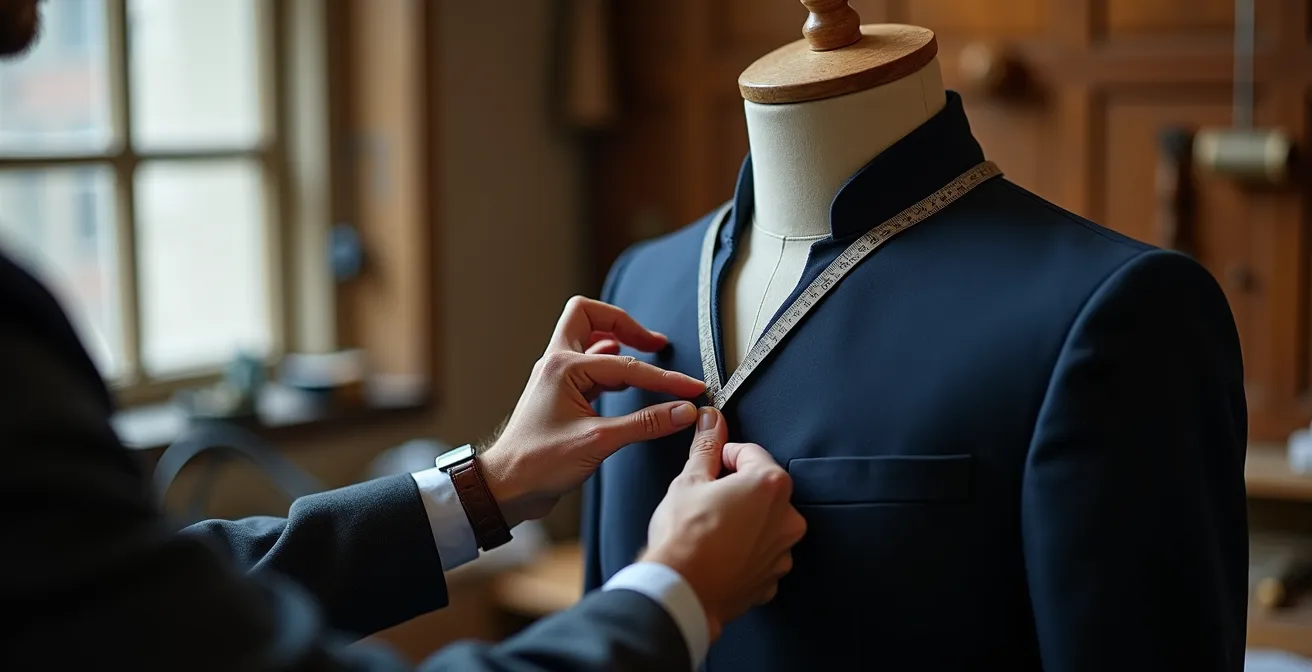
The fitting session is where the art and science of tailoring converge. It’s a dialogue between you and the cutter. By preparing properly, you provide the essential inputs that allow them to sculpt the fabric to your form and function, ensuring the final product delivers on its promise of unparalleled comfort and a flawless silhouette.
Your Pre-Fitting Preparation Checklist
- Schedule strategically: Book your fitting for late afternoon (4-5pm) to reflect posture changes after a full day at your desk.
- Bring your EDC: Carry your work phone, wallet, keys, and building pass to ensure pockets are cut to drape correctly when loaded.
- Wear your work shoes: The exact shoes you’ll pair with the suit are non-negotiable, as a mere 1cm heel difference alters the trouser break.
- Declare your carry side: Inform the tailor which shoulder you carry your laptop or work bag on to account for any developed shoulder drop.
- Define your use cases: Brief the tailor on primary activities—boardroom presentations (needing shoulder room) versus all-day desk work (needing seated comfort).
When to Dry Clean a Super 120s Wool Suit to Prevent Fabric Damage?
Investing £3,000 in a bespoke suit is only the first step; protecting that investment through proper maintenance is what determines its long-term ROI. The most misunderstood aspect of suit care is dry cleaning. The harsh chemicals and high heat involved in the process can strip the natural lanolin from wool fibres, causing them to become brittle and lose their lustre over time. For a fine Super 120s wool, frequent dry cleaning is the fastest way to diminish its lifespan and negate the value of your investment.
A bespoke suit should be dry-cleaned as infrequently as possible—a maximum of twice a year is the Savile Row rule of thumb, typically at the change of seasons. Daily and weekly care are far more important. After each wear, the suit must be hung on a quality wooden hanger with a wide shoulder flare to support the jacket’s structure and allow the fabric to breathe and shed wrinkles. A weekly brushing with a soft, natural bristle brush removes dust and surface dirt from the urban environment before it can embed in the fibres. For minor wrinkles, a gentle steaming—by hanging it in the bathroom during a shower—is far preferable to direct heat.
This disciplined approach to maintenance is what separates a true wardrobe asset from a simple garment. It’s a paradigm shift from the disposable fashion mentality, which is common at junior levels where analysts report spending as little as £100-£200 on suits for daily wear, accepting their short lifespan. In contrast, a well-maintained bespoke suit is a decade-long asset. Calculating its Total Cost of Ownership (TCO)—initial price plus minimal annual maintenance—reveals a far lower per-wear cost over its lifespan than a series of cheaper, frequently replaced suits.
Starting a Professional Wardrobe: The 3 Suits Every London Banker Needs First
For a rising professional, the goal is to build a strategic and versatile wardrobe, not just a collection of clothes. The foundation of this “asset wardrobe” for any London banker rests on three essential suits. This trio provides maximum flexibility, ensuring you are appropriately dressed for any scenario the City can present, from an internal strategy session to a last-minute client dinner at The Ned. The key is to select colours and fabrics that are versatile, authoritative, and quintessentially professional.
The core three are:
- Suit 1: The Workhorse Navy. A solid, dark navy suit in a robust Super 120s wool is the bedrock of your professional attire. Single-breasted with a notched lapel, it is appropriate for approximately 80% of business situations. It projects stability and confidence without being overly aggressive.
- Suit 2: The Power Charcoal. A mid-to-dark charcoal grey, perhaps with a subtle texture like a birdseye or pinpoint, is your go-to for high-stakes moments. It conveys authority and seriousness, making it ideal for board presentations, regulatory meetings, or year-end reviews.
- Suit 3: The Versatile Mid-Grey. A classic mid-grey suit offers the most flexibility. It can be dressed up formally or dressed down for smart-casual events and evening networking. It pairs well with a wider range of shirt and tie combinations, making it invaluable for business travel.
Case Study: The ‘Industry’ Effect on City Style
The HBO/BBC drama ‘Industry’ provides a masterclass in modern banking style. Costume designers for the show meticulously differentiate characters based on their status and origin. American executives at the fictional Pierpoint & Co. are often seen in sleek, tailored Brioni suits, signaling a more modern, aggressive form of power. In contrast, the British old guard demonstrates their established status through understated bespoke Savile Row suits, frequently double-breasted, paired with heritage items like Church’s shoes and old school ties tied in a classic double Windsor knot. This demonstrates how a suit is not just an outfit, but a cultural signifier.
Crucially, these three suits must be rotated daily. Wearing the same suit on consecutive days is the single most destructive habit for a garment’s longevity, as it prevents the wool fibres from resting and recovering their shape. A disciplined rotation can extend the life of your suits by as much as 40%, directly protecting your investment.
Resale Value: Which British Designer Handbags Hold Their Price?
While a bespoke suit is an investment in personal presentation and career advancement, other elements of a professional’s wardrobe are viewed through a more traditional financial lens. For many executives, a designer handbag is a significant purchase, and understanding its potential resale value is a key part of the investment decision. Unlike a suit, which is tailored to an individual, a handbag can be a more liquid asset. However, not all British luxury brands are created equal in the secondary market.
The brand’s prestige, production volume, and marketing strategy all impact how well a bag holds its value. Brands that maintain tight control over their inventory and rarely go on sale tend to perform better. The association with high-profile individuals, particularly British royalty, can also create sustained demand that supports strong resale prices. For an executive building a portfolio of wardrobe assets, choosing the right brand is paramount to protect the initial outlay.
The following table provides a comparative overview of how key British luxury handbag brands perform as investments, helping to guide a strategic purchase decision.
| Brand | Signature Style | Price Range | Resale Strength |
|---|---|---|---|
| Mulberry | Bayswater, Alexa | £895-£1,795 | Moderate – frequent sales impact value |
| Aspinal of London | Mayfair | £550-£950 | Strong – royal association maintains demand |
| Burberry | Check patterns | £1,290-£2,390 | Variable – depends on creative director |
| Smythson | Panama collection | £495-£1,395 | Stable – niche luxury market |
As the data suggests, a brand like Aspinal of London, with its strong royal ties and classic designs, often represents a more stable investment than brands subject to the whims of seasonal fashion trends. Making an informed choice requires looking beyond the initial appeal and analysing the long-term value proposition.
The Analyst to Associate Jump: How to Survive the First 3 Years in Banking?
The career trajectory in investment banking is a series of well-defined stages, and the transition from Analyst to Associate is arguably the most critical. This promotion is not just a change in title; it’s a fundamental shift in responsibility and, crucially, in perception. As an analyst, you are valued for your technical skills and work ethic. As an associate, you are expected to begin managing client relationships and demonstrating leadership potential. Your wardrobe must signal this transition.
Continuing to dress like an analyst—in serviceable but unremarkable off-the-rack suits—sends a conflicting message. Investing in your wardrobe is a non-verbal declaration that you understand the new rules of the game. This is where the strategic timing of your first bespoke commission comes into play. Making this investment just before or immediately after your promotion is a powerful signal to senior management that you are ready for the next level. It shows foresight, attention to detail, and an appreciation for the subtle codes of the corporate hierarchy.
This wardrobe evolution should be a deliberate, multi-year strategy:
- Year 1 (Analyst): Begin with 2-3 quality off-the-rack suits that can withstand the gruelling hours. The focus is on durability and professionalism.
- Year 2 (Senior Analyst): Commission your first MTM suit. This is a noticeable step up, signalling your growth and increasing attention to personal presentation.
- Year 3 (Associate Promotion): This is the moment to invest in your first entry-level bespoke suit. It serves as a personal milestone and a clear visual marker of your new, more senior status.
This progression mirrors the expected increase in compensation. As forum discussions among junior bankers show, first-year analysts might spend £300-500 on a suit, while associates are expected to invest £1,000 or more. Your bespoke suit places you firmly in the senior camp, aligning your image with your newly acquired responsibilities and future potential.
Key Takeaways
- A true bespoke suit is an asset engineered for performance, not a luxury expense.
- Fabric choice, like high-twist wool, is a strategic decision for real-world durability and presentation.
- Proper maintenance and rotation are non-negotiable for protecting your investment and ensuring a decade-long lifespan.
The 3-Coat Rule: Which Outerwear Do You Need for UK Weather?
A perfectly tailored suit can be instantly undermined by inappropriate outerwear. For the London professional, navigating the city’s notoriously unpredictable weather requires a strategic arsenal of coats. A single, all-purpose coat is a compromise that fails in every season. The ‘3-Coat Rule’ ensures you have the right protection for your suit and the right image for the occasion, whether it’s a drizzly April morning or a crisp January afternoon.
Your outerwear collection should be built with the same strategic mindset as your suit wardrobe. Each piece serves a distinct purpose:
- The Trench Coat: An absolute essential for the British climate. A classic Burberry or Aquascutum trench in navy or beige is the ideal garment for the transitional seasons of spring and autumn. Critically, it must be knee-length to fully protect your suit jacket from rain.
- The Overcoat: For the cold months of December through February, a dark wool or cashmere-blend overcoat is non-negotiable. A timeless Chesterfield style in navy or charcoal is the most versatile. The cardinal rule is that it must be long enough to completely cover your suit jacket hem, preserving a clean and professional silhouette.
- The Smart-Casual Jacket: For casual Fridays, weekend work, or less formal client meetings, a Barbour quilted or waxed jacket provides a polished but relaxed option. It signals an understanding of different dress codes and transitions seamlessly to after-work social settings.
Investing in these three key pieces completes your ‘professional armour’, ensuring that your presentation remains impeccable regardless of the weather. As the legendary menswear authority Alan Flusser noted when discussing Wall Street fashion history, the ultimate sign of success was to make the pilgrimage to Savile Row. According to Flusser’s comments in an interview with American Banker, “When successful Wall Street bankers made money in the 1980s, they went to Savile Row to get clothes, shoes and everything else made. That was the top of the sartorial mountain as such.” This historical context underscores the enduring power of dressing with intention.
You are now equipped with the strategic framework to view a Savile Row suit not as a cost, but as a career-defining investment. By understanding the tangible differences in craftsmanship, selecting materials for performance, and committing to a long-term maintenance plan, you can confidently commission a wardrobe asset that will pay dividends in perception, confidence, and career progression for years to come. The next logical step is to begin the dialogue with a tailoring house that aligns with your professional goals.