
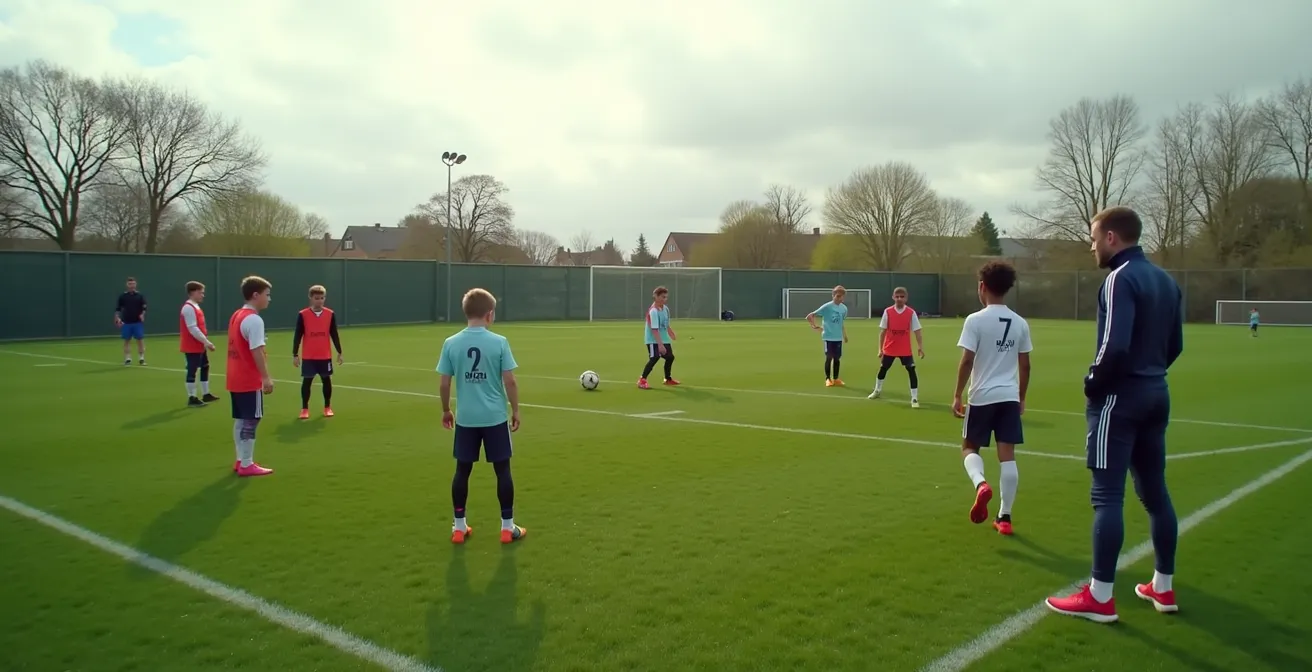
The secret to a great U10 session isn’t a library of drills, but a deep understanding of the FA’s ‘whole-child’ philosophy.
- Focus on diagnosing player needs using the Four Corner Model (Technical, Social, Physical, Psychological).
- Use the STEP principle (Space, Task, Equipment, Players) to adapt activities in real-time, ensuring every child is challenged and engaged.
Recommendation: Stop searching for the ‘perfect’ drill. Instead, use the frameworks in this guide to adapt any activity to meet the specific needs of your players on any given day.
As a volunteer coach, you know the feeling. It’s Tuesday night, and you’re staring at a blank sheet of paper, trying to conjure up a training session for your U10s. The internet shouts advice from all corners: “make it fun,” “focus on the basics,” “use small-sided games.” While true, this advice rarely explains *how* to balance the fun with genuine development, all while staying within the FA’s guidelines. It leaves you wondering if you’re truly helping your players improve or just keeping them busy for an hour.
But what if the key wasn’t about finding more drills, but about adopting a new way of seeing the players in front of you? The most effective grassroots coaches in England are moving beyond rigid session plans. They act less like drill sergeants and more like detectives. They’ve mastered a simple but powerful diagnostic framework that turns every moment of a session—from a misplaced pass to a burst of disruptive energy—into a valuable coaching opportunity. This is the heart of the FA’s modern coaching philosophy.
This guide will equip you with that same framework. We will unpack the FA’s core principles, giving you the tools to not only plan engaging sessions but also to adapt them on the fly. You’ll learn to handle common challenges, from disruptive players to sideline parents, not as problems to be managed, but as chances to coach the whole child. It’s time to build your confidence and transform your coaching.
This article breaks down the essential components of modern U10 coaching, from understanding child development to navigating the practical realities of grassroots football. The following sections provide a complete roadmap for planning and delivering sessions that are fun, effective, and fully compliant with FA principles.
Contents: A Coach’s Guide to U10 Football Development
- Technical or Social: Which Development Area Matters Most for Under-8s?
- How to Handle a Disruptive Player Without Excluding Them from the Session?
- The “Sideline Parent” Problem: How to Set Boundaries Respectfully?
- DBS Checks and Ratios: What Are the Legal Requirements for Assistant Coaches?
- When to Introduce Offside Rules to Junior Teams effectively?
- Red Cards and Fines: What Happens If You Don’t Pay Your County FA Fine?
- The Postcode Lottery: How Council Boundaries Affect Your Child’s School Choice?
- How to Stay Injury-Free During a Wet Winter Sunday League Season?
Technical or Social: Which Development Area Matters Most for Under-8s?
Before we can effectively coach U10s, we must understand the foundation they’re built on. For younger players, especially U8s, coaches often feel a pull between teaching technical skills (dribbling, passing) and fostering social skills (teamwork, communication). The common wisdom might suggest focusing on fun and social interaction, but the FA’s philosophy reveals this is a false choice. The two are deeply intertwined.
The FA’s Four Corner Model provides the essential framework for understanding this connection. It views player development through four lenses: Technical/Tactical, Physical, Psychological, and Social. For a young player, feeling socially excluded or anxious can completely shut down their ability to learn or perform a technical skill. As one expert on the subject explains, a coach’s role is to see how these corners connect; if players don’t feel included in the social group, their technical abilities become irrelevant. The core insight, confirmed by analysis of the FA’s Four Corner Model, is that social comfort is the soil in which technical skill can grow.

As you can see in a simple rondo drill, the task is both technical (one-touch passing) and social (communication, cooperation, inclusion). At the U10 level, this integration becomes even more crucial. Your session design should always consider both aspects. A brilliant technical drill that isolates players will be less effective than a slightly simpler one that encourages teamwork, decision-making, and communication. The goal is not just to create good footballers, but to develop confident and connected young people.
How to Handle a Disruptive Player Without Excluding Them from the Session?
Every coach has faced it: one player’s behaviour is pulling the focus away from the entire group. The old-school reaction might be to issue a time-out or remove them from the game. However, as a mentor coach, your goal is to diagnose the root cause, not just treat the symptom. Excluding a player is a missed opportunity for development—for both the player and the coach. A ‘disruptive’ player is often a player whose needs are not being met by the session.
This is where the Four Corner Model shifts from a development theory to a powerful, practical diagnostic tool. Instead of seeing a “naughty kid,” you can ask targeted questions. Is the behaviour a Technical issue (the task is too hard or too easy)? A Physical one (the player is tired or physically less developed)? A Social one (they are struggling to connect with teammates)? Or is it Psychological (they lack confidence or need more ownership)? Adopting this mindset is central to modern coaching, and the FA’s Four Corner model provides a checklist to guide your thinking. Once you’ve diagnosed the ‘why’, you can use the STEP principle (Space, Task, Equipment, Players) to adapt the session for that individual.
For example, if a player is being disruptive because a drill is too easy, don’t remove them. Instead, adapt the Task: can they only use their weaker foot? Or change the Space: give them a smaller area to work in, increasing the technical demand. A case study highlighted how a coach managed a challenging player in a 3v3 game by giving them an individual task to play a split pass. This channelled their energy and skill positively. This approach transforms you from a crowd controller into a precision coach, supporting individuals within the session rather than casting them out.
The “Sideline Parent” Problem: How to Set Boundaries Respectfully?
Managing the passion and expectations of parents on the touchline is one of the most challenging aspects of grassroots coaching. Instructions shouted from the sideline can confuse players, and a “win-at-all-costs” attitude can create a negative environment. The solution isn’t to build a wall between you and the parents, but to build a partnership with them, framed by the FA’s Respect code.
The key is proactive communication. Don’t wait for a problem to arise. At the beginning of the season, hold a parents’ meeting. Present the FA Respect code not as a list of rules, but as a shared agreement to create the best possible environment for their children. Explain your coaching philosophy, focusing on development and enjoyment over results. When parents understand that ‘success’ for the session might be “improving our 3-pass combinations,” they are less likely to fixate on the scoreline. A positive learning environment with clear, shared goals is your greatest tool.

Reinforce this partnership continuously. After a session, share with parents what the players did well and what they achieved against the session’s goals. When children leave training with a smile on their face because they’ve learned and had fun, parents see a value that transcends winning or losing. This approach reframes your role: you are not just coaching the children; you are leading a community of adults in the shared project of youth development.
Your 5-Point Parent Communication Audit
- Points of contact: List all the channels where you communicate with parents and players (touchline, email, WhatsApp group). Are they effective?
- Collecte: Inventory your existing club communications (welcome pack, code of conduct, season goals). Are they up to date and clear?
- Cohérence: Review your messages. Do they consistently reinforce the FA Respect values and a focus on development over winning?
- Mémorabilité/émotion: Are your communications (e.g., match reports) generic, or do they create a positive, memorable feeling for players and parents?
- Plan d’intégration: Identify the gaps. Do you need a pre-season meeting? A clearer policy on touchline behaviour? Prioritise and implement.
DBS Checks and Ratios: What Are the Legal Requirements for Assistant Coaches?
Beyond the tactics and the training, your primary responsibility as a coach is safeguarding the children in your care. This is a non-negotiable part of your role, and the FA has clear, legally-binding requirements to help you create a safe environment. Understanding these rules, particularly around Disclosure and Barring Service (DBS) checks, is essential for you, your assistant coaches, and any parent helpers.
The rule is simple and absolute. According to FA safeguarding requirements, anyone aged 16 or over who is in a role involving regular, unsupervised contact with players under 18 must have an in-date, FA-accepted Enhanced DBS Check with a Children’s Barred List check. This applies to head coaches, assistant coaches, and anyone else who might be left in sole charge of players. A willing parent who helps out occasionally under your direct supervision may not need one, but the moment their help becomes regular or potentially unsupervised, the requirement kicks in. The Club Welfare Officer (CWO) is your point of contact for this; they initiate and manage the process through the FA’s Whole Game System, ensuring everything is tracked and compliant.
The following table, based on common practice outlined by County FAs, clarifies who needs what. It is vital that your club has a clear policy and that your CWO uses the Whole Game System to manage all applications, as this provides a clear audit trail.
| Role | DBS Required | Type of Check | Who Processes |
|---|---|---|---|
| Head Coach | Yes | Enhanced with Barred List | Club Welfare Officer via WGS |
| Assistant Coach (Regular) | Yes | Enhanced with Barred List | Club Welfare Officer via WGS |
| Parent Helper (Supervised) | No | N/A | N/A |
| First Aider | Yes | Enhanced with Barred List | Club Welfare Officer via WGS |
Alongside DBS checks, you must also adhere to the FA’s recommended coach-to-player ratios. For U10s, the standard ratio is 1 coach for every 16 players (1:16). However, this is a maximum. For a quality session, a ratio closer to 1:10 allows for far greater individual attention and better overall management. These regulations aren’t bureaucracy; they are the bedrock of a safe and positive football experience for every child.
When to Introduce Offside Rules to Junior Teams effectively?
One of the most frequent questions from new coaches and parents concerns the offside rule. The simple answer is that you don’t need to worry about it for your U10 team. The FA’s youth development pathway is structured to introduce concepts as players become developmentally ready to understand them. For offside, that moment comes later. Specifically, U10s play a 7v7 format with no offside rule. The rule is first introduced at the U12 level when teams move to the 9v9 format.
However, just because the rule doesn’t exist doesn’t mean we can’t coach the principles behind it. Forcing the offside rule on young players too early often leads to confusion and stifles attacking play. Instead, you can use clever games and constraints to teach the underlying concepts of timing runs, spatial awareness, and not “goal-hanging.” This is a far more effective and age-appropriate approach than simply explaining a complex rule.
By building these concepts into your sessions, you prepare players for the formal introduction of the rule later on. When they finally encounter offsides at U12, it will feel like a natural extension of what they’ve already learned, rather than an arbitrary new restriction. Your job at U10 is to build the intelligent movement patterns, not to enforce the rule itself.
Drills to Teach Offside Principles (Without the Rule)
- End-Zone Games: Create a scoring zone near the goal that players can only enter *after* the ball has been played into it. This teaches them to time their attacking runs.
- 2v1 Overloads: In a narrow channel, have two attackers try to score against one defender. This focuses on the timing of the final pass and the runner’s movement to stay behind the ball.
- Attacking Half Rule: Introduce a condition where your team can only score once all of your attacking players are in the opposition’s half. This naturally discourages goal-hanging and promotes a cohesive team shape.
- Diamond Heist Game: A fun warm-up that implicitly trains players to recognise and exploit gaps in a defensive structure, a key skill for beating an offside trap later on.
Red Cards and Fines: What Happens If You Don’t Pay Your County FA Fine?
While we all strive for a positive environment, discipline is a part of the game. On rare occasions, issues can escalate, leading to red cards and, subsequently, fines from your County FA. It’s crucial for every coach and club official to understand that these are not optional payments. The consequences of non-payment are severe and can impact your entire club, from the U7s to the senior teams.
When a disciplinary issue occurs, the County FA investigates. If a fine is issued and not paid by the deadline, the club is placed under a ‘sine die’ suspension. This Latin term means ‘without a day’ and translates to an indefinite ban from all affiliated football. This is not just a ban for the offending player or team; it’s a ban for the entire club. No team registered under your club’s name can play in any official league or cup fixture until the fine is paid and the suspension is lifted. It’s a powerful mechanism to ensure accountability across the board.
Of course, the best approach is prevention. Disciplinary issues are often a symptom of frustration, and as a coach, you set the tone. By focusing on the FA’s Respect values in every session, you are doing more than just teaching good sportsmanship; you are actively reducing the likelihood of incidents that lead to cards and fines. Teaching players self-control should be considered as fundamental as teaching them to pass a ball. A positive demeanour from you, clear session goals, and a consistent emphasis on fair play are the most effective tools to keep your team on the pitch and your club out of disciplinary trouble.
The Postcode Lottery: How Council Boundaries Affect Your Child’s School Choice?
Many parents worry about a “postcode lottery,” not just for schools, but for football too. Does living in one area versus another mean your child has a better or worse chance of receiving quality coaching? It’s a valid concern. Access to facilities, the number of local clubs, and the availability of qualified coaches can vary significantly from one region to another. The FA is acutely aware of these regional disparities and is actively working to level the playing field.
Through initiatives like the England Football Accredited club scheme, the FA sets a national standard for what good grassroots football looks like. This kitemark helps parents identify clubs that are safe, well-organized, and committed to player development, regardless of their location. The FA’s own research has involved two years of working with grassroots stakeholders to explore how to improve the football offer for young players across the country, with new strategies set to roll out from the 2026-27 season. The aim is to ensure that a child in a rural village has access to the same quality of coaching philosophy as a child in a major city.
As a coach, this is empowering. You are not an island. Through resources like England Football Learning, you have direct access to the FA’s central brain. England Football Learning resources show that the FA provides over 50 different session plans specifically for the 7-11 age group, available to any coach, anywhere in the country. By tapping into these national resources, you can deliver high-quality, FA-approved coaching that transcends any limitations of your local “postcode.” Your commitment to development is more important than your geography.
Key takeaways
- Coach the child, not the drill: Use the Four Corner Model to understand and develop the whole person.
- Adaptability is your superpower: Employ the STEP principle to ensure every player is challenged, included, and engaged in real-time.
- Safeguarding is the foundation: Non-negotiable adherence to DBS checks, ratios, and the Respect code underpins everything you do.
How to Stay Injury-Free During a Wet Winter Sunday League Season?
Coaching in England means coaching in the cold and rain. A wet winter season brings specific challenges, not least the increased risk of injury and cancelled sessions due to waterlogged pitches. A core part of your role is player welfare, and that includes adapting your plans to keep players safe and engaged when the weather turns. This requires a flexible mindset and a ‘Plan B’ always ready in your back pocket.
Your first consideration is the surface. Training on a muddy, heavy pitch is different from playing on a pristine 3G surface or in a sports hall. You must adapt your drills and your expectations accordingly. Shorter sessions, with a focus on close control and less long-range running, might be more appropriate on a heavy pitch. You also need to ensure players have the right equipment, such as the correct studs for the surface, and that you lead them through a thorough, dynamic warm-up designed for cold conditions to activate their muscles properly.
| Surface Type | Key Adaptations | Safety Considerations |
|---|---|---|
| Waterlogged Grass | Shorter sessions, focus on ball control | Check for standing water, appropriate studs |
| 3G/Artificial | Can maintain normal training structure | Different footwear needed, adjust sliding tackles |
| Indoor/Sports Hall | Small-sided games, futsal rules | Non-marking shoes, wall safety awareness |
Player safety also extends to evolving rules. A significant recent development is the FA’s new guidance on heading. As part of a phased implementation, the FA’s new heading guidance states that from the 2025-26 season, deliberate heading will be removed from the game at the U10 level and below. This is a crucial welfare update. While heading is already minimal at this age, your session plans should reflect this, focusing on developing other skills. Embracing these adaptations demonstrates your commitment to the long-term health and development of your players, proving that great coaching can happen in any weather.
Now that you are armed with this framework, the next step is to apply it. Take your next session plan and, instead of just listing drills, start by asking questions: What are the technical, physical, social, and psychological needs of my players today? How can I use STEP to create an environment where they can all succeed? Your journey to becoming a more effective and confident coach starts now.