
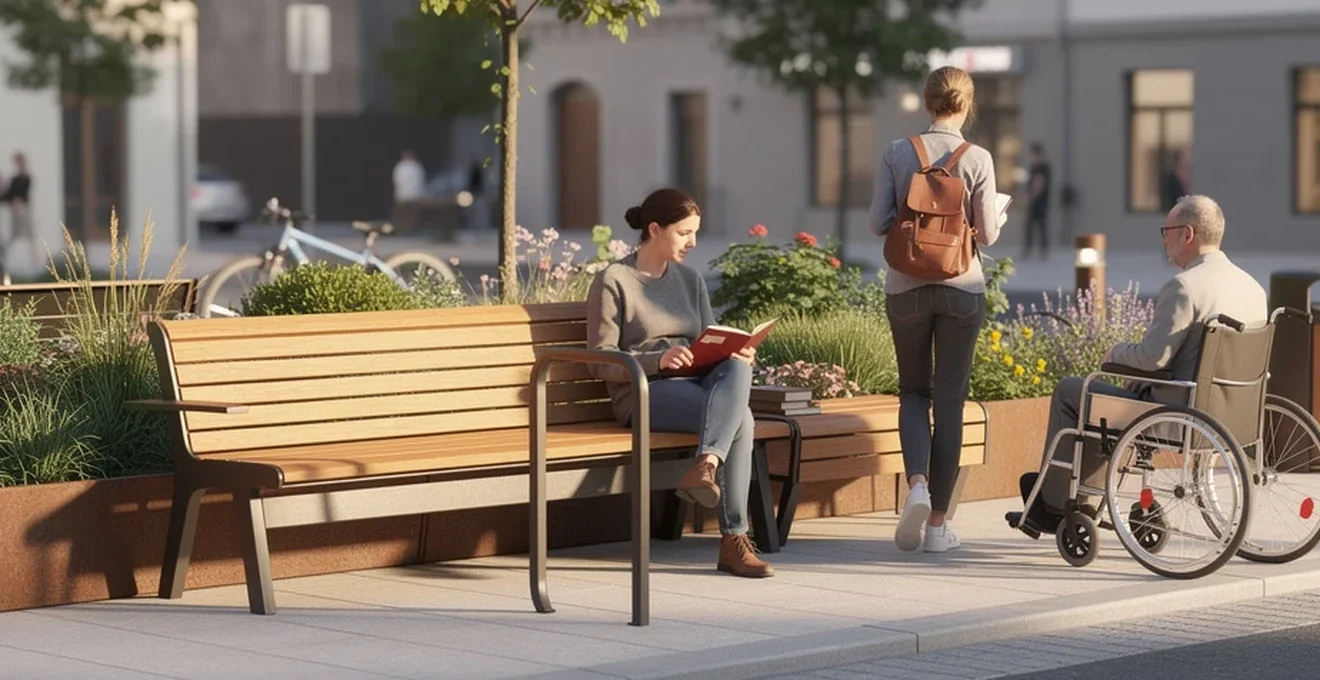
Public spaces succeed or fail on the strength of their details. A high street, park or square might have excellent architecture and generous space, but without the right benches, bins, lighting and planting, it can still feel uninviting or poorly used. Street furniture is the collective term for these functional, everyday elements, and thoughtful selection and placement can transform how a space is experienced, who feels welcome there, and how safely and sustainably it operates. This article looks at how street furniture is defined and categorised, how it supports accessibility and social interaction, how sustainability and technology are shaping newer designs, and how strategic placement has been used to improve public realm in real places.
Defining street furniture within urban design frameworks
Street furniture refers to the items and structures found in public spaces, most commonly on streets, that provide functionality, comfort and aesthetic value to the people who use them. It sits within the wider discipline of urban design because it is rarely an afterthought when done well; it is one of the tools planners and councils use to shape how a space looks, feels and functions. Correctly chosen and positioned, street furniture can alter the character and perception of a location while still blending into its surroundings.
Core typologies: benches, bollards, bins and bike racks
The most familiar categories of street furniture include benches and seating, litter bins, bollards, planters, lighting and bike racks. Each has a specific job to do:
- Benches and seating give people a place to rest, wait or socialise, and are often positioned to create designated gathering points.
- Bollards control traffic flow, reduce vehicle speed and restrict access to pedestrian zones, improving both safety and security.
- Bins, including specialist units for cigarette litter or dog waste, help keep streets and parks clean when placed strategically along routes with high footfall.
- Bike racks and cycle stands encourage cycling as a cheaper, lower-pollution way to travel, and give people confidence that their bike will be secure while they visit a town centre or park.
Used together, these typologies do more than serve individual functions; they shape the flow of pedestrians and vehicles, and influence how comfortable people feel spending time in a space.
Materials selection: corten steel, recycled plastics and timber composites
The materials used for street furniture affect durability, maintenance costs and environmental impact. Durability and ease of cleaning are key considerations, since public furniture is constantly exposed to weather, footfall and, at times, vandalism. Materials such as stainless steel, high-pressure laminates and specially treated timber are commonly chosen because they withstand this exposure well and are easier to maintain over the long term.
Sustainability credentials are increasingly part of the selection process too. Designers and manufacturers are working with recycled materials, including plastic, metal and wood, for benches, bins and bike racks, which reduces waste and supports resource conservation rather than relying solely on virgin materials.
Distinguishing functional furniture from placemaking installations
Not all street furniture serves a purely functional role. Some pieces are chosen specifically to act as a focal point, drawing the eye and adding interest to an outdoor space. Comfortable or unique seating designs, decorative planters, and lighting that changes the ambience of a space at night are examples of items that go beyond basic utility. The distinction matters for planning purposes: functional furniture is judged mainly on how well it meets practical needs, whereas placemaking installations are judged on how effectively they help define the identity and atmosphere of a location.
Enhancing pedestrian accessibility through ergonomic design
Accessible design is not an added extra; it is central to whether a public space genuinely works for the people who need to use it, including older adults, parents with pushchairs, wheelchair users and people with visual impairments. Inclusive design means considering these different needs from the outset rather than retrofitting a ramp as an afterthought.
Universal design principles and DDA-Compliant seating
Universal design principles aim to create environments that as many people as possible can use, regardless of age, ability or background. In practical terms for street furniture, this includes benches with armrests that provide support for elderly users or those with mobility issues, and seating arranged so that people using wheelchairs or mobility aids can comfortably join others rather than being placed apart. Picnic tables designed so that wheelchair users can sit at the ends, rather than being excluded from the table altogether, are a simple example of how a small design choice changes an isolating experience into an inclusive one. Multi-use seating with varying heights also helps accommodate different bodies, from children to people with limited mobility.
Wayfinding systems and tactile paving integration
Clear wayfinding helps everyone move through a space with confidence, and it is particularly important for people with visual impairments or those unfamiliar with an area. Tactile paving uses textured ground surfaces to warn pedestrians of upcoming crossings or steps, helping people navigate safely without relying on sight alone. Clear signage, using large, high-contrast text and universal symbols, further supports this by making information easy to interpret quickly, regardless of language or literacy level. Maps and information boards in parks serve a similar purpose, giving people a reason to stop, orient themselves and engage with their surroundings.
Shade structures and microclimate management in public squares
Comfort in a public space is heavily influenced by microclimate. Trees and planting soften the landscape and make a setting more pleasant, while also providing shade that helps cool streets in summer. This has both an environmental and a social benefit: shaded seating areas encourage people to linger rather than move through a space quickly, which in turn supports the kind of casual social interaction that makes a public square feel alive.
Lighting bollards and pathway illumination for nighttime safety
Good lighting is one of the most effective ways to make a public space feel secure after dark. A well-lit path, park or square makes it easier to see where you are going and creates a much greater sense of security, discouraging people from avoiding an area once the sun goes down. Modern LED lighting is energy-efficient and can be directed precisely where it is needed, reducing light pollution while still improving safety. Lighting bollards, which combine low-level illumination with the traffic-control function of a standard bollard, are a practical way to light pathways without the visual bulk of taller lamp posts.
Fostering social cohesion in community spaces
Seating and other street furniture do more than provide comfort; carefully positioned pieces actively encourage people to interact, turning a space people pass through into one where they choose to stay.
Multi-generational seating arrangements in parks like new york’s bryant park
William H. Whyte’s pioneering study, The Social Life of Small Urban Spaces, documented how people will create informal seating in almost any environment, a pattern of behaviour that remains consistent across cultures and contexts. His observations, drawn from close study of urban plazas including those in New York, underpin much of what urban designers now understand about seating: movable chairs and benches positioned in high-footfall areas, near cafés, parks and transport stops, naturally draw people together and give them a reason to slow down. Multi-generational design, offering a range of seat heights and configurations, means the same space can serve children, older adults and everyone in between.
Chess tables and interactive furniture as social catalysts
Interactive furniture, such as built-in chess or games tables, gives people an explicit reason to sit together and engage, rather than simply occupying the same space in parallel. Research on the spatial arrangement of urban furniture, including work by Ahmadi and Toghyani published in Urban Design International in 2021, has found that circular and semi-circular seating arrangements are particularly effective at fostering spontaneous engagement, since they create natural gathering points that suit both those seeking solitude and those looking for connection.
Pop-up parklets and their role in neighbourhood engagement
Temporary or modular installations, sometimes known as parklets, allow councils and communities to test new uses for underused kerbside space, such as converting a parking bay into a small seating area with planters. Because they rely on modular components rather than permanent construction, they can be installed quickly with minimal disruption, adjusted based on how they are used, and expanded or removed depending on community feedback and budget. This flexibility makes them a useful low-risk way to trial changes before committing to permanent street furniture schemes.
Sustainable street furniture and circular economy principles
Sustainability is an increasingly central consideration in the design, manufacture and specification of street furniture, from the raw materials used to how a product is maintained, repaired and eventually replaced.
Recycled ocean plastic benches: case studies from bournemouth seafront
Using recycled materials such as plastic, metal and wood for benches and other street furniture reduces waste and promotes resource conservation instead of relying on newly manufactured materials. Recycled plastic benches, sometimes made using reclaimed ocean or marine plastic, are becoming a familiar sight along coastal promenades and seafronts, offering a durable, low-maintenance seating option that also gives a visible, practical outlet for recovered plastic waste.
Rain gardens and sustainable drainage integration in street planters
Planters do more than add greenery. Positioned as part of a sustainable drainage strategy, they can help manage surface water alongside their traditional roles of softening hard landscaping and providing a natural traffic-calming solution in pedestrian zones. Large planters restrict vehicle access in pedestrian-only areas, enhancing public safety in the same way bollards do, while also contributing environmental, economic and social benefits by making streets more pleasant and helping to moderate temperature through shade and evapotranspiration.
Solar-powered smart benches: the soofa bench model
Street furniture is increasingly being adapted with technology that adds extra value beyond its traditional function. Solar-powered smart benches, such as the Soofa bench model, incorporate features like device charging points and, in some cases, environmental sensors, turning a simple resting spot into a reason for people to spend longer in a public space, whether that is working outdoors or simply charging a phone while they take a break.
Smart city integration and IoT-Enabled street furniture
As councils look to modernise public spaces, street furniture is increasingly being connected to wider digital infrastructure, allowing it to gather data and provide services beyond its traditional physical function.
Sensor-equipped bins for waste management optimisation
Strategically placed litter bins remain essential for keeping public spaces clean, giving people an easy way to dispose of general waste as well as specialist items such as cigarette litter and dog waste. Sensor-equipped versions of these bins can monitor fill levels, allowing waste collection services to prioritise routes more efficiently rather than emptying bins on a fixed schedule regardless of need.
Wi-fi-enabled kiosks and digital information totems
Adapting street furniture with technology such as Wi-Fi hotspots and charging stations adds an additional reason for people to use, and stay in, a public space. A bench or kiosk fitted with connectivity becomes more than a place to rest; it becomes somewhere people might choose to work, browse or wait comfortably, extending the amount of time they spend in a town centre or park.
Air quality monitoring stations embedded in urban furniture
Environmental monitoring is another area where street furniture is taking on a dual role. Embedding sensors within existing structures, such as lamp posts or bins, allows councils to track conditions like air quality without needing entirely separate infrastructure, making data collection a quieter, more integrated part of the streetscape.
Case studies: transforming public realm through strategic furniture placement
The principles above are easier to grasp with concrete examples of how careful furniture selection and placement have shaped specific public spaces.
Copenhagen’s superkilen park and modular seating systems
Superkilen in Copenhagen is frequently cited as an example of how modular, varied street furniture can serve a highly diverse local population. Rather than relying on a single uniform bench design, the park draws together furniture and objects from many different cultural backgrounds, reflecting the make-up of the surrounding community and giving the space a distinct identity that standard municipal furniture would not achieve.
London’s south bank riverside benches and pedestrian flow
Along London’s South Bank, riverside seating is positioned to take advantage of views while also managing the very high pedestrian footfall the route attracts. Benches set back from the main walking route allow people to stop and rest without obstructing the flow of pedestrians moving along the riverside, illustrating how placement is as important as the design of the furniture itself.
Barcelona’s superblocks and Traffic-Calming street elements
Barcelona’s superblock model reorganises street layouts to prioritise pedestrians over vehicles across a grouped set of blocks. Bollards and planters play a practical role within this approach, restricting vehicle access on interior streets and creating safer, calmer areas where people can walk, cycle and socialise with reduced traffic speed and volume. This mirrors, on a larger scale, the same traffic-calming logic seen in smaller pedestrian zones elsewhere: correctly used bollards and planters reduce vehicle access and speed, cutting the likelihood of road accidents and creating safer conditions for public life.