
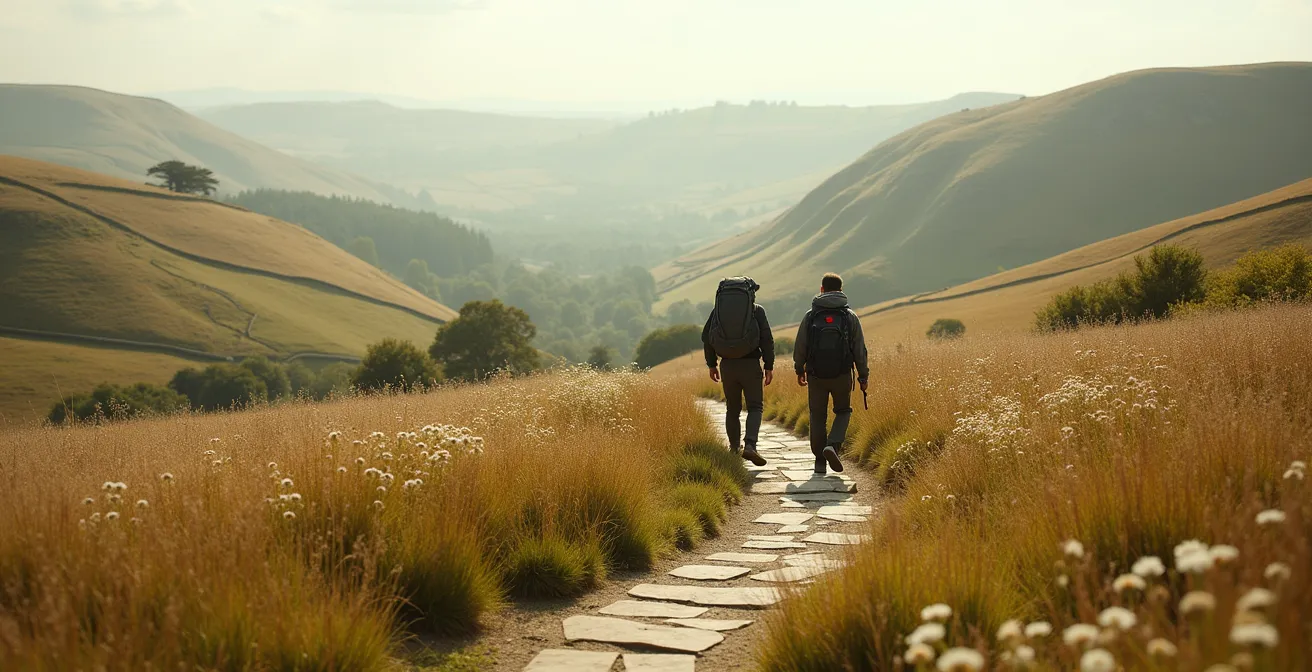
The familiar advice to “leave no trace” is no longer enough to protect the Cotswolds. As a guest in this living, working landscape, your every decision—from where you park to the food you buy—has a direct impact. This guide moves beyond the basics, offering a ranger’s perspective on how to actively preserve the fragile beauty of the AONB, ensuring your visit supports the very environment you’ve come to enjoy rather than contributing to its decline.
The sight of rolling hills, honey-coloured stone villages, and ancient woodlands is what draws so many of us to the Cotswolds Area of Outstanding Natural Beauty (AONB). It feels timeless, a perfect escape from the rush of modern life. As a countryside ranger, I see this deep appreciation every day. But I also see the unintended consequences of that love: eroded footpaths widening into scars, verges churned to mud, and habitats under pressure.
Many well-intentioned visitors arrive armed with the principle of “Leave No Trace,” and that’s a commendable start. They stick to paths, take their litter home, and respect the countryside code. Yet, the subtle degradation of this precious landscape continues. The reason is that the Cotswolds isn’t a wild, empty national park; it’s a living, working landscape, shaped by millennia of farming and inhabited by communities whose livelihoods are intertwined with the land.
What if the key to its protection lies not just in what you take away, but in what you understand and how you interact with it? The real challenge is to see the area not as a backdrop for a walk, but as a delicate ecosystem and a place of business. It’s about understanding that your access is a privilege that comes with responsibilities, where the economics of your visit can directly fund the repair of a dry-stone wall or the preservation of a wildflower meadow.
This guide will take you beyond the surface-level rules. We will explore the nuances of public access, the unseen damage from simple mistakes, the reasons behind why you must keep your dog on a lead, and how your spending choices become a tool for conservation. Together, we’ll learn how to be not just a visitor, but a true custodian of the Cotswolds.
To navigate this journey into responsible exploration, the following sections break down the key decisions you’ll face on the ground. From legal access rights to interacting with livestock and planning your travel, each part provides practical, expert advice to help you protect this national treasure.
Summary: A Ranger’s Guide to Hiking the Cotswolds Without Causing Erosion
- Footpath vs Open Access Land: Where Can You Legally Walk?
- The Verge Parking Mistake That Blocks Tractors and Angers Locals
- Cows with Calves: How to Cross a Field Without Getting Trampled?
- Farm Shops vs Supermarkets: Why Spending £20 Locally Protects the Landscape?
- Ground-Nesting Birds: Why You Must Keep Dogs on Leads in Spring?
- The Warm-Up Mistake: Why You Get Cold on the Start Line?
- Train vs Electric Car: Which Mode of Transport Is Truly Lower Carbon for UK Trips?
- How to Plan a Car-Free Holiday in Cornwall That Actually Works?
Footpath vs Open Access Land: Where Can You Legally Walk?
The freedom to roam is a cherished part of English culture, but it’s not an unlimited right. Understanding the difference between a Public Right of Way (like a footpath) and ‘Open Access Land’ is the first step to responsible hiking. A footpath is a linear route from A to B that you must stick to. Open Access Land, designated under the Countryside and Rights of Way (CROW) Act 2000, allows you to wander more freely, but this right is far from universal. In fact, a surprising report from the BMC shows the CROW Act gives access to only 11% of England and Wales. This makes our access rights precious and conditional.
This land is often privately owned and used for grazing or conservation. Your right to walk there is on foot only—no bicycles or horses—and comes with legal duties. For dog owners, this is critical: you must keep your dog on a short lead around any livestock, and it is a legal requirement to do so on all Open Access Land between 1st March and 31st July to protect birds. These aren’t just polite requests; they are the law.
Maintaining these routes is a huge undertaking. The 102-mile Cotswold Way, for example, is entirely maintained by over 400 Cotswold Voluntary Wardens. When you stick to the marked path, you are respecting their incredible effort and helping to prevent erosion that creates more work and damages the very landscape you came to see. When a path is muddy, it’s tempting to walk on the edge, but this widens the path and destroys the bordering vegetation. It is better to walk through the mud, wearing appropriate waterproof boots, to keep the path narrow and contained.
The Verge Parking Mistake That Blocks Tractors and Angers Locals
In the narrow lanes of the Cotswolds, parking is a constant source of friction. Many popular walking spots have limited official parking, and the temptation to pull onto a grassy verge is strong. However, this seemingly harmless act has severe consequences. Firstly, it creates an obstruction. I have lost count of the times farmers with wide machinery, local buses, or emergency services have been blocked by inconsiderately parked cars. This is not just an annoyance; it can be dangerous and economically damaging for the farmers who manage this land.
Secondly, it causes significant ecological damage. Those green verges are often remnants of precious habitat. The Cotswolds is a major stronghold for lowland calcareous grassland, a habitat rich in wildflowers and insects. Research has shown significant decreases of about 13,000 ha of this grassland in recent decades. When car tyres churn up a verge, they compact the soil, destroy the root systems of delicate flowers like cowslip and orchids, and create a gateway for invasive weeds. This is infrastructural pressure in its most visible form.

The only responsible solution is to park in designated bays or car parks, even if it means a longer walk to your starting point. If a car park is full, the responsible choice is to have a backup plan and drive to a different location, not to add pressure to a fragile spot. Think of the extra walk as part of your hike and a contribution to preserving the landscape.
Cows with Calves: How to Cross a Field Without Getting Trampled?
Crossing a field of cattle, especially when protective mothers are with their young calves, can be an intimidating experience. It requires confidence, respect, and situational awareness. The key is to see them not as obstacles, but as a vital part of the farmed landscape. Their grazing is what maintains the iconic open grasslands of the Cotswolds. Your right of way passes through their home, and acting like a considerate guest is paramount.
Before you even enter a field, check your OS map for alternative routes. If you see calves, and an alternative path exists, using it is often the wisest choice. As the Cotswolds National Landscape’s guidance wisely states:
Just because you can walk there, doesn’t mean you should.
– Cotswolds National Landscape, Responsible Access Guidelines
If you must cross, make a wide, slow detour around the herd. Never walk between a cow and her calf. Watch for warning signs: a lowered head, staring, and snorting are clear signals to give them more space. If you have a dog, keep it on a very short lead. If cattle charge, it is almost always the dog they see as a threat. The official advice is to release the dog immediately. The cows will pursue the dog, and you can retreat to safety. The dog is faster and more agile and will almost certainly escape unharmed. Remember that while dairy bulls are illegal on public footpaths, beef bulls in a field with cows are permitted, so always be vigilant.
Farm Shops vs Supermarkets: Why Spending £20 Locally Protects the Landscape?
Your economic footprint as a visitor is a powerful tool for conservation. Where you choose to spend your money—whether on a pre-hike snack or post-walk dinner—can either support the landscape or be entirely disconnected from it. This concept of landscape economics is simple: spending money with the people who manage the land helps them continue their conservation work. A £20 spend in a local farm shop is a direct investment in the Cotswolds.
That money helps the farmer-custodian repair the iconic dry-stone walls (which can cost over £100 per metre), maintain hedgerows that are vital corridors for wildlife, and continue the traditional grazing practices that create the beautiful vistas. In contrast, spending that same £20 at a national supermarket chain sees most of the money leave the local economy immediately, with no direct benefit to the landscape you’ve just enjoyed.
The following table, based on principles outlined by sources like guides to responsible tourism, illustrates this stark difference.
| Spending Location | Local Economic Benefit | Landscape Impact |
|---|---|---|
| Local Farm Shop | 100% stays in local economy | Directly funds dry-stone wall repairs (£100+/metre), hedgerow maintenance, traditional grazing |
| Chain Supermarket | Less than 15% stays local | No direct landscape benefit, may source from intensive farming |
| Farm-gate sales | 100% to farmer-custodian | Supports low-impact traditional methods, maintains AONB character |
A tangible example of this is the story of Single Gloucester cheese. This Protected Designation of Origin (PDO) product can only be made with milk from Gloucester cattle grazing in the area. By buying this cheese, you create a market demand for traditional, low-impact farming methods. This, in turn, helps preserve the ancient grasslands which, according to The Wildlife Trusts, have been maintained by grazing since the Mesolithic period, preventing them from reverting to scrub and woodland. Your lunch becomes a direct act of habitat preservation.
Ground-Nesting Birds: Why You Must Keep Dogs on Leads in Spring?
Spring in the Cotswolds brings an explosion of life, but it also brings a critical period of vulnerability for much of our beloved wildlife. From Skylarks and Lapwings to Curlews, many bird species nest directly on the ground in open grassland and heathland. Their nests are incredibly well camouflaged, making them almost impossible to see. This is where the rule about dogs on leads becomes a non-negotiable matter of life and death.
An off-lead dog, even one that is just excitedly bounding through the grass, can disturb a sitting bird or trample a nest of eggs or chicks in seconds. The ecological disturbance doesn’t have to be direct; if a parent bird is flushed from the nest, the eggs or young are left exposed to the cold and to predators like crows. Legally, the CROW Act mandates that dogs must be on a short lead on all Open Access Land during the core breeding season. As Natural England clarifies, the Act requires walkers to keep dogs on short leads from 1st March to 31st July. This is a legal requirement, not a suggestion.

Areas like Cleeve Common and Minchinhampton Common are designated as Sites of Special Scientific Interest (SSSI) partly for these bird populations. You will see signs reminding you of the rules—please heed them. Sticking to clear paths, even outside of Open Access areas, is the best policy during this sensitive period. The brief freedom for your dog is not worth the potential destruction of a new generation of endangered birds.
Action plan: Protecting ground-nesting birds
- Check your dates: Always keep dogs on short leads on Open Access Land from March 1st to July 31st. It’s the law.
- Read the signs: Pay close attention to SSSI signage at sensitive sites like Cleeve Common and Minchinhampton Common.
- Understand the impact: Realise that even without direct contact, causing a parent bird to flee can doom its young to cold or predation.
- Stick to the path: Even in fields without specific restrictions, keeping to designated paths minimises your area of potential disturbance.
- Report issues: If you see a consistently off-lead dog in a signed, sensitive area, you can inform the Cotswold Wardens.
The Warm-Up Mistake: Why You Get Cold on the Start Line?
This title might seem to be about race-day tactics, but for a countryside ranger, “getting cold on the start line” has a different, more damaging meaning. It refers to the unprepared hiker: someone who arrives cold, hasn’t warmed up their muscles, and sets off ill-equipped for the physical demands of the trail. This lack of preparation is a direct cause of landscape damage. Why? Because a cold, tired, or injured hiker is far more likely to make poor decisions.
When you get a sudden chill because you didn’t layer properly, or pull a muscle because you skipped any form of warm-up, the temptation to take a “shortcut” becomes immense. These shortcuts almost always involve scrambling down a steep, undesignated bank, which is a primary cause of erosion. This dislodges soil and vegetation, creating a “desire line” that other walkers then follow, quickly turning a green slope into a muddy scar. As guidance for the Cotswold Way highlights, being prepared is part of respecting the environment; unprepared hikers are the ones who inadvertently cause the most harm.
A responsible warm-up doesn’t happen on the fragile grass verge. It happens in the car park. Before you even set foot on the trail, take five minutes on a hard, paved surface to prepare your body. This small ritual not only prevents injury but also puts you in the right mindset to respect your surroundings. A responsible warm-up includes:
- Dynamic stretches like leg swings and torso twists on the tarmac.
- Arm circles and shoulder rolls away from any vegetation.
- Walking lunges along the edge of the car park, not on soft ground.
- Using a fence or bench for balance exercises.
Train vs Electric Car: Which Mode of Transport Is Truly Lower Carbon for UK Trips?
Your effort to protect the Cotswolds should begin before you even arrive. Your choice of transport has a massive impact on both carbon emissions and the infrastructural pressure on the AONB’s fragile villages. While an electric vehicle (EV) is a step up from a petrol or diesel car, it is not a silver bullet. It still contributes to traffic congestion on narrow lanes and adds to the immense pressure on limited parking spaces in historic villages like Bourton-on-the-Water or Castle Combe.
The train, by contrast, offers a far superior solution for both the environment and the local infrastructure. Taking the train to a hub station like Moreton-in-Marsh or Kemble removes a car from the road entirely. This not only has a lower carbon impact but also directly alleviates the congestion and parking chaos that plagues the most popular spots. As one local tour operator puts it, the train is a key tool because it “removes cars from pinch points in fragile historic villages.”
For a truly low-impact trip, the best approach is often a hybrid one: take the train to a main station, then use the excellent local bus services (like Stagecoach or Pulham’s) or a pre-booked taxi to reach your final destination. This multi-modal approach supports public transport and eliminates your contribution to local traffic problems.
| Transport Mode | CO2 Impact | Village Congestion | Parking Pressure |
|---|---|---|---|
| Train to Moreton-in-Marsh | Lowest – electrified line | None – removes cars entirely | None – station parking only |
| Electric Vehicle | Medium – UK grid mix | High – adds to narrow lanes | High – limited village spaces |
| Hybrid approach (train + local bus) | Low – shared transport | Minimal – uses existing services | None – no private parking needed |
Key takeaways
- True conservation in the Cotswolds means going beyond “Leave No Trace” and understanding your role in a living, working landscape.
- Your access is a privilege with legal responsibilities, especially regarding dogs during the bird nesting season (1st March – 31st July).
- Spending your money at local farm shops and pubs is a direct investment in the maintenance of the landscape, from dry-stone walls to wildflower meadows.
How to Plan a Car-Free Holiday in Cornwall That Actually Works?
While the specifics of this section’s title point to Cornwall, the principles for planning a successful car-free holiday are universal and perfectly applicable to the Cotswolds. In fact, embracing “slow travel” is one of the most profound ways to reduce your impact and deepen your connection to the landscape. A car-free itinerary forces you to engage with the area on a more human scale, using historic footpaths, quiet cycleways, and local bus routes that are themselves part of the region’s character.
The key to success is planning. You can’t just turn up and expect it to work. You must book accommodation strategically near public transport links, download bus timetables offline, and pack light enough to be mobile. Many local companies now offer luggage transfer services between B&Bs, making a multi-day walking or cycling tour entirely feasible without a car. This approach allows for authentic interactions in village pubs and the discovery of hidden corners impossible to find by vehicle.
Here is a sample 3-day car-free itinerary for the Cotswolds, which can serve as a template for planning a similar trip in Cornwall or any other UK beauty spot:
- Day 1: Arrive by train at Kemble station. Pick up a pre-booked hire bike and cycle the quiet lanes to Tetbury. Explore the historic market town and its many independent shops.
- Day 2: Using an OS map, hike a section of the Monarch’s Way long-distance path, perhaps towards the Westonbirt Arboretum, before returning to Tetbury.
- Day 3: Cycle to the ancient Roman town of Cirencester for the morning. In the afternoon, catch a local bus back to Kemble station for your train journey home.
By embracing these principles, your visit to the Cotswolds can be a truly positive force. You leave behind not erosion and pressure, but economic support and a demonstration of respect for this unique corner of England. To put this all into practice, the next logical step is to start planning your trip with these new considerations at its heart.