
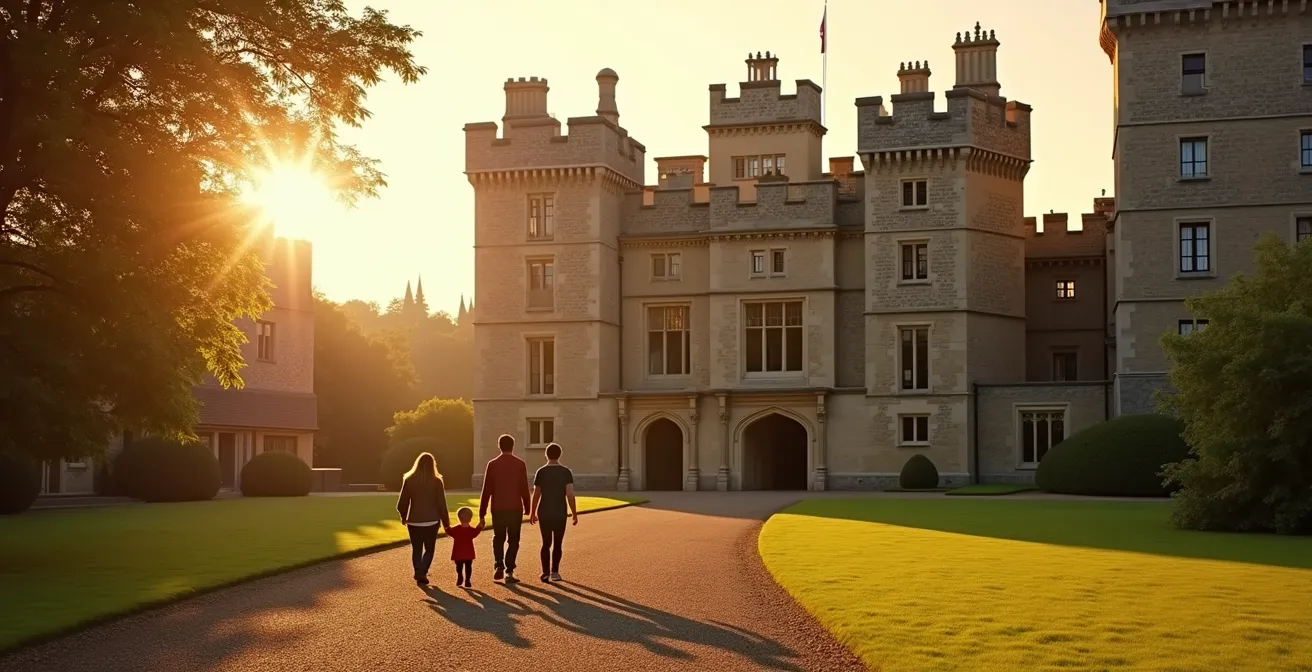
The key to saving over £400 annually isn’t just buying a heritage membership, but treating it as a strategic financial and educational asset for your family.
- Calculate the “Membership ROI” by comparing the £146 annual fee to the cost of just three individual family day trips, which often exceeds £130.
- Adopt a “Hub-and-Spoke” holiday model, staying in one central village to cut accommodation and fuel costs by over 40% while increasing site visits.
- Plan “Curriculum-Led” trips that align with your child’s Key Stage 2 topics to transform days out into memorable educational experiences.
Recommendation: Before your next school holiday, choose one core strategy from this guide—like the car-free Cornwall itinerary or a Tudor history trail—to test the true value of planned heritage travel.
For many budget-conscious parents in the UK, the school holidays present a familiar dilemma: how to create enriching cultural experiences for the children without the budget spiralling out of control. A family day out to a single historic site can easily cost upwards of £50 in tickets alone, making repeated trips feel like an extravagance. The common advice is often to simply “get a National Trust membership,” but this guidance rarely scratches the surface of true value optimisation.
Most families use their membership sporadically, visiting a few popular spots on sunny weekends and questioning if they’ve truly broken even. This approach misses the fundamental point. A National Trust or English Heritage membership is not a simple discount card; it’s a powerful strategic tool for your family’s finances and your children’s education. The secret to unlocking hundreds of pounds in savings lies not just in owning the card, but in adopting the mindset of a cultural travel planner.
But what if the real key to maximising its value wasn’t about visiting more places, but about visiting them smarter? What if strategic timing could eliminate crowd-induced stress, and a different approach to holiday planning could slash your accommodation costs while deepening your connection to a region? This is where the real savings and the most rewarding experiences are found.
This guide will walk you through the precise strategies to transform your membership from a recurring expense into a high-return investment. We’ll break down the real costs, compare the key providers for your region, and provide actionable plans for everything from avoiding parking fines to planning an educational road trip that your children will actually remember.
Summary: A Strategic Guide to Maximising Your UK Heritage Membership
- Why Paying a £146 Annual Membership Is Cheaper Than Three Day Trips?
- When to Visit Stonehenge and Bath to Avoid the 11 AM Tourist Crush?
- National Trust or English Heritage: Which Membership Suits Southern England Residents Best?
- The Parking Mistake at Rural Heritage Sites That Results in £60 Fines
- How to Plan a Tudor History Road Trip for Key Stage 2 Students?
- Farm Shops vs Supermarkets: Why Spending £20 Locally Protects the Landscape?
- Why Staying in One Village for a Week Beats Touring the Whole County?
- How to Plan a Car-Free Holiday in Cornwall That Actually Works?
Why Paying a £146 Annual Membership Is Cheaper Than Three Day Trips?
The initial outlay for a family membership can seem substantial, but the financial logic is overwhelmingly in its favour when you analyse the real cost of “pay as you go” visits. It’s a classic case of short-term spending versus long-term investment. The key is to shift your perspective from cost to Membership Return on Investment (ROI).
Consider a typical family of four exploring Southern England. A single day’s entry to a popular National Trust property can cost between £30 and £40. A case study of a family visiting just three sites showed that entry fees alone amounted to £90. When you factor in the almost-inevitable costs of parking (£5-£10 per site) and a modest spend on refreshments, the total for those three trips quickly approaches £130.
In this light, the £146.40 annual family membership for the National Trust suddenly looks very different. It essentially pays for itself after just two or three visits. Every subsequent trip for the rest of the year—whether it’s a grand day out or a spontaneous two-hour visit to a local garden for some fresh air—is effectively free. This transforms the membership from a liability into an asset that encourages exploration without the constant “cost per visit” calculation. The monthly payment option of £12.20 further softens the financial blow, making it comparable to the cost of a few weekly coffees.
Once you’ve made the investment, the goal becomes maximising its value through frequent, low-cost outings, turning what was once a significant expense into a year-long pass to the UK’s heritage.
When to Visit Stonehenge and Bath to Avoid the 11 AM Tourist Crush?
Owning a membership is only half the battle; the other is ensuring your visits are enjoyable rather than a stressful battle against crowds. The biggest threat to a peaceful family day out, especially at world-famous sites like Stonehenge or the Roman Baths, is the 11 AM tourist surge. The secret to a superior experience lies in Strategic Visitation and employing a “visitor counter-flow” mentality.
The vast majority of visitors arrive between 10:30 AM and 12:30 PM. To avoid this, plan your arrival for either the first hour after opening or, even better, the last two hours before closing. Visiting during the “golden hour” in the late afternoon not only guarantees fewer people but also offers spectacular lighting for photos and a more magical atmosphere, particularly at atmospheric sites like stone circles.

As this image of Stonehenge illustrates, a late afternoon visit transforms the experience from a crowded queue into a personal moment of wonder. Beyond timing your arrival, you can apply a visitor counter-flow strategy. Instead of following the herd from the entrance to the main attraction, start at the furthest point of the estate—the lake, the walled garden, or the far end of the castle bailey—and work your way back towards the house or main feature as the crowds begin to thin out after 2 PM. During the peak lunch hour (12-2 PM), tackle the indoor exhibitions while everyone else is in the café.
A little foresight turns a potentially overwhelming trip into a serene and memorable family adventure, maximising the experiential value of your membership.
National Trust or English Heritage: Which Membership Suits Southern England Residents Best?
For families in Southern England, the choice between National Trust (NT) and English Heritage (EH) is a crucial one, as the density of their properties varies significantly by region. Making the right choice depends entirely on your family’s interests. The NT excels in stately homes, landscaped gardens, and vast parklands, while EH is the undisputed custodian of castles, abbeys, and ancient ruins. A quick comparison reveals their different strengths for a family day out.
This comparative table clearly shows that for families with younger children who need space to run and engaging play areas, the National Trust often holds the edge in Southern England. The sheer number of properties and extensive indoor options also make it a more reliable choice for the unpredictable British weather.
| Criteria | National Trust | English Heritage |
|---|---|---|
| Annual Family Cost (2 adults) | £146.40 | £111 |
| Properties in Southern England | 200+ houses and gardens | 100+ castles and ruins |
| Children Included | Up to 10 children under 17 | Up to 6 children under 18 |
| Adventure Playgrounds | Excellent at most properties | Limited facilities |
| Rainy Day Indoor Options | Extensive house tours | Fewer indoor spaces |
| Free Parking Locations | 500+ car parks nationwide | Limited to main sites |
| Best For | Garden lovers, stately homes | History buffs, castle explorers |
Case Study: The “Split Membership” Strategy for Border Counties
Families living in areas rich with both types of properties, like Wiltshire, can employ a savvy “split membership” approach. One parent takes out an individual National Trust membership (£91.20) while the other gets an individual English Heritage membership (£64). The total cost of £155.20 is only slightly more than a single family NT membership but grants access to the complete portfolio of both organisations. This is the ultimate strategy for families with diverse interests, allowing for a weekend exploring Avebury stone circle (NT) followed by a trip to nearby Old Sarum (EH).
Ultimately, the best membership is the one you will use most often, so aligning it with your family’s passions is the most financially prudent decision.
The Parking Mistake at Rural Heritage Sites That Results in £60 Fines
One of the most frustrating and entirely avoidable costs associated with heritage sites is the dreaded parking fine. Many families assume that the membership sticker on their car windscreen is sufficient, but this is a common and expensive mistake. An increasing number of National Trust car parks, especially at popular rural and coastal locations, are managed by third-party companies using Automatic Number Plate Recognition (ANPR) cameras.
The critical error is failing to interact with the parking machine at all. Even though parking is free for members, you are almost always required to scan your membership card at the machine to generate a £0.00 ticket to display on your dashboard. Simply arriving and walking away can trigger an automatic £60 fine in the post a week later. The system has no way of knowing you are a member unless you complete this crucial step. It’s a small administrative task that saves a significant amount of money and hassle.
Furthermore, be wary of overflow car parks. During peak season, you may be directed to a nearby field for parking. Always check the signage carefully, as these overflow areas are sometimes privately managed and may not be covered by your membership, requiring a separate payment. Saving your parking tickets for a few weeks after your visit is also a wise precaution, providing evidence should a fine be issued incorrectly.
Your Checklist to Beat Heritage Parking Fines
- Always Scan: Go to the machine and scan your membership card, even if you have a car sticker.
- Wait for the Ticket: Do not walk away until the free (£0.00) ticket has fully printed.
- Display Clearly: Place the ticket face-up on your dashboard where it is clearly visible from the outside.
- Check Overflow Signage: At busy sites, confirm that overflow fields are part of the free NT parking scheme.
- Save Receipts: Keep your parking tickets for a few weeks as proof of your visit and compliance.
It’s a habit that protects your budget and ensures your day out remains a positive experience from start to finish.
How to Plan a Tudor History Road Trip for Key Stage 2 Students?
A heritage membership can be one of the most powerful educational tools you own, allowing you to transform abstract classroom topics into tangible, exciting experiences. For children aged 7-11 studying the Tudors in Key Stage 2, a well-planned road trip can bring history to life far more effectively than any textbook. The key is Curriculum-Led Travel, linking specific sites to learning objectives.
A fantastic Tudor trail can be created through Kent and Sussex, counties steeped in the history of the period. For instance, you can structure a multi-day trip that provides a complete narrative of Tudor life. Start at Knole, a vast Tudor palace, to understand the scale of aristocratic life and the calendar house myth (365 rooms, 52 staircases). Move on to Sissinghurst Castle Garden, focusing on its surviving Tudor tower and the role of nobility. Finally, visit Pevensey Castle to see how coastal defences were adapted during the Tudor period against threats from the continent.
This thematic approach connects directly to the KS2 curriculum. Knole illustrates domestic life and social hierarchy, Sissinghurst explores the lives of the wealthy, and Pevensey covers military strategy and the Spanish Armada. The impact of this hands-on learning is profound; research suggests that students can retain 60% more historical facts when they learn them at the actual historic sites compared to a classroom setting alone. You’re not just having a day out; you’re creating vivid, lasting educational memories.
This method ensures every visit is an investment in your child’s understanding of the world, making your membership work harder for your family’s educational goals.
Farm Shops vs Supermarkets: Why Spending £20 Locally Protects the Landscape?
Maximising the value of your membership extends beyond entry fees; it’s also about understanding the ecosystem your visits support. Many National Trust properties are part of vast agricultural estates, and a small change in your spending habits—choosing the on-site farm shop over a supermarket for your picnic supplies—has a direct and positive impact on landscape conservation.
When you spend £20 at a National Trust farm shop, you are not just buying high-quality local produce. You are directly supporting the tenant farmers who manage the surrounding countryside. There are over 1,500 tenant farmers managing 250,000 hectares of land on behalf of the Trust. The revenue from their farm shops is often what enables them to continue using traditional, conservation-friendly farming methods that protect biodiversity, maintain historic field patterns, and preserve the very landscapes you came to enjoy.
This creates a virtuous cycle. For example, buying single-variety apple juice at the Sherborne Estate farm shop in the Cotswolds helps maintain 200-year-old orchards. Purchasing rare-breed meat from the Killerton shop in Devon supports the grazing that maintains the historic parkland. This conscious consumerism also has environmental benefits; local apples can have a carbon footprint as low as 0.03kg of CO2 per kilogram, compared to 0.82kg for imported equivalents. It’s a tangible way to make your visit count for more.
That £20 spend becomes an investment not just in your lunch, but in the future of the British countryside for generations to come.
Why Staying in One Village for a Week Beats Touring the Whole County?
For a week-long holiday, the instinct is often to plan a grand tour, moving from town to town to “see everything.” However, this approach is frequently more expensive, more stressful, and less rewarding than adopting a Heritage Hub-and-Spoke model. By choosing one strategically located village as your base, you can dramatically cut costs and improve the quality of your family holiday.
This strategy involves renting a single cottage or holiday home for the week and making shorter day trips to surrounding sites. This immediately eliminates the “time tax” of packing and unpacking every day or two, which can consume over 7 hours of precious holiday time. It also significantly reduces fuel costs and opens up the possibility of self-catering, which is vastly cheaper than eating out for every meal.
Case Study: The Lacock Village “Hub-and-Spoke” Holiday
Using the picturesque village of Lacock in Wiltshire as a base, a family can reach at least six major heritage sites within a 30-minute drive, including Dyrham Park, Avebury, and The Courts Garden. A week-long cottage rental might cost around £800. In contrast, a touring holiday staying in different hotels could easily cost £1,200 or more for accommodation alone. Families using this single-base approach report not only significant financial savings but also a 50% reduction in travel-related stress and a 40% increase in the number of sites they comfortably visit.
The benefits are not just financial. Staying in one place allows you to develop a genuine feel for the local area. You learn the pub’s opening times, discover the quietest footpaths, and find the best local bakery. You become a temporary local rather than a fleeting tourist. This deeper connection to a place is often the most cherished memory of a family holiday.
It shifts the focus from a frantic checklist of places to a relaxed and immersive exploration of a region.
Key Takeaways
- Treat your membership as a financial tool; calculate its ROI against the cost of just three pay-as-you-go visits to see the immediate savings.
- Adopt a “Hub-and-Spoke” holiday plan, using a single village base to cut accommodation costs by up to 40% and eliminate daily travel stress.
- Plan visits around your children’s school curriculum (e.g., a Tudor History road trip) to transform days out into powerful, memorable learning experiences.
How to Plan a Car-Free Holiday in Cornwall That Actually Works?
The idea of a car-free holiday in a rural county like Cornwall might seem impractical, but with strategic planning around public transport and coastal paths, it is not only possible but can lead to a more relaxing and authentic experience. It forces you to slow down and engage with the landscape on a more intimate level, all while saving on fuel and parking stress.
The key is to base yourself in a town with good rail and bus links, such as St Ives or Penzance. From there, you can use a combination of local buses (like the excellent Coaster service), scenic train lines, and your own two feet to explore a wealth of heritage sites. A well-planned itinerary can feel like a true adventure.
- Day 1: Arrive by train in St Ives. Explore the town and the Barbara Hepworth Museum and Sculpture Garden (NT).
- Day 2: Take the bus to Zennor and walk a stunning section of the coastal path towards Gurnard’s Head.
- Day 3: Use buses to reach the heart of the Cornish Mining World Heritage Site at Levant Mine and Botallack (NT).
- Day 4: Experience the magic of walking the causeway to St Michael’s Mount (NT) at low tide, returning by boat if the tide is in.
- Day 5: Take the scenic St Ives Bay Line train to St Erth and connect to a bus for Godolphin Estate (NT).
This approach transforms travel from a means to an end into part of the experience itself. As the Cornwall Heritage Trust notes, a car-free approach can offer a deeper connection to the history of a place.
Car-free access to St Michael’s Mount via the tidal causeway offers a more authentic medieval pilgrimage experience than arriving by car park.
– Cornwall Heritage Trust, Sustainable Tourism in Cornwall Report
By combining a weekly bus pass with your heritage membership, you create a powerful, low-cost toolkit for exploring one of the UK’s most beautiful regions without ever needing to search for a parking space.
Frequently Asked Questions about Tudor History for Key Stage 2 Students
Which Tudor sites are most suitable for children aged 7-11?
Hampton Court Palace offers the best Tudor kitchens experience, which is wonderfully immersive for children. For a less overwhelming visit, smaller, more intimate properties like Ightham Mote in Kent provide a manageable and fascinating glimpse into Tudor life.
How can we make Tudor history interactive during visits?
Create a Tudor feature checklist before you go. Include items like priest holes, garderobes (medieval toilets), Tudor roses in carvings or plasterwork, elaborate chimney stacks, and portraits of monarchs. You can award points for each feature the children spot, turning the visit into a fun treasure hunt.
What’s the best way to explain social hierarchy to KS2 students at heritage sites?
The most effective way is to contrast the “upstairs” with the “downstairs.” Start your tour in the kitchens, sculleries, and servant quarters. Discuss the work that was done there before moving to the grand halls and bedrooms. This physical journey through the house provides a clear and memorable illustration of how differently people lived within the same building.