
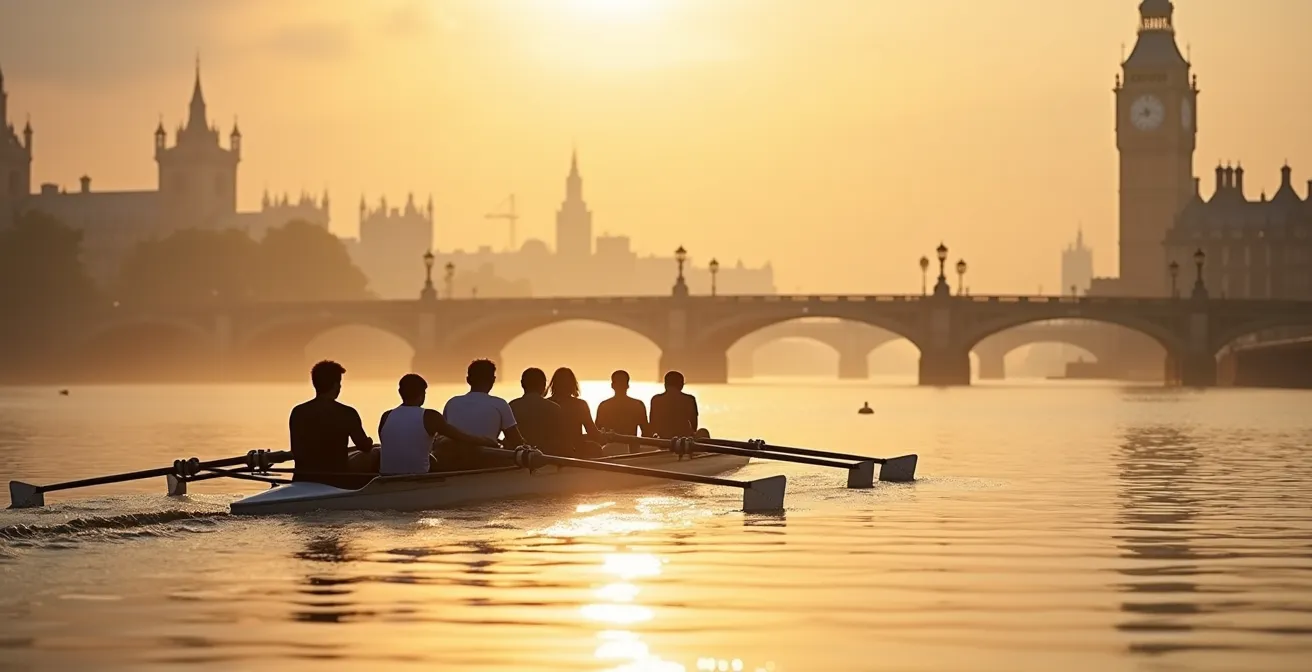
In summary:
- Navigating the Tideway requires understanding the ‘why’ behind the rules, not just memorising them. Safety is non-negotiable.
- The PLA flag system (Red/Yellow boards) is a direct indicator of river conditions and dictates whether it is legal and safe to row.
- Tidal flow, especially wind-over-tide conditions and currents around bridges, poses the single greatest threat. Know the circulation patterns.
- Progression from novice to senior squads depends on demonstrating mastery of Tideway-specific skills and emergency procedures.
- Your training schedule is dictated by the tide, not the clock. Adaptability is mandatory for any Tideway rower.
For a novice coxswain, the Tideway can feel like a churning, unpredictable beast. The water moves with a power that can intimidate even seasoned athletes. Many guides will tell you to “follow the circulation pattern” or “check the tide,” but this advice barely scratches the surface. It treats navigation as a matter of following a map. This is a dangerous oversimplification. The Tideway is not a lake or a non-tidal river; it is a dynamic, powerful environment where a moment’s inattention can lead to catastrophic failure.
The rules set out by the Port of London Authority (PLA) are not bureaucratic suggestions. They are survival protocols, written from decades of experience and near-misses. Understanding them is not about passing a test; it’s about internalising the lethal physics of a fast-flowing tidal river. The true key to safety isn’t memorising which arch of a bridge to take, but understanding *why* taking the wrong one could put your crew in the path of a commercial vessel or into a current that will overwhelm you.
This guide moves beyond simple rule-following. It is designed to instill a coach’s mindset, teaching you not just *what* the rules are, but *why* they exist. We will break down the critical safety protocols, from interpreting tide warnings to handling emergencies, so that you can develop the non-negotiable survival instinct required to keep your crew safe. Your responsibility is absolute, and your knowledge must be too.
This article will provide a structured breakdown of the most critical aspects of Tideway navigation and safety. The following summary outlines the key areas we will cover, from on-shore decisions to on-water execution.
Summary: How to Steer a Rowing Boat on the Tideway Without Breaching PLA Rules?
- Red Boards vs Yellow Boards: When Is It Illegal for Clubs to Row?
- Slack Water vs Ebb Tide: When Is the Best Time for a Long Outing?
- Bridge Arches: Which Arch Must You Use When Going Upstream at Hammersmith?
- Pogies or Gloves: Which Keeps Hands Warmer Without Losing Grip on Oars?
- Locks and Pubs: How to Plan a Rowing Tour from Oxford to Henley?
- Novice to Senior Squad: How to Earn Your Seat in the First VIII?
- Cold Showers: Do They Boost Immunity or Just Make You Cold?
- How to Balance 5 AM Rowing Training with a Full-Time Corporate Job?
Red Boards vs Yellow Boards: When Is It Illegal for Clubs to Row?
Your first decision about safety is made before you even get on the water. The PLA’s Ebb Tide Flag Warning System is not a suggestion; it is a command. These flags, or ‘boards’ as they are often called, indicate that the flow rate of the river has exceeded defined safety limits for rowing boats. Ignoring them is not just reckless, it is a breach of the Tideway Code and, as Cygnet Rowing Club points out in their safety policy, means that if red boards are showing then, in the interest of safety, no rowing should take place.
The system is simple and absolute:
- Check the Status: The flag status is updated automatically twice daily. Your first action before any outing is to check the official PLA status.
- RED FLAG: Rowing is prohibited for all crews on the ebb tide. The river is considered dangerously fast. Launching under a red flag invalidates your club’s insurance and puts your crew in unjustifiable peril.
- YELLOW FLAG: Rowing is restricted. Only senior, experienced crews with a qualified Tideway steer are permitted on the water, and often only on specific, less challenging stretches of the river. Novice crews are forbidden from boating.
Furthermore, individual clubs may impose stricter rules than the PLA. Always check your own club’s policy. The flags are a direct communication from the river itself, telling you its current power level. Learning to respect this is the first and most crucial step in becoming a competent Tideway navigator.
Slack Water vs Ebb Tide: When Is the Best Time for a Long Outing?
Understanding the tide is about more than knowing when it’s high or low. It’s about ‘reading the water’ and understanding the forces at play. An ebb tide flows out towards the sea, while a flood tide flows inland. The period of calm in between is known as slack water. For a novice, the safest and most manageable conditions are typically found around high slack water. The Tideway Code’s guidance to start outings no more than 1 hour and 30 minutes before high tide isn’t arbitrary; it ensures you are on the water during the weakest part of the tidal cycle.
However, the tide’s direction is only one part of the equation. You must also consider the wind. The most dangerous condition on the Tideway is ‘wind-over-tide’. This occurs when a strong wind blows against the direction of the current, creating steep, choppy waves that can easily swamp a fine rowing shell. As the PLA warns, this can make for very difficult conditions, especially at high tide when there is more water in the channel. A benign-looking day on land can be treacherous on the water if the wind and tide are in opposition.
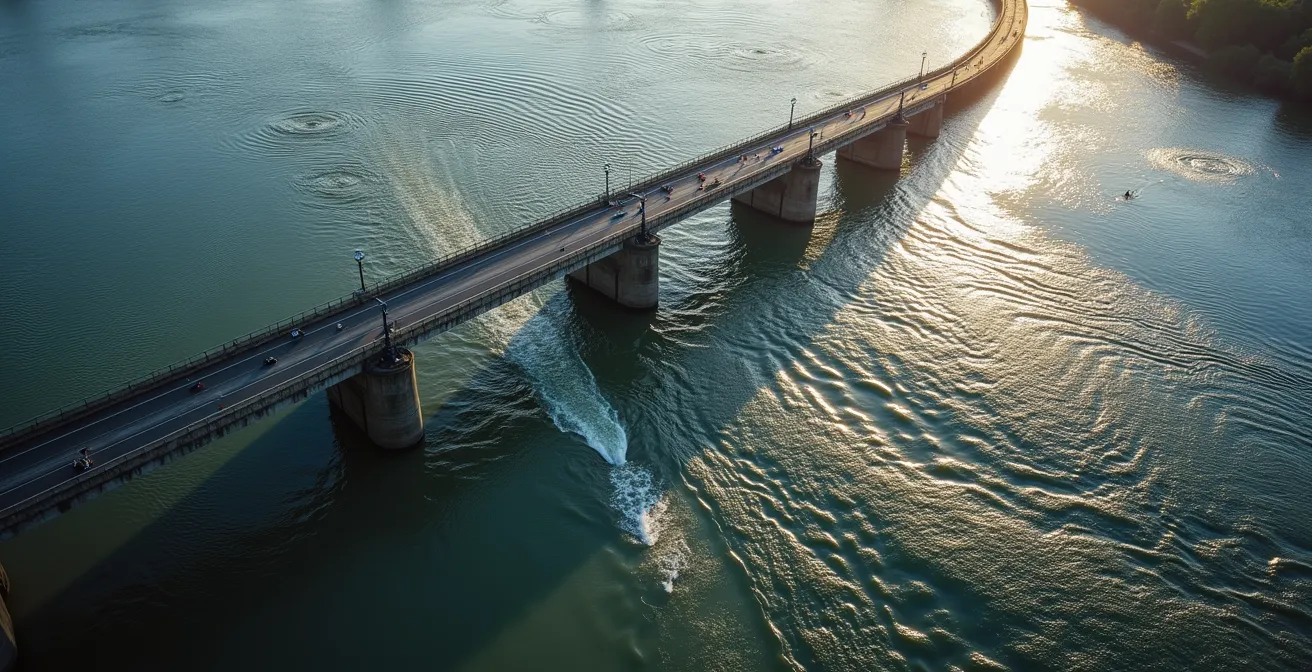
As this view demonstrates, the river’s surface is a map of its underlying power. Look for the smooth, fast-flowing water in the main channel and the swirling eddies behind bridge supports. These patterns tell you where the energy is and where the safe water lies. A long outing should be planned to take advantage of the flood tide on the way upriver and the beginning of the ebb tide for the return journey, always keeping a vigilant eye on how the wind is affecting the water’s surface.
Bridge Arches: Which Arch Must You Use When Going Upstream at Hammersmith?
Bridges are natural chokepoints that constrict the river’s flow, accelerating the current and creating complex eddies. Following the correct navigation path under every bridge is a non-negotiable part of the Tideway’s circulation pattern. It is designed to keep small, vulnerable rowing boats out of the main shipping channel used by larger, less manoeuvrable commercial traffic. Getting this wrong can lead to a direct collision or being pushed into a pier by the current.
Each bridge on the Tideway has its own specific rules for upstream (flood tide) and downstream (ebb tide) navigation. While the general principle is to stay to the right-hand side of the river (starboard side), the designated arch for passage can vary. For example, the guidance from clubs like SONS OF THE THAMES Rowing Club is explicit: when coming up river on the flood tide, you must pass under Hammersmith Bridge under the section marked with the word ‘BRIDGE’. This positions you correctly for the bend that follows.
The following table, based on established Tideway navigation rules, outlines the requirements for the key bridges in the central Tideway section. This must be committed to memory.
| Bridge | Upstream Navigation | Downstream Navigation | Special Hazards |
|---|---|---|---|
| Hammersmith Bridge | Pass under the word ‘BRIDGE’ on flood tide | Center arch on ebb | Current navigation restrictions published by PLA |
| Putney Bridge | Surrey arch | Center or Middlesex arch | No turning, no stopping, no crossing in restricted zone |
| Barnes Bridge | Surrey arch | Center arch | Watch for RNLI launch station on Surrey bank after passing |
| Kew Bridge | Surrey arch (if impassable, do not proceed) | Center arch | Strong cross-currents at certain tide states |
Memorise this. A moment of uncertainty as you approach a bridge is a moment where you are not in control. You must know your line long before you reach the arch.
Pogies or Gloves: Which Keeps Hands Warmer Without Losing Grip on Oars?
Maintaining control of your vessel is paramount. This control begins with your hands. In the cold, damp conditions of a London winter, keeping your hands functional is not a matter of comfort, but of safety. Cold hands become numb, weak, and clumsy, severely compromising your ability to feather, square, and steer the oars effectively. This is where the choice of hand protection becomes critical.
While traditional gloves may seem like an obvious choice, they have a significant drawback for rowing: they can slip on the oar handle when wet, and the fabric between your palm and the handle reduces your tactile feel and control. The superior solution, as recommended by the Port of London Authority in the Tideway Code, is a set of pogies. These are neoprene mitts that attach directly to the oar, allowing you to grip the handle with your bare hand inside the insulated pouch.
This design provides the best of both worlds:
- Direct Grip: Your hand is in direct contact with the oar, ensuring maximum grip and feel. There is no fabric to slip or bunch up.
- Superior Warmth: The neoprene shell protects your hands from wind and water, trapping warm air inside like a small tent.
- Safety: Your hands are not attached to the oar. In the event of a capsize, you can pull your hands out instantly without being tangled.
Choosing pogies over gloves is a clear example of selecting specialist equipment to meet the specific demands of the sport. It demonstrates an understanding that every piece of kit has a direct impact on safety and performance. A warm hand is a hand that can react, adjust, and maintain control.
Locks and Pubs: How to Plan a Rowing Tour from Oxford to Henley?
If you are a novice learning the Tideway, your focus is not on planning a tour from Oxford to Henley. That is a different river system with a different set of challenges, primarily involving navigating locks. Your “tour” is on the Tideway, and it involves navigating past historical landmarks, not mooring at riverside pubs. The tidal nature of the Thames in London makes casual stops extremely dangerous.
Attempting to moor a fine shell against a pier or pub landing stage in a fast-flowing tide is a recipe for disaster. The current can pin the boat, snapping riggers and causing significant damage, or worse, capsize the crew. For this reason, touring on the Tideway is a very different proposition from its non-tidal upper reaches. It requires meticulous planning around the tides and a focus on continuous movement rather than intermittent stops.
Case Study: The Tideway Landmark Tour
Many London-based clubs have strict rules about how far downriver crews can travel. For instance, London Rowing Club’s safety plan states that no intermediate crews will row down river of Putney Pier. Instead of attempting countryside tours, the standard Tideway “long outing” is a landmark tour. This involves rowing from the Putney embankment upriver towards Chiswick or Richmond on the flood tide, and returning on the ebb. The points of interest are riverside landmarks like The Dove pub at Hammersmith (viewed from the water), Syon House, or Kew Gardens, with the outing finishing safely back at the club’s own landing stage.
This approach respects the river’s power. It provides the experience of a long-distance row within a controlled, well-understood environment. As a novice, your goal is to master this environment, not to treat the Tideway like a leisurely canal.
Novice to Senior Squad: How to Earn Your Seat in the First VIII?
Earning a seat in a senior boat, especially the First VIII, is not just about having a strong erg score or clean bladework. On the Tideway, it is about earning the trust of your coach and crew. It is a demonstration that you have mastered the unique challenges of the river and can be relied upon to act correctly under pressure. As a coxswain or steer, you are seeking to prove you are ready to assume ultimate responsibility for the crew’s safety.
This progression is measured against a clear set of competencies. You must move from being a passenger who can follow instructions to a leader who can anticipate hazards and make split-second decisions. As the safety guidelines from SONS OF THE THAMES Rowing Club state:
Authorised steers are ‘Master of the Vessel’ and legally responsible for the navigation, safety and behaviour of the crew.
– SONS OF THE THAMES Rowing Club, Rowing on the Tideway Guidelines
To be considered for this role, you must prove your ability through practical application. Coaches look for coxes who actively manage the crew, make clear and concise calls, and demonstrate an intimate knowledge of the Tideway’s circulation pattern, including all hazards and exclusion zones.

Action Plan: Tideway Skills Matrix for Squad Progression
- Complete Tideway navigation test demonstrating knowledge of all circulation patterns, bridge arches, and exclusion zones.
- Master emergency stop and spin manoeuvres in both light and strong tidal flow conditions.
- Successfully navigate a crew from Putney to Chiswick Bridge and back, demonstrating correct lines and hazard awareness without coach intervention.
- Demonstrate correct procedure for handling and crossing the wash from commercial vessels, such as Thames Clippers.
- Pass a practical assessment on docking and landing the boat safely at the club pontoon in a fast-flowing tide.
Ticking these boxes is how you build trust. It shows you take the role of ‘Master of the Vessel’ seriously and possess the skills to back it up.
Cold Showers: Do They Boost Immunity or Just Make You Cold?
Let’s be clear: we are not here to discuss wellness fads. We are here to discuss survival. The real relevance of cold exposure for a Tideway rower isn’t a morning shower; it’s the life-threatening shock of falling into the Thames. The water which can drop to a lethal 4°C in the winter months. At this temperature, cold water shock can incapacitate you in less than a minute, and hypothermia can set in shortly after.
A capsize is the most dangerous emergency a Tideway rower can face. The combination of fast-flowing water and extreme cold is a deadly one. You will not have time to think. Your response must be automatic and correct. Every rower and coxswain must have the capsize drill drilled into them until it becomes pure instinct. There is no room for improvisation.
The Tideway Capsize Protocol is a non-negotiable survival sequence:
- Stay with the boat. The upturned hull is your primary flotation device and makes you far more visible to rescuers. Never attempt to swim to the bank. The current is faster than you are, and you will exhaust yourself fighting it.
- Count heads. Ensure all crew members are accounted for and holding onto the boat.
- Swim the boat to the bank. As a group, hold onto the boat and kick with the current, angling towards the nearest bank. Work with the river, not against it.
- Get out of the water. As soon as you reach the bank, get as much of your body out of the water as possible to reduce heat loss. If you cannot get out completely, try to climb onto the hull.
- Signal for help. Use a whistle if you have one. Shout for attention. All Tideway clubs and safety launches are trained to look and listen for crews in distress.
Forget about the supposed benefits of cold showers. Focus on memorising and rehearsing the procedure that will save your life and the lives of your crew if you end up in the water.
Key takeaways
- The PLA flag system is a command, not a suggestion. A red flag means no rowing.
- Understanding wind-over-tide conditions is more critical than knowing the tide times alone.
- Mastering bridge arches and circulation patterns is a non-negotiable collision avoidance protocol.
- The capsize drill must be an ingrained, automatic survival instinct for every person in the boat.
How to Balance 5 AM Rowing Training with a Full-Time Corporate Job?
One of the biggest misconceptions for those new to Tideway rowing is the idea of a fixed training schedule. The reality for any rower in London, from a club athlete to an Olympian, is that your life revolves around the tide. You do not tell the river when you will be training; the river tells you. This requires a level of flexibility and dedication that goes far beyond simply setting a 5 AM alarm.
As a city-based rower, you must learn to adapt your corporate life to the natural cycles of the river. The need to assess actual tide and wind conditions before every outing means that the training window is constantly shifting. One week, the optimal time for a high-tide outing might be 5:30 AM. The next, it could be 7:30 AM, or in the evening after work. The PLA flag status, which dictates whether the ebb tide is even usable, updates automatically at 06:00 and 18:00 hrs, further defining your possible training slots.
This dynamic schedule is the central challenge of balancing a full-time job with serious Tideway training. Success requires meticulous planning, a supportive employer, and an acceptance that the river is in charge. You will need to become an expert at managing your energy, nutrition, and sleep around a schedule that is anything but routine. This is the ultimate test of commitment. It weeds out those who are merely interested from those who are truly dedicated to the sport.
To consistently and safely apply these principles, the next logical step is to integrate them into your crew’s pre-outing briefings and personal preparation until they become second nature.