
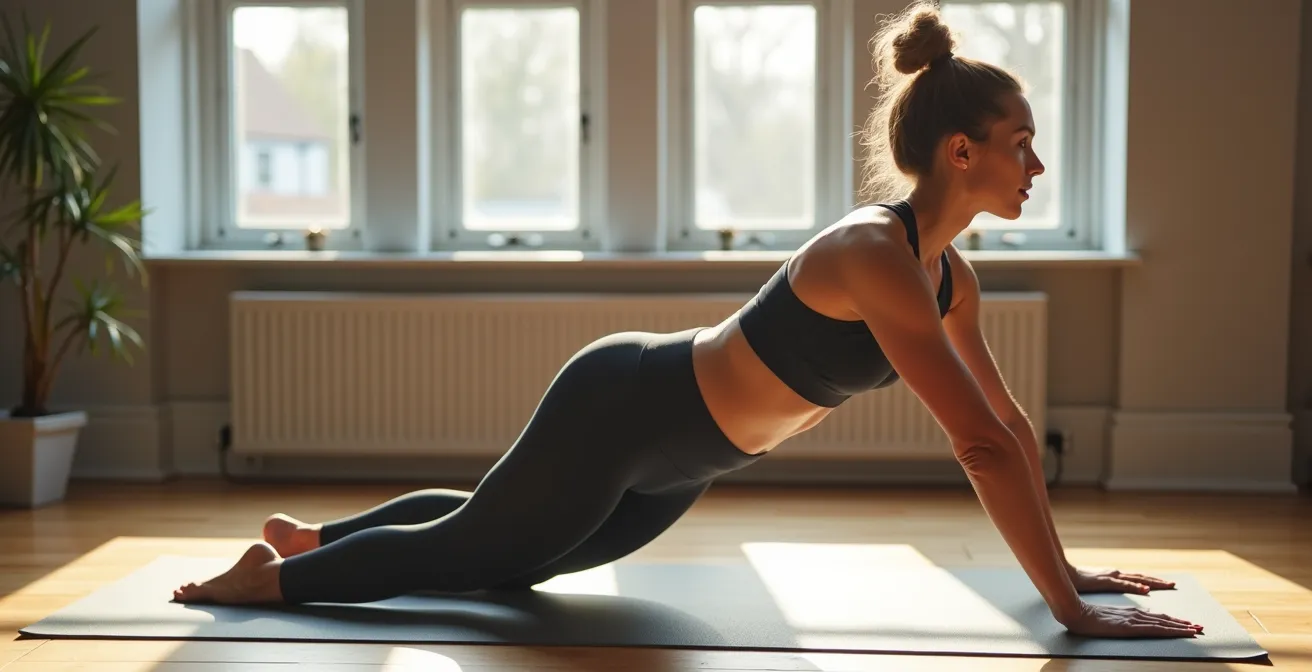
For desk-induced back pain, Clinical Pilates is diagnostically superior to Yoga because it directly targets the root cause: core muscle deactivation from prolonged sitting.
- Yoga improves general flexibility, which can feel good, but may not fix the underlying spinal instability.
- Clinical Pilates focuses on reactivating deep stabilising muscles (like the transversus abdominis) to rebuild your body’s “internal corset,” correcting the postural failure itself.
Recommendation: Begin with a foundation of Clinical Pilates to restore core function before incorporating Yoga or other activities. This builds a resilient spine, rather than just stretching a sore one.
The persistent, dull ache in your lower back after a day at the desk has become an unwelcome part of your routine. You stretch, you shift in your chair, but the stiffness remains. This discomfort is more than just a nuisance; it’s a modern epidemic. In the UK, the economic toll is staggering, as studies suggest that back pain alone costs the UK economy around £10 billion annually. In response, many turn to popular remedies like Yoga and Pilates, often viewing them as interchangeable solutions for flexibility and strength.
This common approach, however, often misses the fundamental issue. The question isn’t simply about stretching versus strengthening. From a physiotherapist’s perspective, chronic desk-related back pain is rarely a problem of tight muscles alone; it is a symptom of postural failure. Hours spent sitting in a chair effectively switch off the deep core and gluteal muscles responsible for stabilising your lumbar spine. Your body, seeking stability, compensates by over-tensing other muscles, like the hamstrings and lower back erectors, leading to that familiar feeling of tightness and pain.
Therefore, the most effective solution isn’t just to stretch what feels tight. The key is to first reactivate what has become dormant. This article will deconstruct the “Pilates or Yoga” debate through a corrective lens. We will not just compare two exercise systems; we will build a logical, progressive roadmap. We will establish why building foundational stability is the non-negotiable first step, how to integrate this into your daily life, and how to then safely layer on other forms of exercise to build a truly resilient, pain-free body for the long term.
This guide provides a structured, physiotherapist-led approach to understanding and resolving your back pain. Each section builds upon the last, moving from foundational principles to practical, weekly application.
Summary: A Corrective Roadmap for Desk-Related Back Pain
- The Dead Bug Exercise: How to Fix Your Posture Without straining Your Neck?
- Zone 2 Cardio: Why Brisk Walking Is Enough for Heart Health?
- Desk Stretches: 3 Moves to Open Tight Hips While Seated?
- Breaststroke vs Crawl: Which Is Safer for Knees and Hips?
- Resistance Bands: How to Build Muscle Without Heavy Weights?
- Why Your Hamstrings Feel Tight on Tuesday After a Sunday Match?
- Chair Exercises: How to Keep Legs Strong When You Can’t Stand for Long?
- How to Stay Injury-Free During a Wet Winter Sunday League Season?
The Dead Bug Exercise: How to Fix Your Posture Without straining Your Neck?
The Dead Bug exercise is the cornerstone of rebuilding spinal stability. Its genius lies in its ability to teach you how to engage your deep core—specifically the transversus abdominis—while keeping your spine in a neutral position. For a desk worker, this is crucial. Prolonged sitting encourages a posterior pelvic tilt (a ‘slumped’ posture) which deactivates these muscles. The Dead Bug reactivates them without placing any strain on the neck, a common pitfall of exercises like sit-ups or crunches, which can exacerbate the ‘forward head’ posture many office workers already have.
To perform it correctly, lie on your back with your knees bent at a 90-degree angle over your hips and your arms extended towards the ceiling. The critical first step is to gently flatten your lower back towards the floor, engaging your core to close the gap. This is your neutral spine position. From here, you slowly lower one opposite arm and leg towards the floor, moving only as far as you can without allowing your lower back to arch. The goal isn’t range of motion; it’s unwavering core control. This movement retrains the brain-to-muscle connection that sitting has severed, creating a stable base from which all other movement can safely originate.
Mastering this exercise provides the foundational stability necessary to make all other activities, from walking to lifting, safer and more effective. It is not just an ‘ab exercise’; it is postural retraining at its most fundamental level.
Zone 2 Cardio: Why Brisk Walking Is Enough for Heart Health?
Once you begin establishing core stability, the next step is to add low-impact cardiovascular exercise. High-intensity workouts can be counterproductive if your postural muscles aren’t yet strong enough to support the impact, potentially leading to injury. This is where Zone 2 cardio, often described as a pace where you can hold a conversation, becomes invaluable. For most sedentary individuals, a brisk walk is perfectly sufficient to achieve this state. It raises your heart rate enough to stimulate cardiovascular benefits without producing high levels of metabolic stress.
The key is consistency. Official guidance confirms that the NHS recommends at least 150 minutes of moderate-intensity activity per week. A 30-minute brisk walk during your lunch break five days a week easily meets this target. This type of activity improves mitochondrial function, enhances fat utilisation for fuel, and lowers resting heart rate over time. Crucially, it does so with minimal stress on joints that may already be aggravated by poor posture.
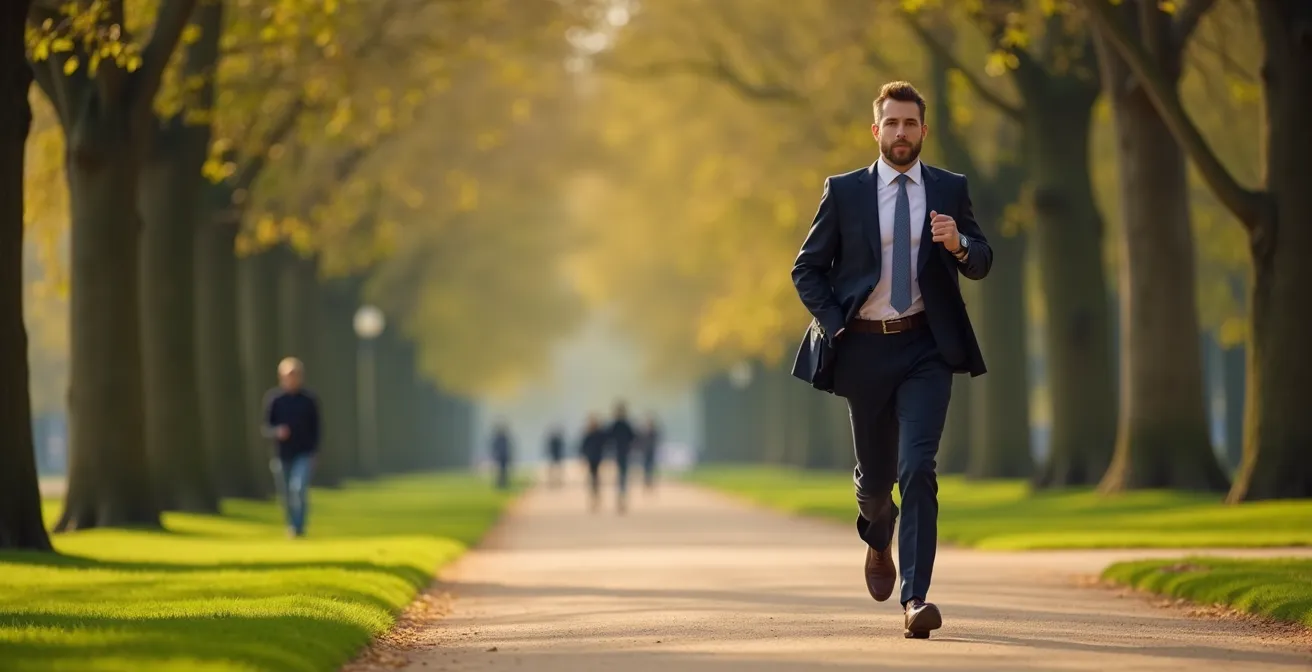
To make walking a corrective exercise, focus on your form. Engage the core as you learned in the Dead Bug, keep your chest lifted, and allow your arms to swing naturally. This transforms a simple walk into a dynamic postural exercise, reinforcing the stability you are building elsewhere. It proves that you don’t need an expensive gym membership or punishing routine; leveraging your lunch break in a local park is a powerful and accessible tool for both heart health and spinal longevity.
Desk Stretches: 3 Moves to Open Tight Hips While Seated?
While foundational stability and cardio are crucial, you must also counteract the direct physical stress of sitting for eight hours a day. The primary victim of the office chair is the hip flexor, a group of muscles at the front of your hip that become chronically shortened and tight. This tightness pulls your pelvis forward, contributing to lower back arching and pain. Integrating short, targeted “movement snacks” throughout your day is an effective strategy to combat this.
These are not complex routines, but simple, discreet movements designed to release tension and reset your posture. A consistent micro-routine can make a significant difference. As Jill Drummond, a NASM-certified trainer, explains:
Spending 5 minutes on these stretches daily is ‘pre-habilitation’, making the weekly Yoga or Pilates session more effective because the body isn’t starting from extreme stiffness.
– Jill Drummond, Bodybar Pilates Vice President, NASM-certified trainer
Here are three essential moves you can perform at your desk to maintain mobility and prevent stiffness from accumulating:
- Seated Figure-4 Stretch: A discreet way to open the hips. Cross your ankle over the opposite knee. Sit tall and gently lean forward until you feel a stretch in your glute and hip. Hold for 30 seconds on each side.
- Seated Spinal Twist: Ideal for open-plan offices. Place your hand on the outside of the opposite knee. Use it as a lever to gently rotate your upper body, keeping your spine tall. Hold for five deep breaths in each direction.
- Seated Cat-Cow: Best for a home office. Place your hands on your knees. On an inhale, arch your spine and look up (Cow). On an exhale, round your spine and drop your chin to your chest (Cat). Repeat for 10 cycles to mobilise the entire spine.
Breaststroke vs Crawl: Which Is Safer for Knees and Hips?
Swimming is often recommended as the ideal low-impact exercise for back pain sufferers. However, not all strokes are created equal, and choosing the wrong one can exacerbate existing postural issues. The primary concern for a desk worker is the rounded-shoulder, forward-head posture. This directly impacts your stroke mechanics, particularly the front crawl.
The front crawl requires good thoracic (upper back) mobility and shoulder stability to execute the overhead arm action without impingement. Many desk workers lack this, compensating by over-rotating their lumbar spine or hiking their shoulders, which can lead to new patterns of pain. The breaststroke, while seemingly gentler, presents its own challenge. The powerful ‘whip kick’ can place significant stress on the knee ligaments and cause the lower back to arch excessively, especially if you lack the core control established through exercises like the Dead Bug.
For these reasons, the safest and most corrective starting point is often the backstroke. It naturally counteracts the forward slump of desk posture by opening up the chest and strengthening the upper back muscles. It encourages a neutral spine and places minimal stress on the hips and knees. This is why building foundational stability *before* starting a swimming programme is so critical, a fact demonstrated by targeted coaching programmes.
Case Study: Swim England’s Adult Technique Correction Programme
Accredited Swim England providers have noted a common pattern: desk workers frequently present with compromised crawl stroke mechanics due to rounded shoulders. Data from their adult swimming programmes reveals a significant finding: participants who first complete four weeks of Pilates-based core strengthening show 65% better stroke efficiency and a 40% reduction in shoulder strain compared to those who begin swimming immediately. This highlights that core stability is a prerequisite for effective and safe swimming technique.
Resistance Bands: How to Build Muscle Without Heavy Weights?
After establishing core control and incorporating low-impact cardio, the next logical step is to add resistance. However, jumping straight to heavy weights can be a recipe for re-injury, especially if subtle movement dysfunctions still exist. Resistance bands are the perfect bridge. They are affordable, portable, and uniquely effective for targeting the specific muscles weakened by a sedentary lifestyle, particularly the glutes.
The gluteus medius, located on the side of your hip, is a key pelvic stabiliser that becomes notoriously weak from sitting. A weak glute medius can lead to an unstable pelvis when you walk or run, causing knock-on effects in the lower back and knees. Resistance bands are brilliant for isolating and activating these muscles through exercises like clamshells, lateral band walks, and glute bridges with a band around the knees. The band provides accommodating resistance, meaning the tension increases as you move through the range of motion, forcing the muscle to work harder at its point of peak contraction.
This type of training is not about building bulk; it’s about building functional strength and muscular endurance. It teaches your body to maintain correct alignment under load, a skill that is directly transferable to daily activities like climbing stairs or lifting groceries. The convenience of being able to perform these exercises in a small UK flat removes one of the biggest barriers to consistent training. They are a powerful tool for progressing your rehabilitation safely and effectively.
Why Your Hamstrings Feel Tight on Tuesday After a Sunday Match?
For the many office workers who are also “weekend warriors,” the Tuesday morning stiffness is a familiar ordeal. After a Sunday league football match, it’s often the hamstrings that feel painfully tight. The common assumption is that the hamstrings were simply over-worked or inadequately stretched. However, from a physiotherapy standpoint, the tightness is often a symptom of another problem: weak and underactive glutes.
During explosive movements like sprinting, your glutes should be the primary engine for hip extension. When they are weak or don’t “fire” properly—a common consequence of sitting all week—the body recruits the next best thing: the hamstrings. This forces the hamstrings to perform a role they were not designed for, leading to overload, strain, and the sensation of extreme tightness, a phenomenon known as synergistic dominance. This delayed onset muscle soreness (DOMS) isn’t just an inconvenience; it’s a warning sign of a muscular imbalance that significantly increases your risk of a hamstring tear.
The impact of these seemingly minor weekend-sport injuries on professional life is significant. Musculoskeletal issues are a leading cause of sick days, and data shows the scale of the problem; according to HSE data, the UK loses over 7 million working days each year to work-related musculoskeletal disorders. The solution isn’t to stretch the hamstrings more aggressively. The solution is to strengthen the glutes and core during the week so they are ready to do their job on Sunday. This proactive approach turns your weekday exercises into a direct performance-enhancer and injury-prevention strategy for your weekend sport.
Chair Exercises: How to Keep Legs Strong When You Can’t Stand for Long?
For some individuals, whether due to acute injury, a chronic condition, or severe deconditioning, even standing for extended periods can be painful or impractical. In these situations, chair-based exercises are often dismissed as an inferior alternative. This is a clinical misconception. Chair exercises are a powerful tool for rebuilding foundational strength in a safe, supported environment, allowing individuals to progressively overload muscles without the full-body stability challenge of standing.
The goal is to re-establish the mind-muscle connection and build a baseline of strength that can later be transferred to standing movements. Simple exercises like seated leg extensions (straightening the knee), seated heel raises, and, most importantly, sit-to-stands (practising rising from the chair without using hands) are incredibly effective. The sit-to-stand is a fundamental movement pattern for daily life, and mastering it builds strength in the quads, glutes, and core simultaneously.
This approach is not about resignation to a seated state; it is a strategic starting point for rehabilitation and functional improvement. Community programmes across England have demonstrated the profound success of this method.
Case Study: Age UK’s Chair Exercise Programme Success
Age UK’s chair-based exercise programme, delivered in over 200 community centres across England, provides compelling evidence of this strategy’s effectiveness. Their data shows that an impressive 68% of participants who complete a 12-week, twice-weekly programme successfully progress to standing exercises. The programme is particularly targeted at those managing chronic conditions or recovering from injury, with NHS physiotherapists observing improved functional movement scores and a tangible reduction in fall risk among participants. It proves that starting from a supported position is a highly effective pathway back to functional independence.
Key takeaways
- Back pain from sitting is a postural failure, not just muscle tightness. The primary cause is deactivated core and glute muscles.
- Clinical Pilates is superior to Yoga as a *first step* because it specifically targets the reactivation of these deep stabilising muscles.
- A corrective roadmap involves: 1) Building foundational stability (Dead Bug), 2) Adding low-impact cardio (brisk walking), and 3) Progressively adding resistance (bands) to build functional strength.
How to Stay Injury-Free During a Wet Winter Sunday League Season?
Bringing all these principles together is the key to creating a truly resilient body—one that can withstand the demands of both the work week and a wet, slippery Sunday league pitch. An injury-free season is not a matter of luck; it is the result of a structured, consistent weekly plan that addresses stability, mobility, and recovery. The amateur athlete who sits at a desk all week is uniquely vulnerable to injury because their body is deconditioned for the dynamic, multi-directional movements required in sport.
Playing on a wet, uneven pitch dramatically increases the demand on your proprioception and stabiliser muscles. Every step is unpredictable, requiring your ankles, knees, and hips to make constant micro-adjustments. If the stabilising muscles around these joints (like the gluteus medius) are weak, the risk of a ligament sprain or muscle tear skyrockets. Therefore, your weekday training must specifically prepare you for this instability.
This is where single-leg and balance exercises become non-negotiable. Movements that challenge your stability, such as single-leg deadlifts or Pilates side planks, build the neuromuscular control needed to stay upright and strong on a muddy field. This structured approach, combining corrective exercise with sport-specific preparation, is the ultimate strategy for longevity in amateur sport.
Action Plan: Wet Pitch Stability Training
- Balance Assessment: Start with the Tree Pose. Begin against a wall for support, then progress to freestanding. Aim to hold for 30 seconds on each leg to identify imbalances.
- Hip Stabiliser Activation: Perform single-leg deadlifts with a light resistance band. Focus on maintaining a level pelvis and stable standing leg. This directly targets the gluteus medius.
- Core Endurance Under Load: Integrate Pilates side planks with a leg lift. This challenges the core’s ability to resist lateral forces, mimicking the demands of changing direction on an unstable surface.
- Ankle Proprioception: Before every training session and match, perform ankle mobility drills. Tracing the alphabet with your foot is a simple way to activate the stabilising muscles around the ankle joint.
- Progressive Overload: If you have access to one, use a Bosu ball for squats. This safely mimics the unstable surface of a wet pitch and enhances your body’s reactive stability.
By shifting your focus from simply treating pain to correcting its underlying cause, you build a body that is not only free from discomfort but also stronger, more stable, and better prepared for all the activities you enjoy. Your first step is to book an assessment with a qualified physiotherapist or Clinical Pilates instructor to get a plan tailored to your specific needs.